Free SWOT Competitor Analysis Template (2026)
Analyze competitors with this free 3-sheet SWOT Excel template. Rate competitors across 10 dimensions with automatic scoring and radar charts.
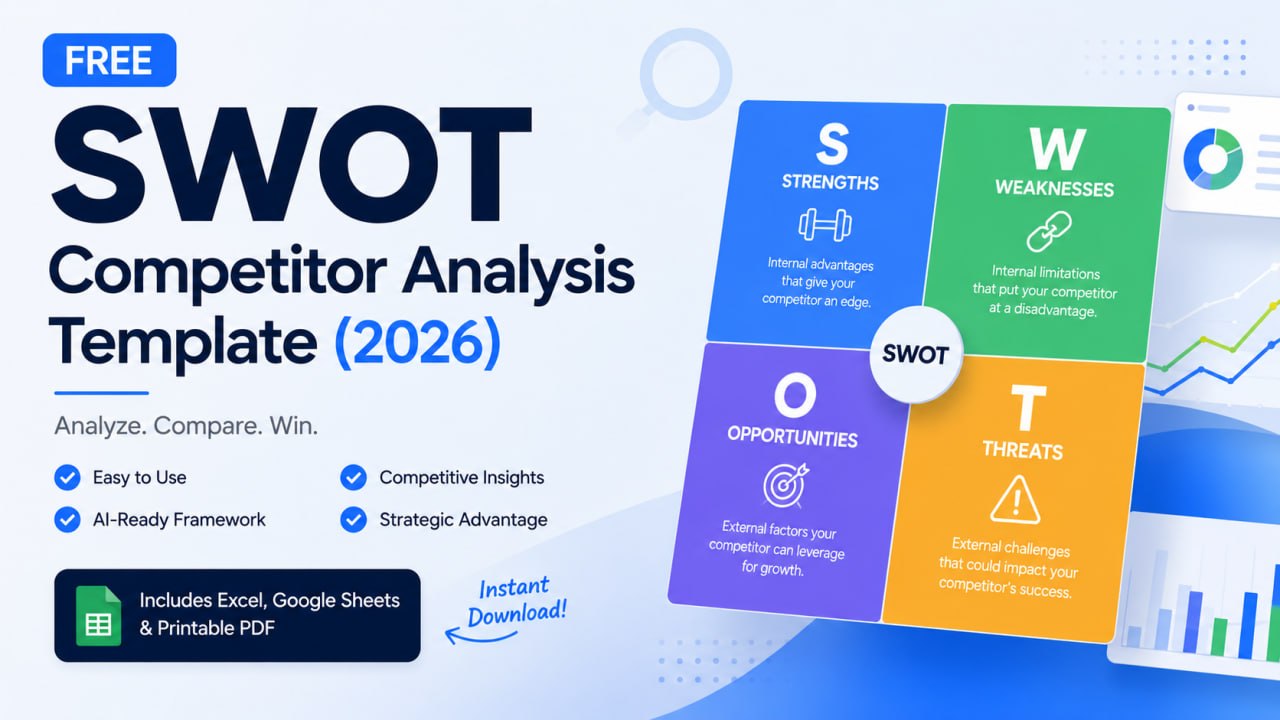
Free SWOT Competitor Analysis Template (2026)
TL;DR
- Analyze any competitor's Strengths, Weaknesses, Opportunities, and Threats in one structured spreadsheet
- Three dedicated sheets: competitor profile, SWOT scoring, and competitive landscape overview
- Rate competitors across 10 dimensions with automatic scoring and visual radar charts
- Download the free template with sample data and start your first SWOT analysis in minutes
Quick Answer
Understanding competitors takes structure, not guesswork. This free SWOT Excel template gives teams a repeatable framework to evaluate any competitor across four dimensions: Strengths, Weaknesses, Opportunities, and Threats. With automatic scoring, visual charts, and a competitive landscape overview, teams move from scattered notes to clear competitive strategy.
What Is SWOT Competitor Analysis?
SWOT competitor analysis is a simple but powerful framework for understanding competitors. SWOT stands for Strengths, Weaknesses, Opportunities, and Threats. It helps businesses answer four key questions about every competitor: What do they do better? Where do they fall short? What market gaps can be exploited? And what risks do they pose?
The framework works for any industry. A coffee shop can SWOT the cafe across the street. A SaaS company can SWOT three competing tools. An e-commerce store can SWOT top sellers in its category. The method is the same — only the data changes.
At its core, a competitor SWOT analysis organizes scattered information into a clear, structured view. Instead of guessing which competitor actions matter, teams can see strengths and threats side by side and decide where to focus.
Why SWOT Still Matters for Modern Businesses
In 2026, competitors move faster than ever. New products launch weekly. Pricing changes overnight. A competitor can go from unnoticed to threatening in a single quarter.
SWOT remains relevant because it is fast and flexible. Unlike complex frameworks that take weeks to complete, a SWOT analysis can be done in an afternoon. It does not require expensive tools or specialized training. Anyone on the team — marketing, product, sales — can contribute.
A free competitor analysis template that is ready to use means teams can start analyzing competitors in minutes instead of building spreadsheets from scratch.
Modern businesses use SWOT as a starting point. They run a quick SWOT to identify the biggest gaps and opportunities, then dive deeper into specific areas using other frameworks. The [competitive intelligence framework](/blog/how-to-build-a-competitive-intelligence-dashboard-metrics-kpis-and-real-time-tracking-2026-guide) that starts with SWOT is almost always faster to act on than one that starts with 50-page reports.
Benefits for Business Companies
Every business — from startups to enterprises — faces competitors. The SWOT framework provides value across all types of companies.
For retail businesses, a SWOT analysis for business reveals which competitors are undercutting on price, which have better in-store experiences, and which are winning on e-commerce.
For B2B companies, SWOT shows which competitors have stronger enterprise features, better sales teams, or more aggressive account-based marketing.
How to Build a SWOT Analysis Step by Step
Building a [competitor analysis template](/blog/the-free-saas-competitor-analysis-template-that-ships-10-fields-3-tabs-one-weekly-habit) with SWOT follows five steps:
Step 1: Pick your competitors. Choose 3-5 direct competitors. If there are too many, pick the ones your sales team mentions most often.
Step 2: Collect data. Gather information from competitor websites, social media, review platforms, pricing pages, and user forums. The more sources, the better the SWOT.
Step 3: Fill the Strengths column. List everything the competitor does better. Better SEO rankings. Lower pricing. Bigger social following. Faster customer support. Be honest — sugarcoating hurts your own strategy.
Step 4: Fill the Weaknesses column. Where do they fall short? Slow website. Outdated product. No blog content. Poor reviews. These gaps are your opportunities.
Step 5: Fill Opportunities and Threats. Opportunities are external gaps you can exploit — a market segment they ignore, a content format they do not use. Threats are external risks — their new product launch, their aggressive pricing, their partnership with a major distributor.
Score each item on impact (1-5). Prioritize the high-impact items first. Update quarterly — competitors change fast.
How AI Can Collect SWOT Data Automatically
Gathering SWOT data manually takes hours. AI tools can now do most of the heavy lifting.
Modern AI competitor monitoring platforms automatically track competitor websites for changes. They monitor pricing pages, product updates, job listings, and blog posts. When a competitor drops prices or launches a new feature, the system flags it.
AI can also scan review platforms and social media for sentiment shifts. If a competitor's rating drops from 4.5 to 3.8 after a buggy release, the SWOT weaknesses column gets a real-time update.
Instead of spending Monday mornings hunting for competitor news, teams can open their automated competitor tracking dashboard and see every important change in one place. AI collects the data. Humans make the strategy decisions.
A competitor monitoring dashboard that updates automatically saves 5-10 hours per week compared to manual research.
Free SWOT Competitor Analysis Template
The template below makes SWOT analysis fast and organized. It includes three sheets designed for different needs. — Overview, Detailed Analysis, and Score Matrix sheets for competitor evaluation")
Sheet 1 — SWOT Overview: Compare up to 5 competitors side by side. Each competitor gets strengths, weaknesses, opportunities, threats, an overall SWOT score, and an action priority level. This sheet is perfect for quick team reviews and leadership updates.
Sheet 2 — Detailed SWOT Analysis: Deep-dive on one competitor. Rate each SWOT item by impact (1-5), add evidence and sources, and plan how to counter or exploit each finding. Track status from Research to Action.
Sheet 3 — SWOT Score Matrix: Standardize comparisons with weighted scoring. Each of the four SWOT dimensions gets a 1-10 score, then the template calculates a weighted total. See at a glance who is the strongest competitor — and where they are vulnerable.
📥 Download the free Excel template
The template works in Excel and Google Sheets. No macros required. Just open it and start filling in your competitors.
How to Use This Template — Step-by-Step Guide
Getting started:
- Download the template file and open it in Excel or Google Sheets.
- Rename "Competitor A" through "Competitor D" to your actual competitor names.
- Start with the SWOT Overview sheet for a quick first pass.
How to work through each sheet:
On the SWOT Overview, list strengths, weaknesses, opportunities, and threats for each competitor. Keep entries short — one sentence per item. Assign an overall SWOT score (1-10) and an action priority (H/M/L). Update this sheet every quarter.
On the Detailed SWOT Analysis, pick one competitor and go deeper. For each strength, rate its impact, note your evidence source, and plan your counter-move. For each weakness, plan how to widen the gap. Track everything with status labels: Research → Monitoring → Planning → Action.
On the SWOT Score Matrix, fill the 1-10 scores for each dimension. The template auto-calculates the weighted total. Green means strong competitor (score 7+), yellow means mid-tier (4-6), red means struggling (below 4). Add your own company for a direct comparison.
Best practices:
- Set a recurring calendar event to update the SWOT every quarter.
- Involve multiple team members — marketing sees different strengths than engineering does.
- Use real data, not assumptions. Link every claim to a source (URL, report, screenshot).
- Keep the detailed sheet focused on your top 2 competitors. Do not try to deep-dive all 5.
Real Case SWOT Example
Here is a realistic SWOT analysis for a SaaS company evaluating a competitor:
Competitor: CloudDesk Pro
- Strengths: Ranks #1 for "customer support software" on Google. 800+ five-star reviews on G2. 24/7 live chat with 2-minute average response. Pricing starts at $12/month — 40% cheaper than most alternatives.
- Weaknesses: Website loads in 4.2 seconds — Google PageSpeed scores 38/100. No blog content since 2025. No mobile app. Glassdoor rating of 2.8 stars with reviews mentioning high turnover.
- Opportunities: CloudDesk has zero presence on YouTube or TikTok — video content is wide open. Their enterprise features are weak — no SSO, no audit logs. They only serve English-speaking customers — three large non-English markets are untouched.
- Threats: CloudDesk just raised $20M in Series B funding. They are hiring aggressively for product and engineering roles. A major CRM platform announced a partnership with them for Q4 2026.
Score: Strengths 8, Weaknesses 5, Opportunities 6, Threats 7 → Weighted total 6.5 (Challenger)
This example shows how even a strong competitor has clear weaknesses. A structured competitor analysis turns vague worries into specific, actionable items.
Common SWOT Mistakes
Even experienced teams make these SWOT mistakes:
Mistake 1: Listing opinions as facts. "Competitor has bad customer service" is an opinion. "Competitor has 2.8 stars on G2 with 45 reviews mentioning slow response" is a fact. Always cite a source.
Mistake 2: Being too nice. SWOT is strategy, not politeness. If a competitor's product is outdated, say so. Sugarcoating weaknesses hurts your own planning.
Mistake 3: Doing it once and forgetting it. SWOT is a living document. Competitors change monthly — quarterly updates are the minimum.
Mistake 4: Focusing only on product. Competitors compete on more than features. Brand, pricing, customer support, content, community, and distribution all matter.
Mistake 5: Ignoring your own SWOT. Run SWOT on your own company. How do competitors see your weaknesses? What opportunities are you missing? Your own SWOT is often more valuable than a competitor's.
The fix for most SWOT mistakes is the same: use a digital competitor analysis tool that tracks data automatically and reminds the team to review it regularly.
FAQ
What is a SWOT competitor analysis? SWOT competitor analysis is a framework for evaluating competitors across four categories: Strengths, Weaknesses, Opportunities, and Threats. It organizes competitive research into an actionable format.
How many competitors should I include in a SWOT? 3-5 competitors is ideal. Fewer than 3 gives an incomplete picture. More than 5 becomes hard to maintain.
How often should I update a SWOT analysis? At minimum, every quarter. In fast-moving industries (SaaS, e-commerce, tech), monthly updates are better.
Can SWOT be used for non-business purposes? Yes. SWOT is used for personal career planning, project evaluations, event planning, and even personal fitness goals. The framework is universal.
What is the difference between SWOT and TOWS? TOWS is SWOT reversed. It starts with external Threats and Opportunities first, then maps internal Strengths and Weaknesses to them. TOWS is more action-oriented.
What data sources should I use for SWOT? Competitor websites, pricing pages, review platforms (G2, Trustpilot), social media, job listings, press releases, and industry reports. Use multiple sources for each claim.
How long does a SWOT analysis take? A first-pass SWOT for 3-5 competitors takes 2-4 hours with manual research. With automated tools, the data collection takes minutes, leaving more time for strategy.
What makes a good SWOT analysis? A good SWOT is specific, evidence-based, honest, and actionable. Every item should have a source and a clear next step.
Can I use this template for multiple industries? Yes. The SWOT template is industry-agnostic. It works for SaaS, retail, manufacturing, healthcare, education, and any other sector.
What is the biggest SWOT mistake? Treating SWOT as a one-time exercise. Markets change fast. A SWOT from six months ago is already outdated.
How is SWOT different from a competitive matrix? A competitive matrix compares features or metrics side by side. SWOT adds qualitative depth — it explains why a competitor is winning, not just what they offer.
Does SWOT work for startups? Absolutely. Startups use SWOT to understand how they stack up against incumbents and to find market gaps the big players have missed.
What should I do after completing a SWOT? Turn the insights into actions. Assign each opportunity and threat to a team member. Set deadlines. Review progress monthly.
Can AI replace manual SWOT analysis? AI can collect and organize SWOT data automatically, but the strategy decisions still require human judgment. AI is a research assistant, not a strategist.
How do I compare my own company against competitors? Fill out a SWOT for your own company with the same honesty. Then compare side by side. The gaps between your SWOT and competitor SWOTs are where strategy lives.
Is SWOT enough for a full competitive strategy? SWOT is a starting point. Combine it with other frameworks (Porter's Five Forces, Benchmarking, Perceptual Mapping) for a complete strategy.
Where can I find reliable competitor data? Start with public sources: competitor websites, social media, review sites. For deeper data, competitive intelligence tools automate the collection process.
How do I present SWOT findings to leadership? Use the SWOT Overview sheet. Keep it to one page. Focus on the top 3 strengths and top 3 threats. Always include recommended actions, not just findings.
Download the Free SWOT Template
Ready to analyze your competitors? Click below to get the free SWOT Competitor Analysis Template — no signup required. The file opens in Excel and Google Sheets.
📥 Download Free SWOT Template (.xlsx)
About the Author
Dylan Dan Founder & CEO, FollowEngine
Dylan Dan is the founder of FollowEngine, bringing over 10 years of experience in competitive intelligence and competitor analysis. He has helped hundreds of businesses build structured CI programs that turn market signals into revenue decisions.
Related Articles
- [The Free SaaS Competitor Analysis Template That Ships — 10 Fields, 3 Tabs, One Weekly Habit](/blog/the-free-saas-competitor-analysis-template-that-ships-10-fields-3-tabs-one-weekly-habit)
- [Free Price Competition Analysis Template (2026)](/blog/free-price-competition-analysis-template-2026)
- [Best SEO Tool for Competitor Site Analysis (2026)](/blog/best-seo-tool-for-competitor-site-analysis-2026)
Next step
Find your real competitors.
Run a free competitor lookup and decide what to monitor next.