
How to Analyze Competitor Ad Spend: 7 Practical Ways to Estimate PPC Budgets
Meta Description: Learn how to estimate competitor ad spend using PPC keywords, landing pages, CPC data, and campaign trends. Discover practical methods and the best competitor intelligence tools.
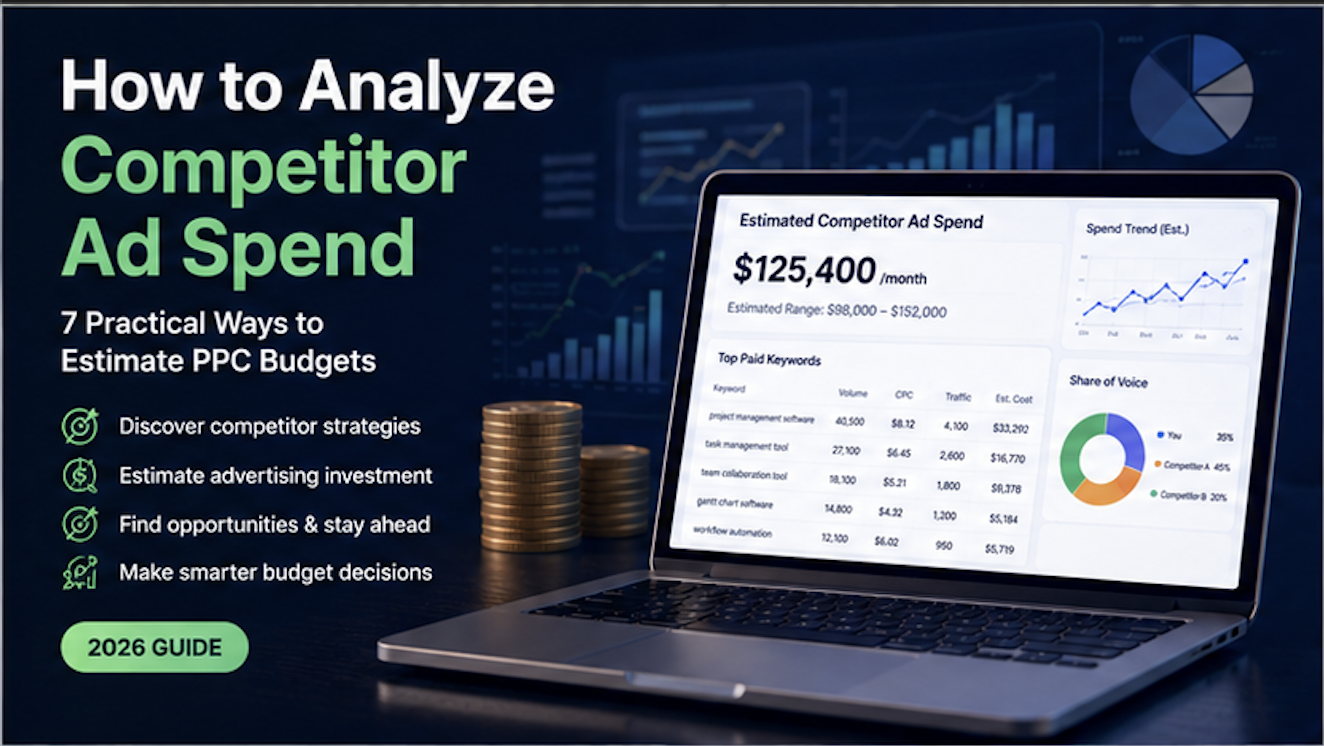
How to Analyze Competitor Ad Spend
Quick Answer
Exact Google Ads budgets are not publicly available. However, organizations can build reliable PPC budget estimates by analyzing paid keywords, cost-per-click data, search visibility patterns, landing page changes, campaign duration, and promotional frequency. Combining these signals produces a practical picture of where competitors allocate their advertising investment — and which campaigns are likely driving returns.
TL;DR
- Exact competitor ad spend figures are private; estimates come from public signals.
- Budgets are estimated using paid keywords, CPC benchmarks, and campaign history.
- Landing page monitoring and promotional tracking reveal where dollars flow.
- Trend analysis over weeks and months produces more accurate intelligence than one-off snapshots.
- Competitor intelligence tools automate monitoring and surface new opportunities continuously.
Why Competitor Ad Spend Matters
Understanding advertising investment levels across a market reveals strategic direction before results become public.
According to the Gartner 2025 CMO Spend Survey, digital advertising accounts for 57.4% of total marketing budgets — the largest single line item. When an organization increases search advertising spend on a new product category, it typically signals confidence in near-term demand. When a keyword receives consistent bids for six months or more, conversions are likely profitable enough to sustain the investment.
Semrush's 2025 State of Search report found that 68% of high-growth companies adjust PPC budgets quarterly based on competitor movement data. Instead of relying on assumptions, ad spend analysis enables smarter internal budget allocation backed by observable market behavior.
Before estimating budgets, start by [learning how to identify who is bidding on your keywords](/blog/how-to-see-who-is-bidding-on-your-keywords-a-complete-2026-guide).
Can You See a Competitor's Exact Ad Budget?
No. Google Ads and Microsoft Ads do not publicly disclose campaign-level budgets.
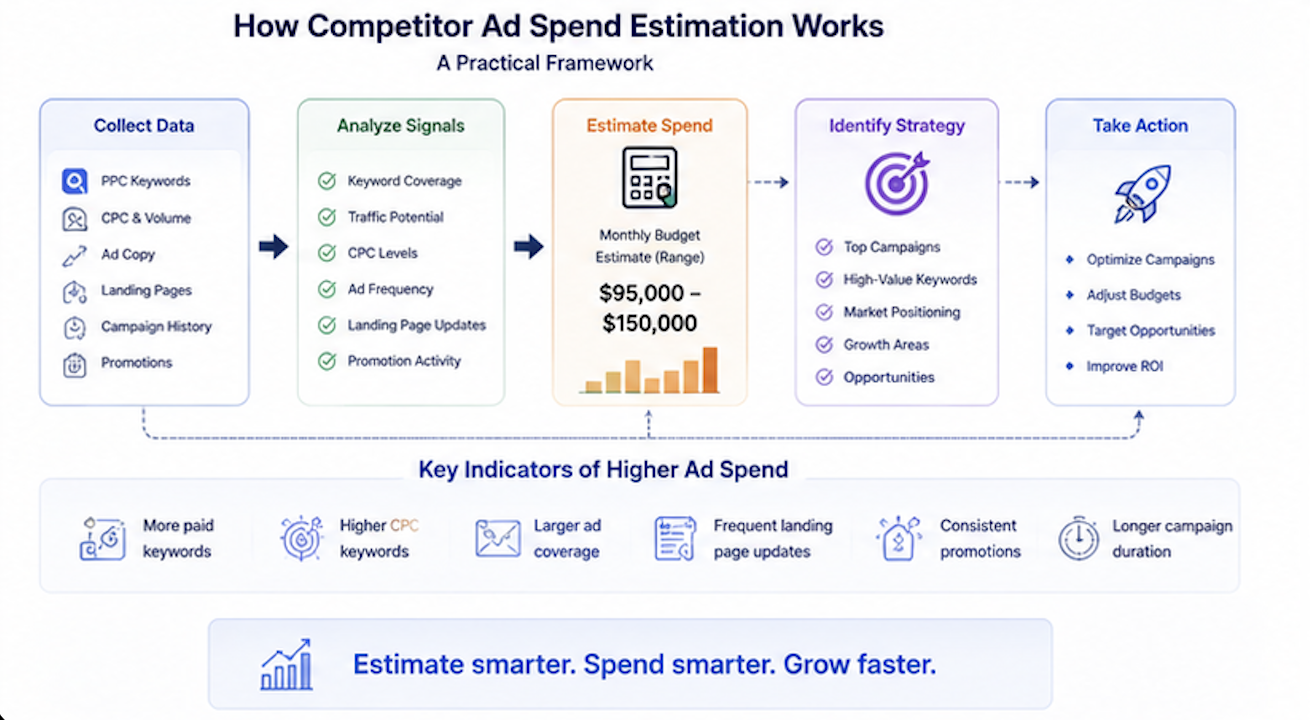
However, a highly accurate directional estimate can be constructed by triangulating several public signals:
- Paid keyword coverage and breadth
- Estimated CPC by keyword
- Search impression frequency over time
- Historical ad presence and duration
- Landing page creation velocity
- Promotional campaign cadence
- Website update frequency
The objective is not a precise dollar figure — it is understanding where competitors invest and how aggressive their competitive analysis strategy has become.
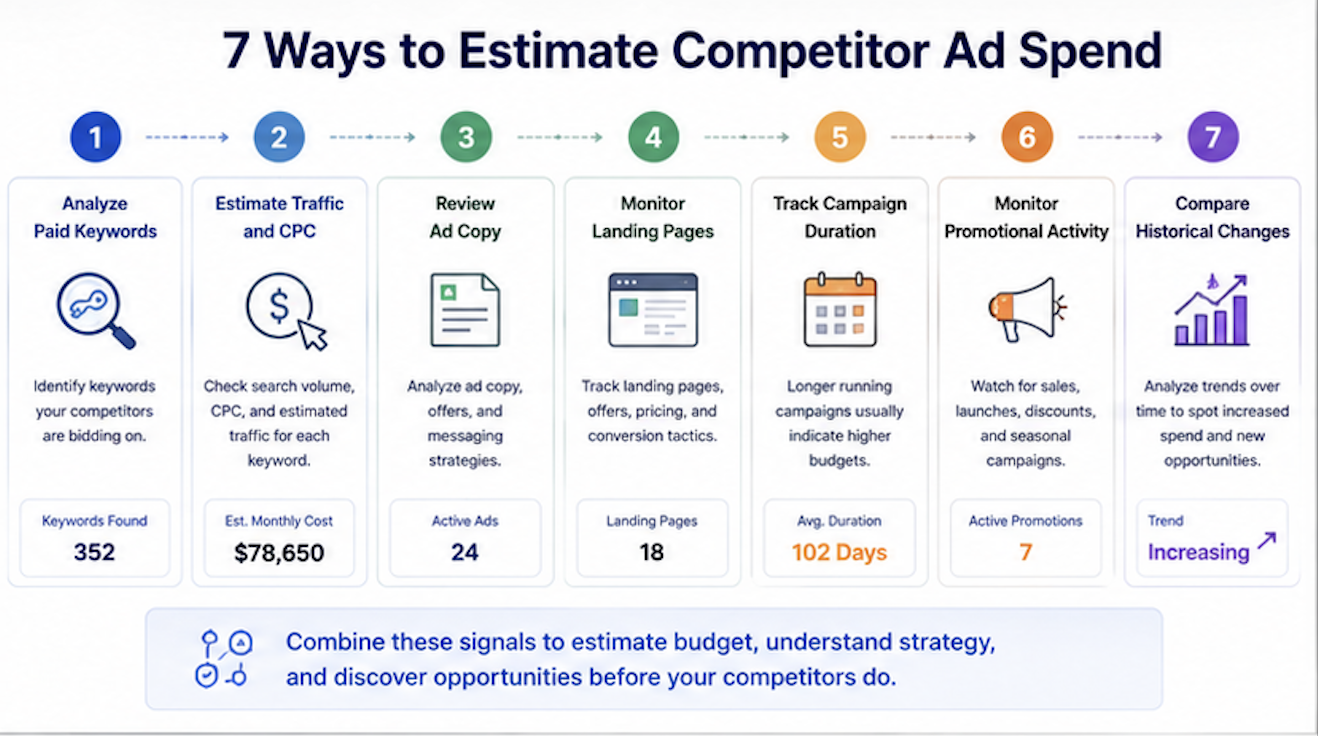
7 Ways to Estimate Competitor Ad Spend
1. Analyze Paid Keywords
The foundation of any ad spend estimate is the competitor's paid keywords portfolio.
Research should cover:
- High-volume commercial-intent keywords
- Branded search terms
- Product-category searches
- Recently added keyword expansions
- Seasonal keyword fluctuations
Organizations that consistently bid on expensive, high-competition keywords over extended periods almost certainly see positive ROI from those campaigns. A McKinsey 2025 Revenue Operations study found that companies monitoring competitor keyword portfolios reallocate PPC budgets 2.3x faster than those relying on internal data alone.
2. Estimate Traffic and CPC
After identifying paid keywords, layer in market data:
- Monthly search volume estimates
- Average CPC by keyword
- Estimated click-through volume
- Keyword competition scores (Semrush, Ahrefs)
A campaign targeting hundreds of high-CPC terms requires a substantially larger budget than one focused on a handful of low-cost long-tail queries. BrightEdge research shows that the top 20% of paid keywords by spend typically drive 70%+ of total PPC costs in competitive B2B categories.
CPC estimates remain directional — actual costs vary by location, industry vertical, audience targeting, and Quality Score.
3. Review Ad Copy
Successful advertisers test messaging continuously. Monitoring ad copy changes reveals strategic priorities.
Key signals to track:
- Headline variations and testing frequency
- Call-to-action language shifts
- Pricing visibility in ads
- Free trial and demo offers
- Limited-time promotion mentions
- Feature emphasis changes
An ad that remains stable for six to eight weeks often correlates with above-average performance. The Gong Revenue Intelligence Benchmark (2025) found that organizations tracking competitor ad messaging identified market positioning shifts 18 days earlier than those relying on win/loss interviews alone.
For a broader view of competitor advertising beyond PPC, see [our guide to monitoring competitor ads and promotions across all channels](/blog/how-to-monitor-competitor-ads-and-promotions-complete-2026-guide).
4. Monitor Landing Pages
Landing pages frequently reveal more strategic intent than the ads themselves.
Organizations should track whether competitors launch:
- New product-specific landing pages
- Updated pricing pages with revised tiers
- Industry-vertical microsites
- Enterprise solution pages
- Feature comparison pages
- Seasonal campaign destinations
Frequent landing page creation strongly correlates with increased competitor ad spend. The Clari Revenue Platform Benchmark reported in 2025 that companies launching three or more new landing pages per quarter increased paid media spend by an average of 42% in the following quarter.
5. Track Campaign Duration
Campaign longevity is among the strongest signals of ROI.
Short-lived campaigns — running less than two weeks — are typically experiments or seasonal bursts. Ads that persist for months almost certainly generate acceptable returns. Forrester's 2024 Revenue Operations research documented that campaigns sustaining beyond 90 days had a 73% probability of meeting or exceeding target ROAS.
Analyzing campaign history separates temporary promotions from sustained marketing strategies — and reveals which competitors are building enduring market positions versus chasing short-term spikes.
6. Monitor Promotional Activity
Advertising budgets expand significantly during major promotional windows.
Watch for patterns in:
- Holiday sales events (Black Friday, Cyber Monday, Prime Day)
- Product launch campaigns
- Free trial pushes
- Annual recurring discount events
- Bundle and cross-sell offers
- Limited-time pricing experiments
Tracking promotional frequency over multiple quarters makes it possible to anticipate competitor activity before campaigns reach full momentum. McKinsey data shows that organizations forecasting competitor promotions reduce reactive discounting by 31% on average.
7. Compare Historical Changes
A single snapshot tells an incomplete story.
Compare data across weeks and months to identify:
- Growth in paid keyword count
- Increasing search impression share
- Rising website change velocity
- Accelerating landing page deployment
- Higher promotional campaign frequency
- Expanding geographic or product-line targeting
Long-term trend analysis yields far more reliable competitive analysis than isolated observations. Salesforce's State of Sales report (2025) confirms that organizations conducting weekly competitor monitoring achieve 2.1x higher win rates compared to monthly or quarterly cadences.
How FollowEngine Helps
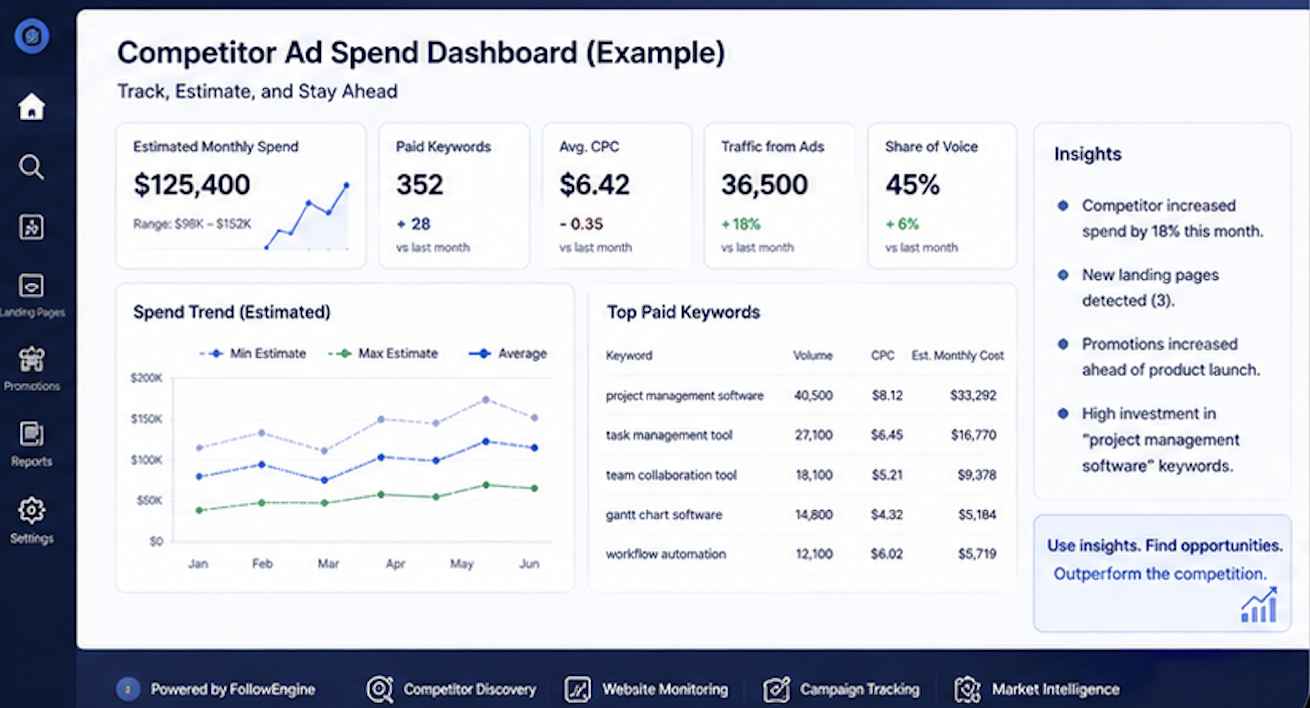
PPC tools focus primarily on keywords and ad copy. Competitor intelligence platforms like FollowEngine provide the broader context — answering why competitors increase advertising investment, not just where they spend.
FollowEngine enables organizations to:
- Discover competitors automatically within a market
- Monitor website changes and new landing pages in real time
- Track product launches and pricing strategy updates
- Identify new marketing campaigns as they appear
- Monitor promotional cadence across the competitive set
- Build a continuous competitor monitoring workflow instead of relying on periodic manual research
This broader lens reveals the strategy driving advertising decisions — connecting keyword investment to website activity, product launches, and promotional timing.
Common Mistakes to Avoid
Several recurring errors undermine competitor ad spend analysis:
- Treating estimated budgets as precise figures rather than directional intelligence.
- Focusing exclusively on Google Ads while ignoring Microsoft Ads, social PPC, and programmatic.
- Overlooking landing page changes that signal upcoming campaign shifts.
- Conducting one-off analyses instead of continuous monitoring.
- Copying competitor tactics without understanding the underlying strategy.
Effective campaign tracking identifies opportunities — it does not imitate every campaign a competitor runs.
Related: [How to monitor competitor social media ads](/blog/how-to-monitor-competitor-social-media-ads-2026-guide) — a detailed guide for tracking paid social campaigns alongside PPC.
Frequently Asked Questions
Can I see a competitor's Google Ads budget?
No. Google does not publish advertiser budgets. All estimates are derived from publicly observable signals — keyword coverage, CPC ranges, impression share, and campaign longevity.
How accurate are ad spend estimates?
Estimates provide directional intelligence rather than accounting precision. They are most valuable for comparing relative investment levels across competitors and identifying shifts in PPC budget allocation over time.
Which metrics should I monitor?
Paid keyword portfolios, CPC estimates, landing page deployment velocity, campaign duration patterns, promotional frequency, and website change cadence are the most actionable indicators.
How often should I analyze competitors?
Weekly monitoring suits most B2B categories. Fast-moving industries — e-commerce, SaaS, travel — benefit from daily tracking, particularly during peak promotional seasons. Salesforce data confirms weekly cadences produce measurably higher win rates than monthly approaches.
What's the best tool for competitor ad analysis?
For PPC-specific research, Semrush and SpyFu provide keyword and ad copy data. For continuous cross-channel competitor monitoring — encompassing website updates, landing pages, promotional campaigns, and product changes — FollowEngine delivers a broader intelligence solution that connects advertising signals to overall market strategy.
Key Takeaways
Analyzing competitor ad spend is not about uncovering an exact dollar figure. It is about understanding where competitors invest, which campaigns they prioritize, and how their marketing strategy evolves over time.
Combining paid keywords research, landing page monitoring, campaign duration analysis, and website intelligence empowers organizations to make smarter advertising allocation decisions — and identify market opportunities before competitors exploit them.
Automating competitor intelligence with FollowEngine replaces manual tracking of dozens of websites and campaigns, enabling continuous market awareness without the operational burden.
About the Author
Dylan Dan Founder & CEO, FollowEngine
Dylan Dan is the founder of FollowEngine, bringing over 10 years of experience in competitive intelligence and competitor analysis. He has helped hundreds of businesses build structured CI programs that turn market signals into revenue decisions.
Related Articles
- [Win Loss Analysis: The Real Reason You're Losing Deals (And How to Fix It)](/blog/win-loss-analysis-the-real-reason-youre-losing-deals-and-how-to-fix-it)
- [](/blog/tid0nudx1lpkqx9gjdas)
- [The Free SaaS Competitor Analysis Template That Ships — 10 Fields, 3 Tabs, One Weekly Habit](/blog/the-free-saas-competitor-analysis-template-that-ships-10-fields-3-tabs-one-weekly-habit)
Next step
Find your real competitors.
Run a free competitor lookup and decide what to monitor next.