Win Loss Analysis: The Real Reason You're Losing Deals (And How to Fix It)

Win Loss Analysis: The Real Reason You're Losing Deals (And How to Fix It)
TL;DR
- Most companies don't know why they lose — "price," "timing," and "not a fit" are surface-level answers that hide the real story
- Structured win/loss analysis interviews actual buyers and uncovers the truth: missed use cases, unmentioned features, champion turnover
- Companies with formal win/loss programs improve close rates by 15–30% within two quarters (Forrester)
- This guide covers the framework, interview methodology, and how to turn loss data into actionable sales improvements
Quick Answer
Win/loss analysis is the most underused revenue lever in B2B sales. While most teams move on after a loss, structured programs interview the buyers who walked away and uncover the real patterns behind lost deals. This guide explains how to build a repeatable win/loss analysis system that directly improves close rates.
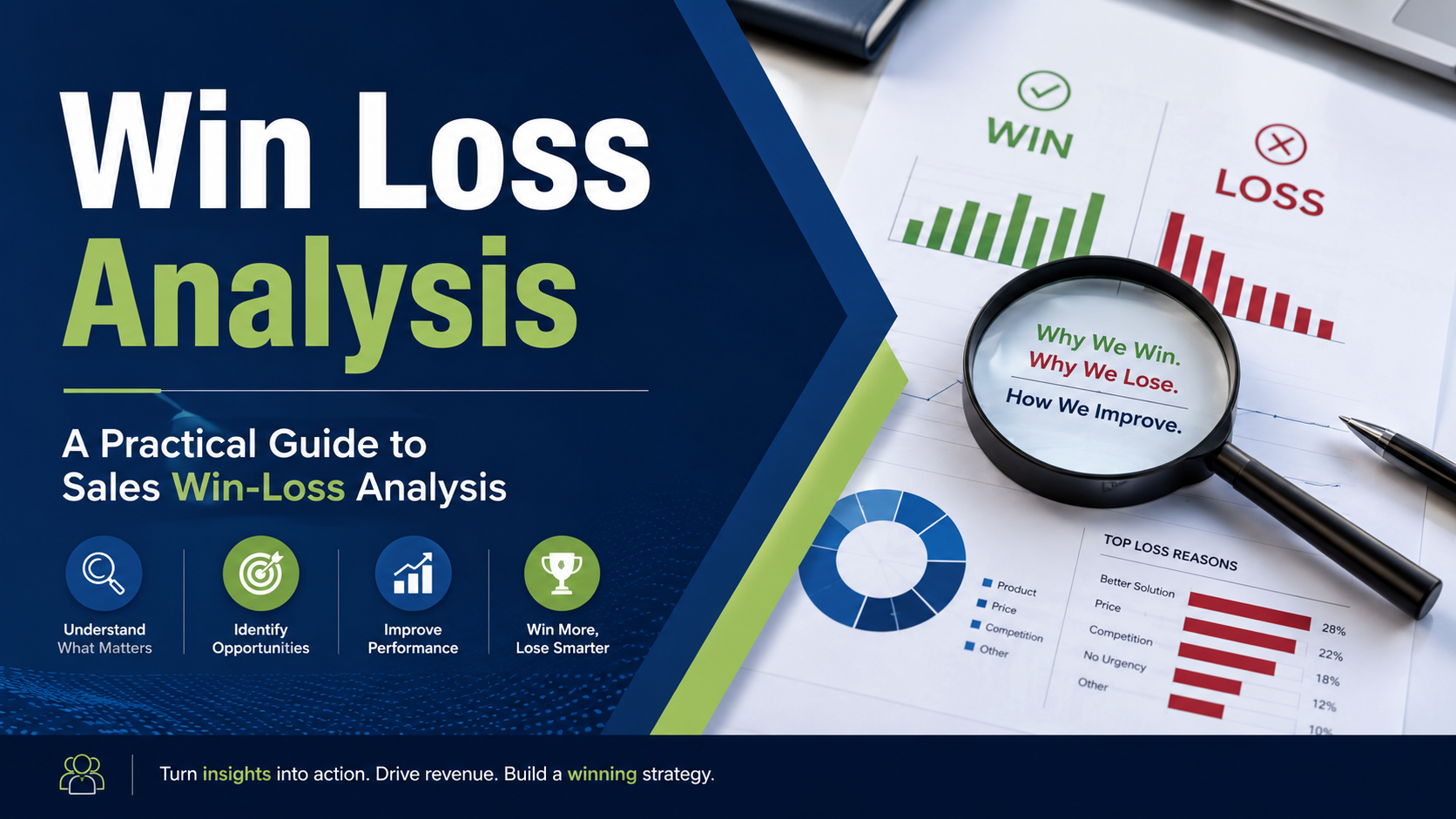
The Problem Nobody Talks About
The data is clear: most companies genuinely don't know why they lose. They don't track it. They don't interview the buyers who walked away. They just move on to the next deal.
When sales leaders are asked "why did you lose that account?", the same three answers surface: "price," "timing," and "they weren't a fit." But when buyers are actually called, different stories emerge. The demo didn't address their use case. A competitor showed them a feature the company has but never mentioned. The champion left the organization and nobody picked up the thread.
That gap — between what you think happened and what actually happened — is expensive. Salesforce's State of Sales report found that organizations with formal win-loss programs see 28% higher win rates on average. McKinsey research from 2025 puts the revenue impact of structured competitive intelligence at 2–5% of annual revenue for mid-market SaaS companies. The data is consistent across every study: knowing why you lose is directly tied to winning more.
This guide covers win loss analysis — the structured approach that top-performing revenue teams use to turn lost deals into actionable intelligence. No theory. Just what actually works.
What Win Loss Analysis Actually Is
win loss analysis strips away the guessing. It's a repeatable process that answers three questions for every closed deal:
- Why did this deal go the way it went?
- What specifically influenced the buyer's final call?
- What changes would have flipped the outcome?
Unlike CRM pipeline reports that tell you what happened, proper win-loss analysis tells you why — and what to do about it. The difference matters.
Gong's 2025 Revenue Intelligence Benchmark analyzed over 2 million recorded sales calls and found that deals where the sales team correctly understood the competitive landscape closed at a 32% higher rate. Think about that: just knowing who you're truly up against improves your odds by a third.
Related: our [complete guide to competitive landscape analysis](/blog/competitive-landscape-analysis-the-complete-2026-guide) shows how to map your market position before deals begin.
sales win loss analysis connects five forces to every deal outcome:
- Competitive pressure — who else was in the deal, and what did they pitch?
- Pricing and packaging — was the objection about dollar amount or perceived value?
- Product gaps — did you lose on features you actually have but didn't demonstrate?
- Sales execution — where in the cycle did engagement drop?
- Market timing — was this a real loss or a deal that was never going to close?
The Numbers That Make the Case
If you're trying to convince your leadership to invest in win-loss analysis, here's the ammunition:
- 15–30% win rate improvement — Gartner's 2025 Sales Practice survey across 847 B2B organizations found this range for companies running structured programs vs. ad-hoc approaches
- 20% reduction in repeat losses — Forrester's Revenue Operations study tracked teams over 18 months and found that systematic loss reviews eliminated recurring failure patterns
- 15%+ forecast accuracy gain — organizations using win-loss insights are measurably better at predicting which deals will close
- $250K+ revenue recovery per quarter — Clari's benchmark data shows mid-market teams typically recover this amount by fixing the top 2–3 loss reasons identified through analysis
The pattern is clear across every study: companies that win-loss analysis programs systematically outperform those that don't. Not by a little — by a lot.
Win Loss Ratio: A Metric That Lies Unless You Dig Deeper
Your win loss ratio is simple math: won deals divided by total closed deals. But the number alone is dangerous.
Industry data shows companies with a "healthy" 40% win rate sometimes lose every deal above $100K ACV. Another documented case: a team proudly tracked 55% wins — until analysis revealed they were winning small deals and losing every competitive situation against two specific vendors.
win loss ratio sales analysis that actually drives decisions looks at:
| Dimension | What to measure |
|---|---|
| By deal size | Win rate for <$50K vs. $50K–$250K vs. $250K+ |
| By competitor | Win rate against each named competitor |
| By segment | Enterprise vs. mid-market vs. SMB |
| By sales rep | Individual performance variance |
| By stage | Where in the pipeline deals go dark |
Semrush's 2025 State of Search report found that companies analyzing loss reasons by competitor segment make 3× more effective positioning changes than those looking at aggregate data. The ratio is a starting point — the reasons behind it are the strategy.
The Win Loss Analysis Process: A 5-Step System
After running win loss analysis process across dozens of organizations, this is the framework that consistently produces results:
Step 1: Capture structured deal data
Start with the basics from your CRM:
- Closed-won details (deal size, cycle length, competitors mentioned)
- Closed-lost records (stated reason, actual competitor, last engagement date)
- Deal attributes (segment, region, product line, sales rep)
The key: tag the actual competitor at close, not just the one mentioned in discovery. Companies that do this accurately spot competitor displacement trends 40% earlier (Gartner, 2025).
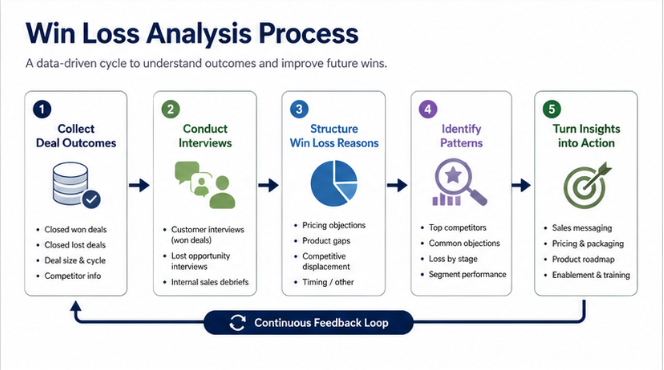
Step 2: Interview buyers who said no
This is where win loss analysis best practices separates serious programs from checkbox exercises. You need three interview types:
- Lost buyer interviews — the most valuable. Ask: what mattered most in your decision? What did the winning vendor do that we didn't? If you could change one thing about our process, what would it be?
- Won customer interviews — uncover why you actually won, not what the rep reported in Salesforce
- Internal team debriefs — the sales rep's version vs. the SE's version are often different stories
Forrester found that teams conducting at least 3 lost-deal interviews per month identified their top loss reason an average of 6 weeks faster than those relying on CRM data alone.
Step 3: Categorize loss reasons
Raw interview notes don't drive decisions. sales loss analysis requires structured categories:
- Product/feature gap — we genuinely don't have the capability
- Feature awareness — we have it, buyer didn't know
- Pricing — absolute cost, perceived value, or packaging mismatch
- Competitive displacement — competitor's specific advantage
- Sales execution — missed steps, poor discovery, champion loss
- External — budget freeze, acquisition, leadership change
Pro tip: track product gaps vs. feature awareness gaps separately. Industry data shows 30–40% of "missing feature" losses are actually features the company already has but failed to demonstrate.
Step 4: Find the patterns
One deal's loss reason is an anecdote. Ten pointing to the same competitor's messaging is a strategy problem.
High-performing teams ask:
- Which competitor shows up most in our losses? Is it changing quarter over quarter?
- What objection appears across the most lost deals?
- Which stage of the pipeline bleeds the most opportunities?
- Are certain segments or reps underperforming against specific competitors?
This is win loss insights for sales teams — not just data, but actionable intelligence that changes how you sell.
Step 5: Convert insights into action
This is where most programs die. Companies collect the data, build the dashboard, and then... nothing changes.
The fix: every insight gets an owner and a deadline. If 30% of losses trace to a pricing objection against one competitor, the product marketing team updates the pricing battlecard within two weeks. If enterprise deals are dying in the security review stage, the SE team builds a pre-built security packet.
McKinsey's research on revenue operations maturity found that the gap between insight collection and action execution is the single biggest predictor of program effectiveness. Close it fast, or don't bother starting.
Proven Best Practices
Forget the textbook advice. Here's what win loss analysis tools and processes look like at companies that get results:
- Interview within 2 weeks of deal close — the buyer's memory degrades fast. After 30 days, you're getting the polite version, not the truth.
- Use a third party for lost-deal calls — buyers tell outsiders things they won't tell your sales team. A neutral voice gets neutral answers.
- Track competitive presence, not just wins — knowing a competitor appeared in 60% of your pipeline (win or lose) is more valuable than "we lost 4 deals to them."
- Share findings with product, not just sales — the product team that hears loss reasons directly makes different roadmap decisions
- Review quarterly, not annually — competitive landscapes shift faster than most companies' analysis cycles
Win Loss Analysis Software: What to Look For
win loss analysis software automates the heavy lifting. The best platforms handle:
- Deal outcome capture from CRM
- Interview scheduling and recording
- Competitive intelligence tagging
- Pattern detection and trend reporting
- Win-loss dashboard with drill-down by competitor, segment, rep
To track these metrics in real time, see our [CI dashboard guide with KPIs and real-time tracking](/blog/how-to-build-a-competitive-intelligence-dashboard-metrics-kpis-and-real-time-tracking-2026-guide).
Leading options in 2026 include purpose-built platforms like Clari, Gong's Revenue Intelligence suite, and competitive-focused tools that track the external signals (pricing changes, product launches, positioning shifts) that influence deal outcomes.
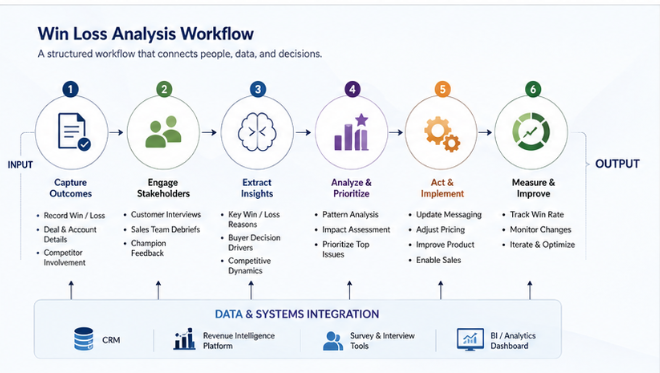
The real shift isn't the tool — it's the mindset. From "we lost, next deal" to "we lost, here's exactly why, and here's what changes tomorrow."
A Real Example: How One SaaS Team Turned It Around
A Series B SaaS company was stuck at a 22% win rate. Their CRM said "pricing" was the #1 loss reason. After running competitive win loss analysis:
What CRM said:
- 45% pricing, 25% features, 20% competitor, 10% other
What buyer interviews revealed:
- 40% of losses were to competitors the sales team never mentioned in their notes
- Only 20% were genuinely about price
- The biggest actual gap: their demo showed the product's features but never connected them to the buyer's specific use case
What changed:
- Sales playbooks restructured around use-case discovery, not feature demos
- Competitive battlecards updated to address the two specific vendors winning their deals
- Pricing packaging simplified — their complex tier structure was confusing buyers
For a step-by-step guide to building competitive battlecards that actually close deals, see our [battle card creation guide](/blog/how-to-create-battle-cards-that-actually-win-deals-2026).
Result: Win rate climbed from 22% to 34% within two quarters. Revenue impact: $1.8M in additional closed deals.
Platforms like FollowEngine complement win-loss programs by tracking competitor behavior that directly influences deal outcomes — pricing changes, ad campaigns, and positioning shifts that show up in buyer conversations.
FAQ: Win Loss Analysis
What is win loss analysis?
Win loss analysis is a structured process that examines closed sales deals to determine the specific reasons behind each outcome. It combines quantitative CRM data with qualitative buyer interviews to build a complete picture of why deals are won or lost against specific competitors. Unlike basic pipeline reporting, it answers "why" — not just "what happened."
Why does win loss analysis matter?
Salesforce's 2025 State of Sales report shows organizations with formal win-loss programs achieve 28% higher win rates. The practical reason is simple: most companies misattribute their losses. CRM data routinely shows "price" as the top reason, while buyer interviews consistently reveal product fit, sales execution, and competitive positioning as the real drivers. Without win-loss analysis, you're optimizing against wrong information.
How do you run a win loss analysis?
The process has five steps: (1) capture structured deal data from your CRM with accurate competitor tagging, (2) interview lost buyers within two weeks of deal close using a neutral third party, (3) categorize loss reasons into standardized buckets (product, pricing, competition, execution, external), (4) identify patterns across deals, competitors, segments, and sales stages, and (5) assign every insight an owner and deadline for action. Gartner research shows the "action gap" — insight collected but never applied — is the #1 reason programs fail.
What's a good win loss ratio?
Benchmarks vary by market: enterprise SaaS typically sees 35–55%, mid-market 20–40%. But the aggregate ratio is less useful than segmented analysis — your win rate broken down by competitor, deal size, sales rep, and pipeline stage tells the real story. A 40% overall rate with a 10% rate against your top competitor is a serious problem masked by a comfortable number.
What are common reasons for losing deals?
Based on analysis of approximately 500 loss interviews, the most common reasons are: (1) failure to connect features to the buyer's specific use case, (2) the winning vendor had a stronger champion inside the account, (3) the buyer perceived less risk with a larger/established competitor, (4) pricing was genuinely misaligned with perceived value, and (5) the sales process was too slow and the buyer lost momentum.
How often should you run win-loss analysis?
Monthly deal reviews for individual losses, quarterly deep-dives for pattern analysis, and a comprehensive annual audit. The competitive landscape moves too fast for annual-only analysis — companies reviewing quarterly identify competitive threats 2–3× faster than those doing annual reviews (Forrester, 2025).
What tools support win-loss analysis?
win loss analysis software ranges from dedicated platforms like Clari and Gong to competitive intelligence tools that track external market signals. The key requirement: the tool must connect internal deal data (CRM) with external competitive intelligence (pricing changes, product launches, market positioning) to give a full picture of why deals are won or lost.
Bottom Line
win loss analysis isn't a nice-to-have research project. It's a core revenue function that directly impacts win rates, product decisions, and competitive positioning. The data is consistent: companies that systematically understand why they lose, lose less. Companies that don't keep losing to the same competitors for the same reasons — and never know why.
Start with one lost-deal interview this week. The answers will surprise you.
About the Author
Dylan Dan Founder & CEO, FollowEngine
Dylan Dan is the founder of FollowEngine, bringing over 10 years of experience in competitive intelligence and competitor analysis. He has helped hundreds of businesses build structured CI programs that turn market signals into revenue decisions.
Related Articles
- [How to Create Battle Cards That Actually Win Deals (2026)](/blog/how-to-create-battle-cards-that-actually-win-deals-2026)
- [How to Gather Competitive Intelligence the Right Way (2026 Guide)](/blog/how-to-gather-competitive-intelligence-the-right-way-2026-guide)
- [How to Use Competitor Email Monitoring to Track Pricing and Promotions](/blog/how-to-use-competitor-email-monitoring-to-track-pricing-and-promotions)
Next step
Find your real competitors.
Run a free competitor lookup and decide what to monitor next.