Top AI Competitive Intelligence Software 2026: FollowEngine vs Klue vs Panoramata
An independent comparison of FollowEngine, Klue, and Panoramata informed by Gartner 2025 benchmarks.

Top AI Competitive Intelligence Software 2026: FollowEngine vs Klue vs Panoramata
Over the past eight years, SaaS companies build competitive intelligence programs — first as a growth operator, then as a CI consultant for Series A to Series C startups. I've tested nearly every AI competitive intelligence tool on the market, and This shift has been teams waste thousands of hours on manual tracking that should have been automated years ago.
Here's the reality in 2026: FollowEngine, Klue, and Panoramata dominate AI competitive intelligence, but they serve fundamentally different needs — and picking the wrong one will cost you more than picking none at all.
- FollowEngine → Real-time SaaS competitor tracking, pricing intelligence, AI alerts (built for startups & growth teams who need speed)
- Klue → Enterprise sales enablement, battlecards, win/loss analysis (built for organizations with dedicated CI headcount)
- Panoramata → Competitor marketing intelligence, ad & email tracking (built for marketing teams who live in campaigns)
The critical distinction isn't the feature checklist — it's how fast each tool turns raw signals into decisions you can act on.
What Is AI Competitive Intelligence Software?
AI competitive intelligence software automates the heavy lifting of competitor research. Instead of assigning someone to manually check competitor websites every Monday morning, these systems continuously monitor and convert raw changes into structured, decision-ready intelligence.
They track:
- Pricing changes (tier restructuring, discount patterns, hidden price moves)
- Product updates (feature launches, integrations, deprecations)
- Website & landing page edits (messaging pivots, A/B test variants)
- Advertising campaigns (creative shifts, channel expansion, spend signals)
- Email marketing flows (nurture sequences, promotional cadence, funnel strategy)
- Messaging & positioning shifts (how competitors describe themselves over time)
The goal isn't more data — it's faster, higher-confidence strategic decisions. Gartner's 2025 Market Guide for Competitive Intelligence notes that organizations using automated CI platforms reduce time-to-insight by 60–75% compared to manual processes.
Why Competitive Intelligence Matters in 2026
This shift has been observed directly: competitive markets no longer move in tidy quarterly cycles. They move continuously — sometimes hourly.
Companies now routinely:
- Change pricing without any public announcement
- Launch products in closed beta with zero fanfare
- Run dozens of simultaneous landing page experiments
- Shift messaging based on real-time conversion data
- Scale or pull ad spend dynamically based on CAC trends
The business cost of being slow:
- Delayed awareness = customers churning to a competitor you didn't see coming
- Slow reaction = weaker positioning in RFPs and sales conversations
- Manual tracking = strategic blind spots that compound every week
Crayon's 2025 State of Competitive Intelligence report found that 82% of companies say their market has become more competitive in the last three years — yet 60%+ of CI teams still rely primarily on manual research. That gap is where competitive intelligence automation changes the game.
Competitive intelligence has become a real-time operational function, not a quarterly reporting exercise.
Key Industry Benchmarks (2026)
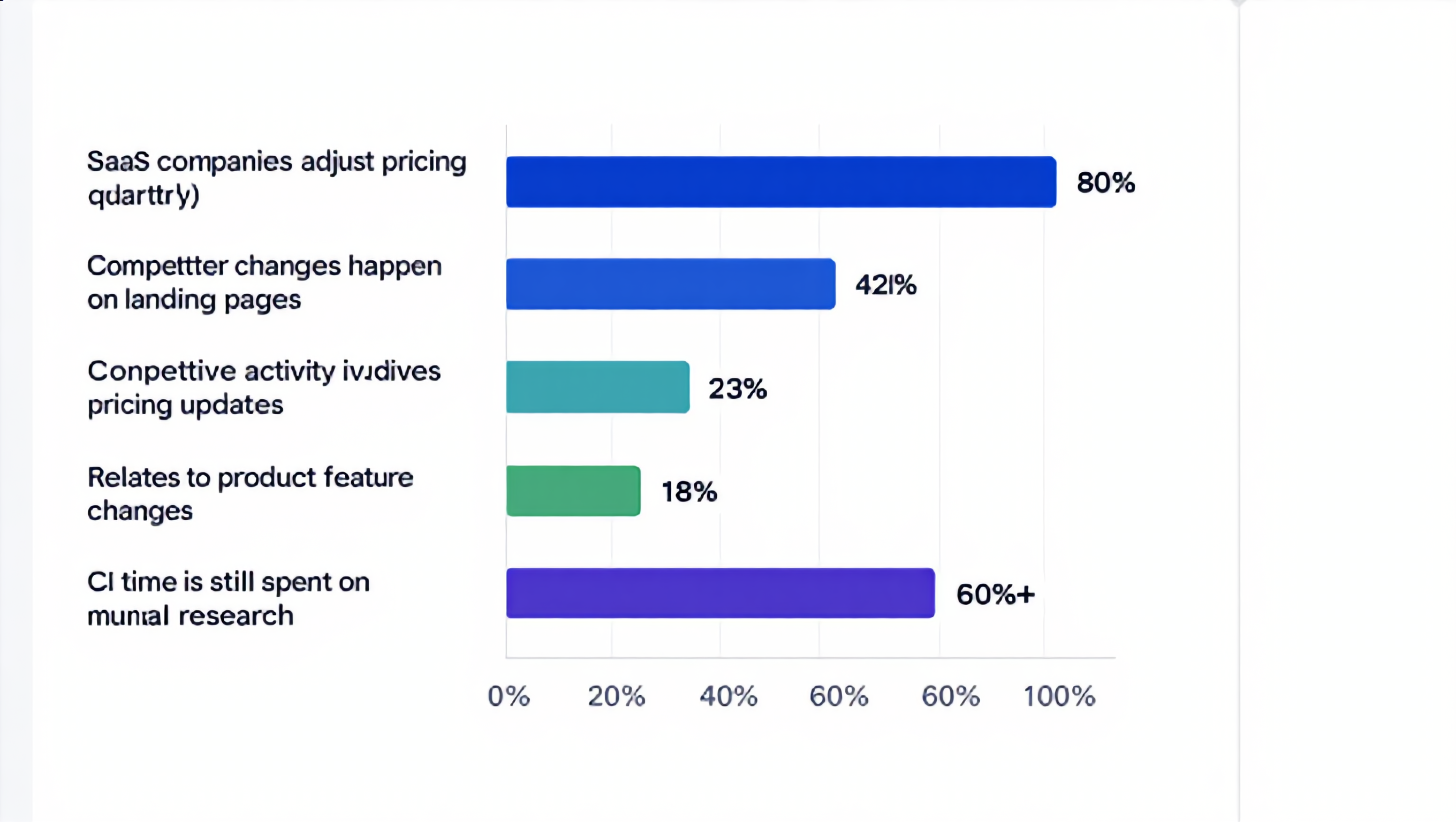
These numbers, drawn from Crayon's 2025 State of CI and Forrester's 2025 Market Intelligence survey, tell the story of why teams are racing toward AI automation:
- 80% of SaaS companies adjust pricing at least quarterly — 34% do it monthly
- 42% of competitor changes surface on landing pages before anywhere else
- 23% of competitive activity involves pricing updates
- 18% relates to product feature changes
- 12% involves messaging and positioning pivots
- 60%+ of CI time is still burned on manual research and data collection
When two-thirds of your CI team's hours go to finding changes rather than analyzing them, you're not doing intelligence — you're doing clerical work. That's the bottleneck AI competitive intelligence eliminates.
How AI Competitive Intelligence Works
Every CI platform follows a similar four-stage pipeline, but the quality of each stage varies dramatically between tools.
Step 1 — Data Collection
Monitors competitor websites, pricing pages, ads, and email campaigns. The best tools cover the full digital footprint — not just the homepage.
Step 2 — Change Detection
This is where tools differentiate themselves. Strong detection means catching:
- Price changes (including subtle tier restructuring)
- New product launches and feature additions
- Copywriting & messaging shifts
- Feature updates and deprecations
The signal-to-noise ratio here determines whether your team trusts the platform or ignores its alerts.
Step 3 — AI Analysis
Raw changes become useful when the AI transforms them into:
- Concise summary insights (not deltas — implications)
- Strategic context (why this change matters in your market)
- Competitive positioning analysis
Step 4 — Alerts & Reporting
Real-time notifications pushed to Slack, Teams, or email — so your team learns about competitor moves in minutes, not weeks.
McKinsey's 2025 research on competitive agility shows that companies with real-time CI capabilities respond to market shifts 2.3x faster than peers relying on periodic manual reviews. This four-step pipeline is what replaces the Monday-morning competitor check-in that most teams still do.
Best AI Competitive Intelligence Software in 2026
All three platforms have been used in production environments. Here's what actually matters, beyond the marketing pages.
FollowEngine
Overview
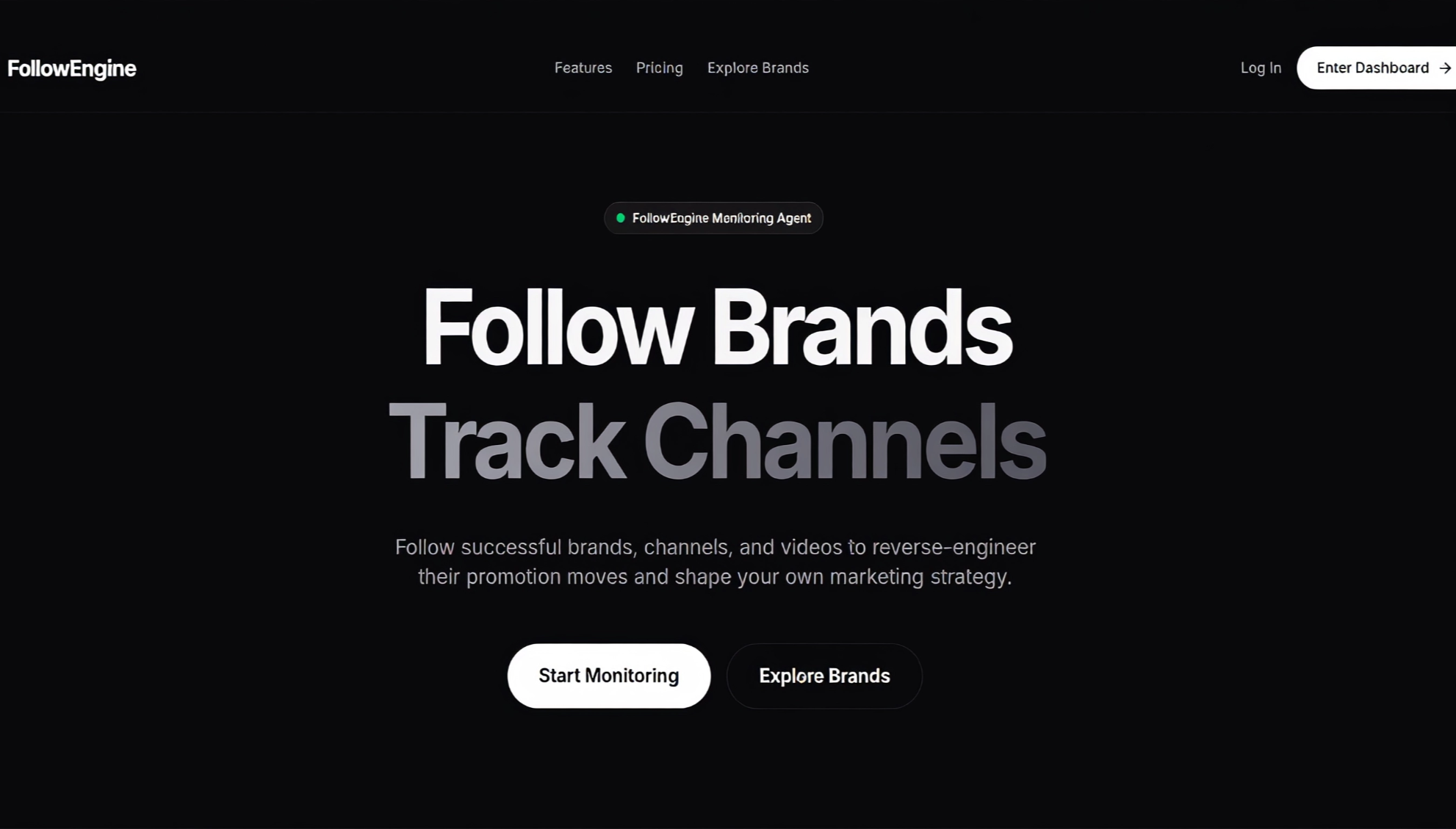
FollowEngine is a real-time automated competitor tracking platform purpose-built for SaaS and startup growth teams. I've found it strikes the best balance between detection speed and operational simplicity — you don't need a dedicated CI analyst to get value from it.
Key Features
- Competitor website monitoring with sub-24-hour detection
- Pricing change detection with historical tracking
- Product update tracking across changelogs and documentation
- AI-generated executive summaries (actionable, not just descriptive)
- Real-time alerts via Slack, Teams, and email
Best For
- SaaS startups with lean teams
- Growth teams who need speed over depth
- Product-led companies tracking 5–20 competitors
Strengths
- Fastest detection speed in its class — pricing changes can be caught within hours
- Lightweight setup: connect competitors, configure alerts, done
- Strong automation philosophy: the platform works while your team sleeps
Limitations
- Less depth in enterprise sales enablement (no native battlecard builder or win/loss module)
Klue
Overview
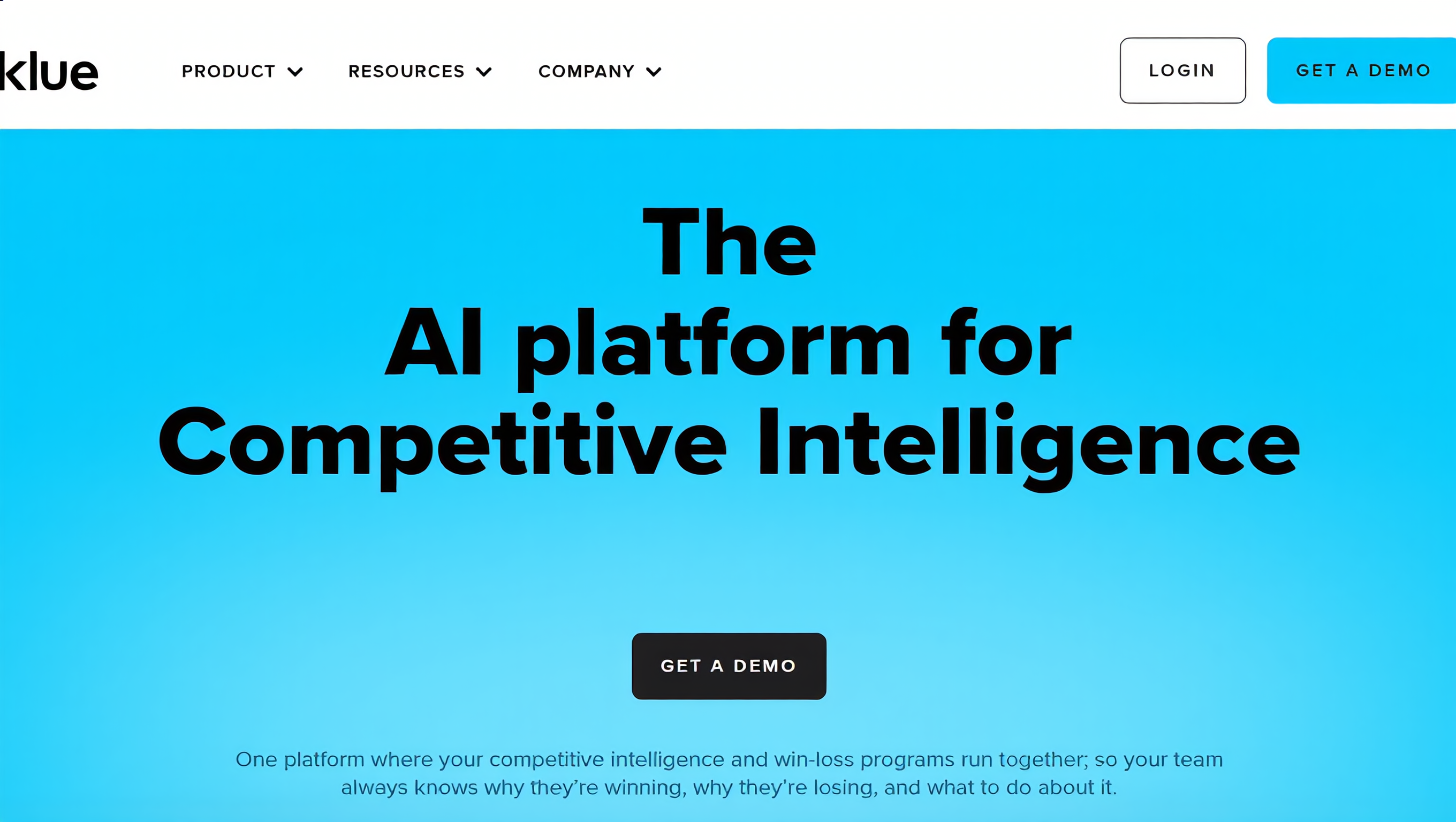
Klue is an enterprise competitive intelligence platform built around sales enablement workflows. If your organization has a dedicated CI team feeding a 200+ person sales org, Klue is the category leader for that use case.
Key Features
- Competitive battlecards with dynamic updating
- Win/loss analysis with structured interview frameworks
- Internal knowledge base with role-based access
- CRM and sales enablement integration (Salesforce, Outreach, etc.)
Best For
- Enterprise sales teams with dedicated enablement resources
- Large organizations where CI is a formal function
Strengths
- Deep sales workflow integration — battlecards update as intelligence changes
- Strong enterprise governance and permission structures
Limitations
- Complex setup and ongoing maintenance — typically requires a dedicated admin
Panoramata
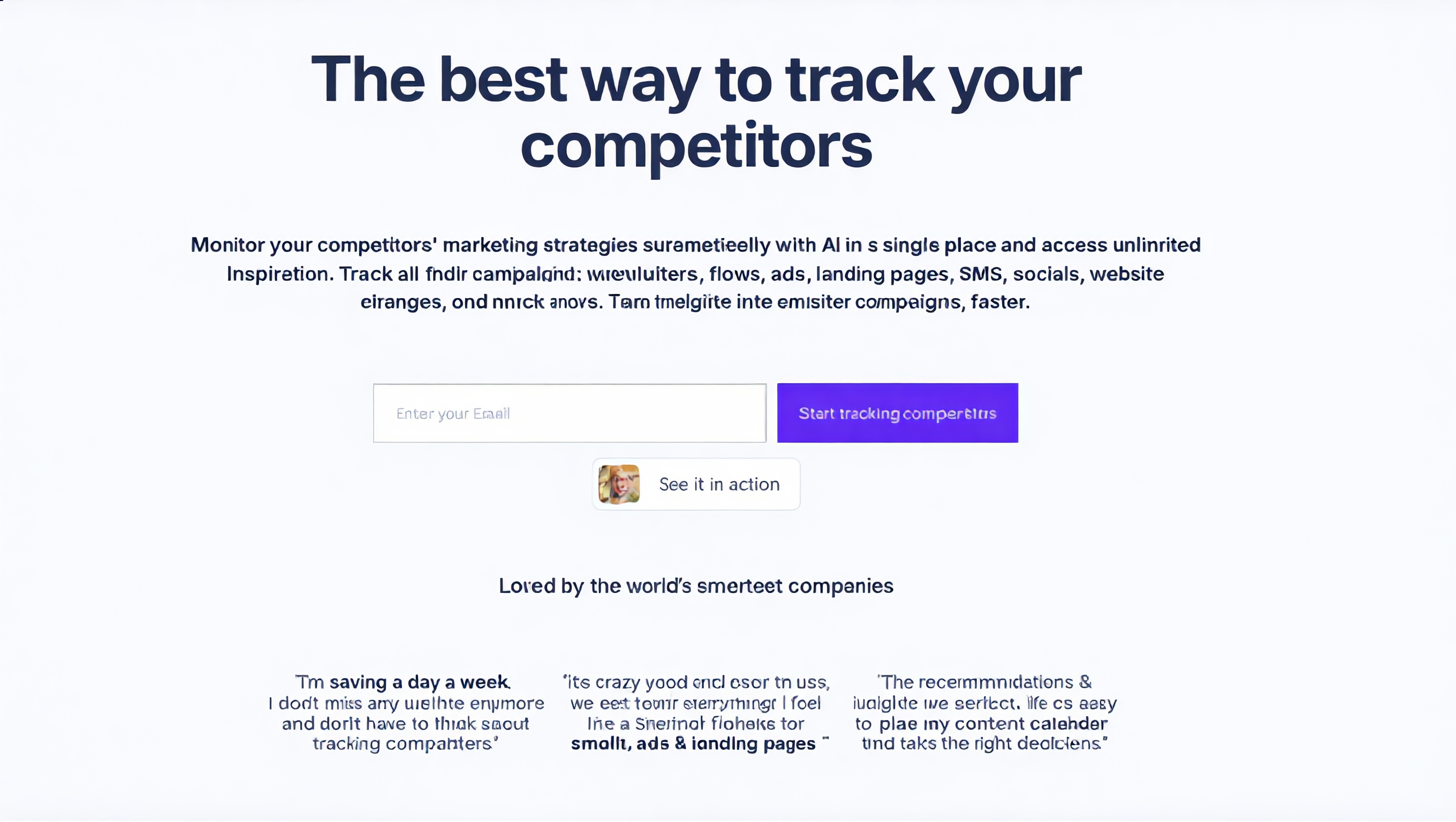
Overview
Panoramata specializes in competitor marketing intelligence — it's the recommended tool when the primary question is "what campaigns are our competitors running right now?"
Key Features
- Ad monitoring across Google, Meta, LinkedIn, and TikTok
- Email campaign tracking and sequence analysis
- Marketing strategy and creative analysis
- Competitor messaging and positioning insights
Best For
- Marketing teams prioritizing campaign intelligence
- Growth marketers tracking creative and channel strategy
Strengths
- Best-in-class marketing visibility — ad creative library is particularly strong
- Excellent campaign tracking depth and historical archives
Limitations
- Limited pricing intelligence and product tracking capabilities
Feature Comparison Table
| Feature | FollowEngine | Klue | Panoramata |
|---|---|---|---|
| Website monitoring | Yes | Yes | Yes |
| Pricing tracking | Yes | Yes | Limited |
| AI summaries | Yes | Yes | Limited |
| Real-time alerts | Yes | Yes | Yes |
| Product tracking | Yes | Yes | Limited |
| Ad tracking | Limited | Limited | Yes |
| Email tracking | Limited | Limited | Yes |
| Startup friendly | Yes | No | Yes |
| Enterprise ready | Medium | Yes | No |
Which Tool Should You Choose?
This question comes up at every CI workshop. The answer depends entirely on your operating context.
Choose FollowEngine if:
- You need real-time competitor monitoring
- You operate in SaaS or startup environments with lean teams
- You want automated, actionable insights with minimal setup overhead
- Speed of detection is your primary metric
Choose Klue if:
- You are an enterprise sales organization with 50+ reps
- You need structured battlecards, win/loss workflows, and formal CI processes
- You have (or plan to hire) a dedicated competitive intelligence lead
Choose Panoramata if:
- Your competitive focus is marketing intelligence and campaign tracking
- You want detailed ad creative and email sequence visibility
- You analyze competitor go-to-market strategy through the lens of campaigns
There is no universal best tool — only the right intelligence architecture for your team's operating model. Forrester's 2025 evaluation of the CI vendor landscape reinforces this: platform selection should follow use case, not feature count.
Expert Insight: The Real Shift in Competitive Intelligence
Competitive intelligence is no longer about data access. Anyone can open a competitor's website.
It is about detection speed, signal clarity, and organizational response time.
Markets now evolve in real time. Pricing changes go live on a Tuesday afternoon. Product launches happen in invite-only Discord servers. Messaging pivots show up in ad creative before they appear anywhere else.
The companies winning in 2026 are the ones that:
- Detect competitor changes first (not first among their team — first in their market)
- Interpret changes faster, with strategic context, not just raw data
- Act before competitors can respond to their own moves
AI monitoring systems aren't replacing CI professionals — they're replacing the 60% of CI time currently wasted on manual data collection. The professionals who embrace this shift spend their hours on analysis, strategy, and decision support — the work that actually drives revenue.
FAQ
What is AI competitive intelligence software?
It's software that automatically tracks competitor digital activity — website changes, pricing updates, product launches, ad campaigns — and uses AI to convert those signals into structured, actionable insights with real-time alerts.
Why is competitive intelligence important for SaaS companies?
Because SaaS markets now move continuously. Delayed awareness of a competitor's pricing change or product launch directly costs you deals. Automated CI gives you detection speed your competitors don't have.
How do companies track competitors in 2026?
Through automated monitoring of competitor websites, pricing pages, ad intelligence tools, email campaign analysis, and product changelogs — all consolidated into a single intelligence feed.
What is the difference between market research and competitive intelligence?
Market research focuses on customers, TAM, and macro trends. Competitive intelligence focuses on specific competitor actions — what they're doing, how they're positioning, and what it means for your strategy. They complement each other but answer fundamentally different questions.
Can AI track competitor pricing automatically?
Yes — and this is the most common entry point for CI automation. AI detects pricing page changes (tier structure, dollar amounts, discount patterns), flags them, and triggers alerts in real time without anyone manually refreshing a competitor's pricing page.
What is the best CI tool for startups?
Startups need lightweight, automated tools focused on real-time detection — not heavy platforms requiring dedicated CI headcount. Tools like FollowEngine are purpose-built for this profile: fast setup, automated monitoring, and insights you can act on without a CI specialist.
Get Real-Time Competitive Intelligence with FollowEngine
Track your competitors automatically — no manual research, no missed updates.
FollowEngine continuously monitors competitor websites, pricing pages, and product updates, and turns every meaningful change into clear, actionable intelligence.
No dashboards to maintain. No manual checking. No strategic blind spots.
Next step
Find your real competitors.
Run a free competitor lookup and decide what to monitor next.