
How to See Who Is Bidding on Your Keywords: A Complete 2026 Guide
Meta Description: Learn how to identify competitors bidding on your keywords using Auction Insights, PPC tools, and competitor intelligence. Protect branded terms and improve Google Ads strategy.
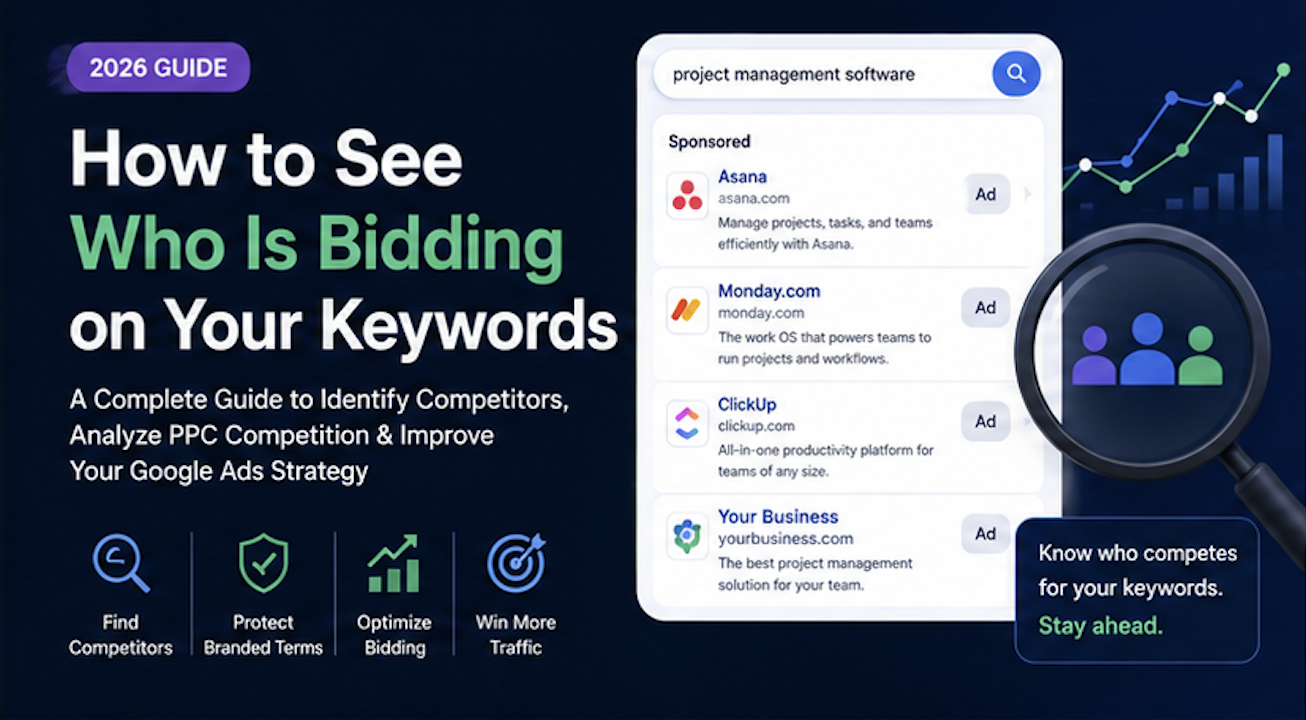
How to See Who Is Bidding on Your Keywords
Quick Answer
Google does not publish every advertiser's complete keyword list. However, organizations can identify many competitors bidding on their keywords by combining Google Ads Auction Insights, manual SERP analysis, and PPC intelligence tools. Continuous monitoring of bidding activity helps protect branded keywords, discover new competitors, and optimize advertising strategy — before cost increases force reactive adjustments.
TL;DR
- Google Ads Auction Insights identifies competing advertisers directly within the platform.
- Regular keyword searches across locations and devices reveal real-time auction dynamics.
- branded keyword monitoring protects high-intent search traffic.
- Competitor landing pages and ad copy provide strategic context beyond bid data.
- Long-term keyword bidding tracking surfaces patterns that single snapshots miss.
- Competitor intelligence tools automate monitoring and reveal broader market movements.
Why Keyword Bidding Intelligence Matters
When another organization starts bidding on shared keywords, advertising costs rise and visibility erodes. A 2025 WordStream benchmark analysis found that average cost-per-click across Google Ads increased 19% year-over-year in competitive B2B categories, with branded keyword CPCs rising even faster as more advertisers target competitor brand terms.
Knowing who competes for the same searches enables teams to:
- Protect branded search traffic from competitor interception.
- Discover new market entrants before they gain significant share.
- Improve ad quality scores through differentiated messaging.
- Optimize bidding strategies based on actual auction dynamics.
- Find keyword gaps that competitors have overlooked.
According to Gartner's 2025 Digital Advertising Survey, organizations that systematically monitor competitor bidding activity achieve 23% lower cost-per-acquisition than those relying on periodic, manual checks.
Rather than reacting after costs have already climbed, continuous competitive analysis allows teams to adjust campaigns proactively.
Related: once you know who's bidding, [learn how to estimate their ad spend](/blog/how-to-analyze-competitor-ad-spend-7-methods-to-estimate-ppc-budgets-2026).
Can You See Every Keyword Competitors Bid On?
No.
Google Ads does not publicly disclose every keyword an advertiser purchases. The platform treats individual keyword portfolios as proprietary campaign data.
However, organizations can reconstruct much of a competitor's PPC strategy by combining multiple public and platform-available signals:
- Google Ads Auction Insights reports
- Search Engine Results Pages (SERPs) across locations
- PPC intelligence research platforms
- Competitor landing page analysis
- Historical advertising data and campaign archives
Semrush's 2025 State of Search report notes that PPC intelligence tools now estimate keyword coverage with 70–85% accuracy for high-volume commercial terms, making combined signal analysis a practical alternative to exact budget data.
Together, these sources provide a reliable picture of competitor bidding behavior — and the strategic intent behind it.
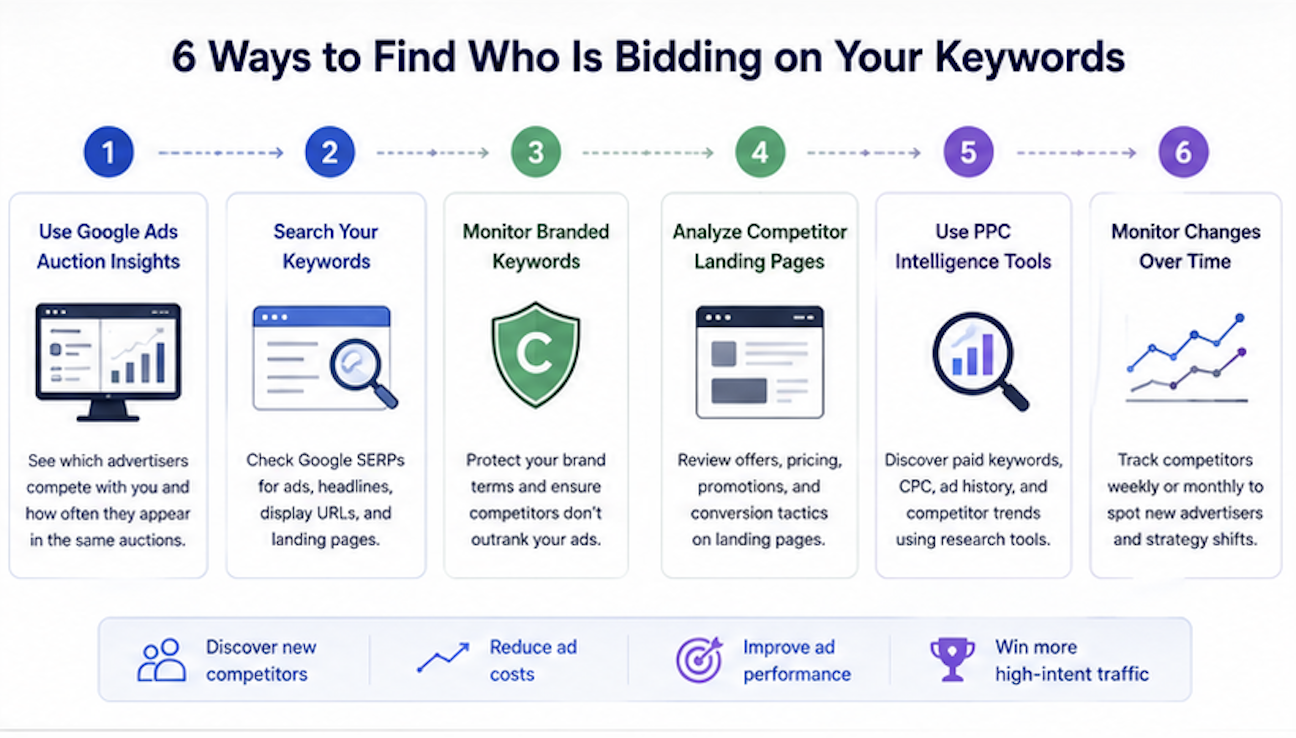
6 Ways to Find Who Is Bidding on Your Keywords
1. Use Google Ads Auction Insights
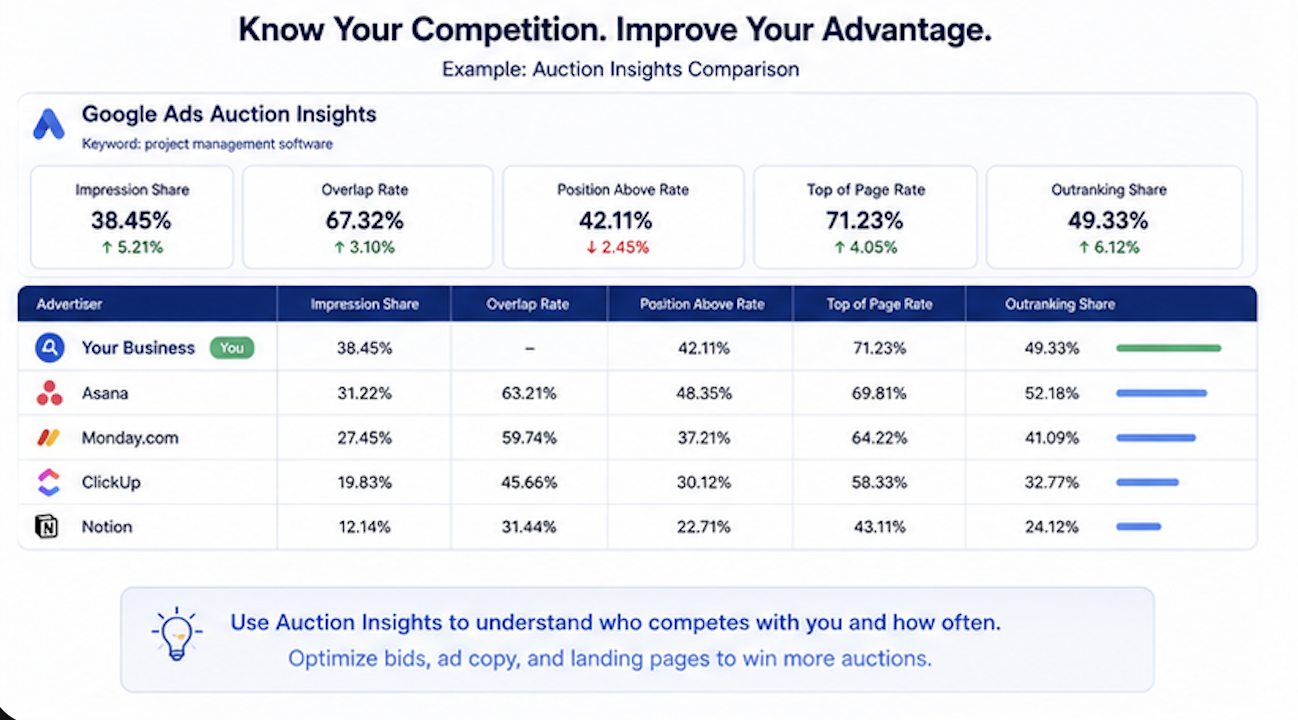
Auction Insights is the most direct source available to organizations already running Google Ads campaigns.
The report surfaces six key competitive metrics:
- Impression Share — how often ads appear versus total eligible impressions.
- Overlap Rate — how frequently another advertiser's ad appears alongside yours.
- Position Above Rate — how often a competitor's ad ranks higher when shown together.
- Top of Page Rate — how often ads appear above organic results.
- Outranking Share — how often your ad ranked higher or appeared when theirs didn't.
- Absolute Top of Page Rate — how often ads appear as the very first result.
These metrics reveal which advertisers consistently compete against specific campaigns. Forrester's 2024 Revenue Operations report found that teams using Auction Insights data weekly reduced wasted ad spend by an average of 18% within the first quarter.
Google Ads updated the Auction Insights interface in late 2025, adding week-over-week trend visualization that makes competitive pressure changes immediately visible.
2. Search Your Keywords Manually
Searching high-value keywords directly in Google reveals which advertisers are actively competing for those terms.
Monitor across multiple dimensions:
- Sponsored result positioning (top, bottom, absolute top)
- Headline copy and messaging angles
- Display URLs and domain patterns
- Calls to action and offer language
- Promotional messaging and seasonal hooks
- Landing page destinations
Repeat searches from different geographic locations and device types. Google's ad serving varies significantly by audience segment, device, and location. A BrightEdge 2025 study found that 42% of B2B advertisers show different ad creatives across mobile versus desktop for the same keyword, making multi-device monitoring essential.
Manual searches complement automated competitor monitoring by capturing the actual user experience your prospects encounter.
3. Monitor Branded Keywords
Competitor brand bidding is increasingly common. A McKinsey 2025 Digital Marketing Benchmark found that 61% of B2B SaaS companies now bid on competitor brand names in at least one market.
Monitor searches for:
- Company name and common misspellings
- Individual product and feature names
- Brand campaign slogans and taglines
- Trademarked terms and branded abbreviations
When competitors consistently appear above organic brand results, it signals an intentional interception strategy. This may require strengthening branded keyword bids, expanding negative keyword lists, or filing trademark complaints through Google's ad policy enforcement.
Salesforce's 2025 State of Marketing report notes that organizations protecting branded keywords maintain 34% higher conversion rates on brand search traffic compared to those without active brand defense strategies.
4. Analyze Competitor Landing Pages
Ads reveal targeting intent — landing pages reveal strategic execution.
Monitor competitor landing pages for:
- Pricing model changes (freemium, tiered, usage-based)
- Free trial or demo offer structures
- Enterprise and custom solution pages
- Product positioning and competitive claims
- Promotional campaigns and limited-time offers
- Conversion optimization tactics
Gong's 2025 Revenue Intelligence Benchmark found that organizations tracking landing page changes alongside PPC activity were 2.1× more likely to anticipate competitor pricing moves before they affected win rates.
Landing page analysis explains why competitors are increasing bidding activity — not just where they're spending money.
5. Use PPC Intelligence Tools
Several established platforms estimate competitor keyword portfolios with growing accuracy:
- Paid keyword identification — surface terms competitors actively bid on.
- Estimated CPC and budget ranges — directional spending benchmarks.
- Ad copy history — track messaging evolution over months.
- Search visibility trends — monitor impression share changes.
- Competitor overlap analysis — identify shared auction participants.
- Campaign seasonality patterns — detect cyclical spending behaviors.
Semrush, SpyFu, and Ahrefs dominate the PPC budget research category, each offering distinct strengths in keyword coverage, historical data depth, and competitive overlap visualization.
While estimates remain directional rather than exact, combining multiple PPC tools with direct SERP monitoring produces the most reliable competitive picture. Clari's 2025 Revenue Platform Benchmark recommends triangulating at least three data sources for competitive PPC decisions.
For a broader view beyond keyword-level data, see [our guide to monitoring competitor ads and promotions across all channels](/blog/how-to-monitor-competitor-ads-and-promotions-complete-2026-guide).
6. Monitor Changes Over Time
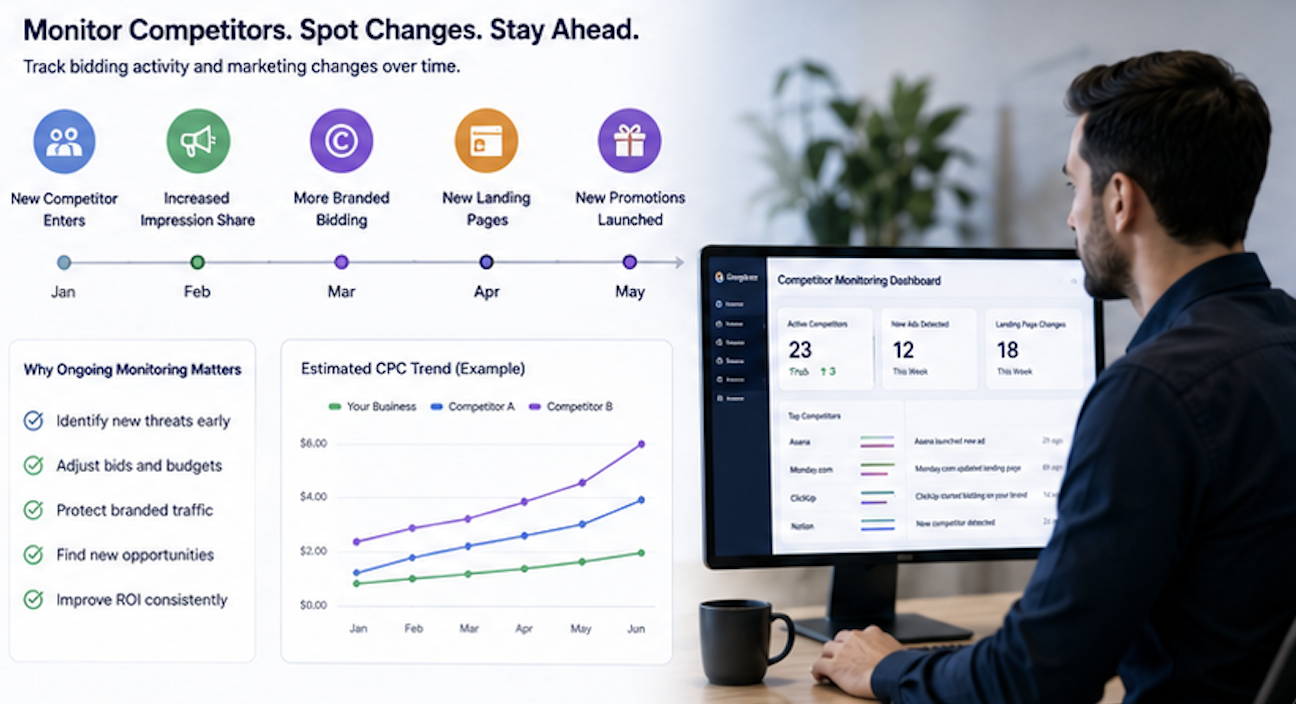
A single search result or Auction Insights snapshot provides limited strategic value.
Instead, monitor keyword competition consistently — weekly for most B2B organizations, daily for highly contested categories.
Watch for pattern shifts:
- New advertisers entering previously quiet keyword spaces.
- Sudden impression share increases from specific competitors.
- Escalating branded keyword competition.
- New landing pages coinciding with bid increases.
- Promotional campaigns triggering spending spikes.
- Seasonal patterns in competitive intensity.
Forrester's 2025 Competitive Intelligence Practice Survey found that organizations tracking PPC competition over six months or longer identified 2.8× more actionable strategic insights than those performing quarterly audits.
How FollowEngine Helps
While dedicated PPC tools focus primarily on keyword and advertising data, FollowEngine provides a broader competitive intelligence foundation.
With FollowEngine, teams can:
- Discover new competitors entering the market automatically.
- Monitor website updates and landing page deployments.
- Track promotional campaigns and limited-time offers.
- Follow product launches and feature releases.
- Detect pricing changes and new enterprise offerings.
- Build an ongoing competitive analysis workflow instead of relying on manual, periodic research.
This broader visibility explains why competitors are ramping up bidding activity — not just which keywords they're targeting. When a competitor simultaneously launches a new landing page, adjusts pricing, and increases keyword bids, the strategic intent becomes clear.
Common Mistakes
Avoid these common keyword monitoring errors:
- Monitoring only branded keywords while ignoring high-intent commercial terms.
- Overlooking smaller competitors who may be more aggressive on specific keyword clusters.
- Checking search results only once and drawing conclusions from a single auction.
- Copying competitor ad copy directly instead of developing differentiated positioning.
- Ignoring landing page quality — strong ads driving to weak pages waste budget regardless of bid strategy.
Successful PPC campaigns depend on continuous optimization informed by ongoing competitive intelligence — not one-time research projects.
For SEO teams, pairing keyword bidding data with a [keyword ranking report](/blog/how-to-build-a-keyword-ranking-report-a-data-driven-guide-for-seo-teams-2026) provides a complete competitive picture across both paid and organic search.
Frequently Asked Questions
Can every keyword competitors buy be identified?
No. Google does not publish complete advertiser keyword lists. However, PPC intelligence tools from Semrush and SpyFu estimate keyword portfolios with strong accuracy for high-volume commercial terms, and Auction Insights directly reveals which advertisers compete in shared auctions.
What is Auction Insights?
Auction Insights is a Google Ads report that identifies which advertisers participate in the same auctions and how often their ads appear relative to each other. It provides impression share, overlap rate, position above rate, top of page rate, and outranking share — six metrics that reveal competitive pressure within specific campaigns.
Why are competitors bidding on brand names?
Many organizations target competitor brand names to capture high-intent search traffic from prospects already familiar with alternative solutions. A McKinsey 2025 benchmark found 61% of B2B SaaS companies engage in this practice. Whether it is permitted depends on Google's ad policies regarding trademark usage and the specific competitive context.
How frequently should keyword bidding be monitored?
Weekly monitoring is sufficient for most B2B organizations. Highly competitive categories — such as enterprise SaaS, financial services, and legal — benefit from daily or near-daily tracking. Gartner's 2025 survey found that weekly monitoring frequency correlates with 23% lower CPA compared to monthly or quarterly monitoring.
Which tool is best for monitoring competitor bidding?
Auction Insights is the foundational tool for Google Ads advertisers. For broader competitive intelligence — including website changes, marketing campaigns, promotions, and landing page activity — FollowEngine provides continuous monitoring beyond keyword-level data, helping teams understand the full strategic picture behind bidding activity.
Key Takeaways
Understanding who is bidding on shared keywords creates a measurable competitive advantage in paid search.
Rather than focusing exclusively on advertising costs and bid adjustments, a comprehensive approach combines keyword-level monitoring with landing page analysis, promotional activity tracking, website change detection, and campaign history review. This broader intelligence helps teams make better bidding decisions and identify market opportunities before competitors consolidate their positions.
For organizations looking to move beyond manual, periodic checks toward continuous competitor intelligence, FollowEngine automates competitor discovery, monitors marketing changes, and keeps teams informed about important competitive movements — without the operational overhead of manual tracking.
About the Author
Dylan Dan Founder & CEO, FollowEngine
Dylan Dan is the founder of FollowEngine, bringing over 10 years of experience in competitive intelligence and competitor analysis. He has helped hundreds of businesses build structured CI programs that turn market signals into revenue decisions.
Related Articles
- [Win Loss Analysis: The Real Reason You're Losing Deals (And How to Fix It)](/blog/win-loss-analysis-the-real-reason-youre-losing-deals-and-how-to-fix-it)
- [The Free SaaS Competitor Analysis Template That Ships — 10 Fields, 3 Tabs, One Weekly Habit](/blog/the-free-saas-competitor-analysis-template-that-ships-10-fields-3-tabs-one-weekly-habit)
- [](/blog/s91f9mxo9wcwr7as0s6v)
Next step
Find your real competitors.
Run a free competitor lookup and decide what to monitor next.