
How FollowEngine Automatically Finds Your Competitors For Free
Quick Answer
Finding competitors manually is slow, incomplete, and often inaccurate. FollowEngine's AI Competitor Finder analyzes a website — not just individual keywords — to identify businesses targeting similar customers, products, and markets. Enter a website URL, select a country, and discover relevant competitors in seconds.
TL;DR
- Discover competitors by entering any website URL
- AI analyzes the full business instead of relying on one keyword
- Find competitors that manual Google searches miss
- Choose any country to research local markets
- Save hours of manual research with FollowEngine's free tools
Why Finding the Right Competitors Matters
Most businesses can name a few well-known competitors. However, the companies a business is actually competing against are often much broader than the brands already known.
Competitors may include:
- Companies ranking higher in Google Search
- Businesses bidding on the same Google Ads keywords
- Fast-growing startups entering the market
- Alternative products solving the same customer problem
- Local businesses targeting the same region
- International companies expanding into the country
Understanding the real competitive landscape is the foundation of every successful SEO, PPC, and marketing strategy.
According to BrightEdge, 68% of online experiences begin with a search engine, making search visibility one of the most important customer acquisition channels. BrightEdge also reports that 53.3% of all website traffic comes from organic search — meaning businesses that dominate search results often become the biggest competitors, even if they have never been heard of before.
Research from Ahrefs found that over 90% of web pages receive little or no traffic from Google. In competitive industries, identifying companies already winning organic visibility can save months of trial and error.
Instead of guessing who the competitors are, AI competitor discovery identifies businesses targeting similar audiences and search intent within seconds.
For a structured framework to categorize those competitors, see [how to identify direct and indirect competitors](/blog/how-to-identify-direct-and-indirect-competitors-a-complete-2026-framework).
Why Manual Competitor Research Falls Short
Most marketers begin with Google. They search a few keywords, open several browser tabs, compare websites, and build a spreadsheet.
Others browse platforms such as Google Search, LinkedIn, G2, Capterra, Product Hunt, Reddit, and industry directories. While these resources are useful, they have several limitations.
They Only Show One Part of the Market
Google shows competitors based on a specific keyword. Software directories only list companies that have submitted products. Social communities often highlight only popular brands. No single platform provides a complete picture.
They Take Too Much Time
Finding competitors manually often means repeating the same process for dozens of keywords and multiple countries. For growing businesses, this can consume hours every week.
They Become Outdated Quickly
New startups launch every month. Existing competitors release new products, enter new markets, or reposition their offerings. A spreadsheet created six months ago may already be incomplete.
Why Not Just Use Google?
This is one of the most common questions marketers ask. Google is an excellent starting point — but it was not designed to be a competitor discovery platform.
Searching for "competitor monitoring software" returns a different set of companies than searching for "competitor intelligence platform," "website monitoring tools," or "market intelligence software." Each keyword produces different search results.
Google ranks pages based on hundreds of signals, including search intent, content relevance, user location, personalization, website authority, and freshness. That means only competitors relevant to one search query at a time are visible.
The actual competitive landscape is much larger.
Instead of asking: "Who ranks for this keyword?", FollowEngine asks: "Which businesses are most similar to yours?" This shift produces a much broader and more accurate competitor list.
How FollowEngine Uses AI to Discover Competitors
Rather than relying on keyword matching alone, FollowEngine analyzes a website as a complete business. Its AI evaluates signals including:
- Website content
- Products and services
- Industry
- Target audience
- Website structure
- Business positioning
- Core topics
- Search intent
By combining these signals, FollowEngine identifies businesses serving similar customers — not just websites ranking for the same keyword.
This helps uncover direct competitors, emerging competitors, niche competitors, alternative solutions, and businesses entering the market. Many of these companies would never appear in a traditional Google search.
Find Competitors in Any Country
Competition varies from one market to another. The businesses competing in the United States may be completely different from those in Canada, Australia, Singapore, Germany, France, Japan, or Brazil.
FollowEngine allows users to choose the target country before running an analysis. Instead of generating a generic global competitor list, the AI focuses on companies relevant to the selected market.
This is particularly useful for:
- Expanding internationally
- Running country-specific SEO campaigns
- Researching local competitors
- Planning Google Ads campaigns
- Launching products in new regions
Whether targeting one country or comparing multiple markets, localized competitor discovery provides more actionable insights.
How to Use FollowEngine's Free AI Competitor Finder
No Google Search Console, Google Analytics, or third-party platform connections are required. Provide a website, choose a market, and let AI do the research.
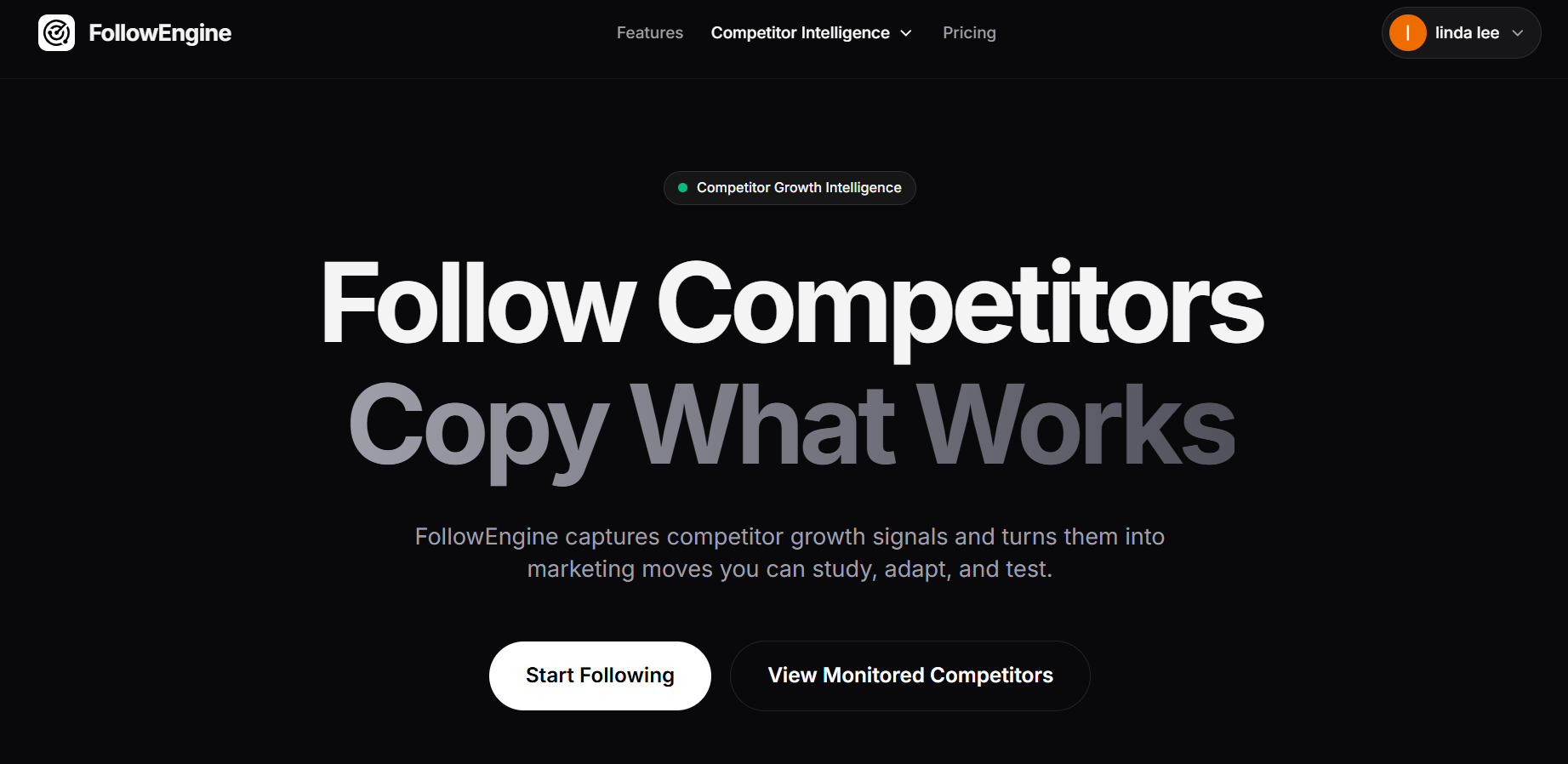
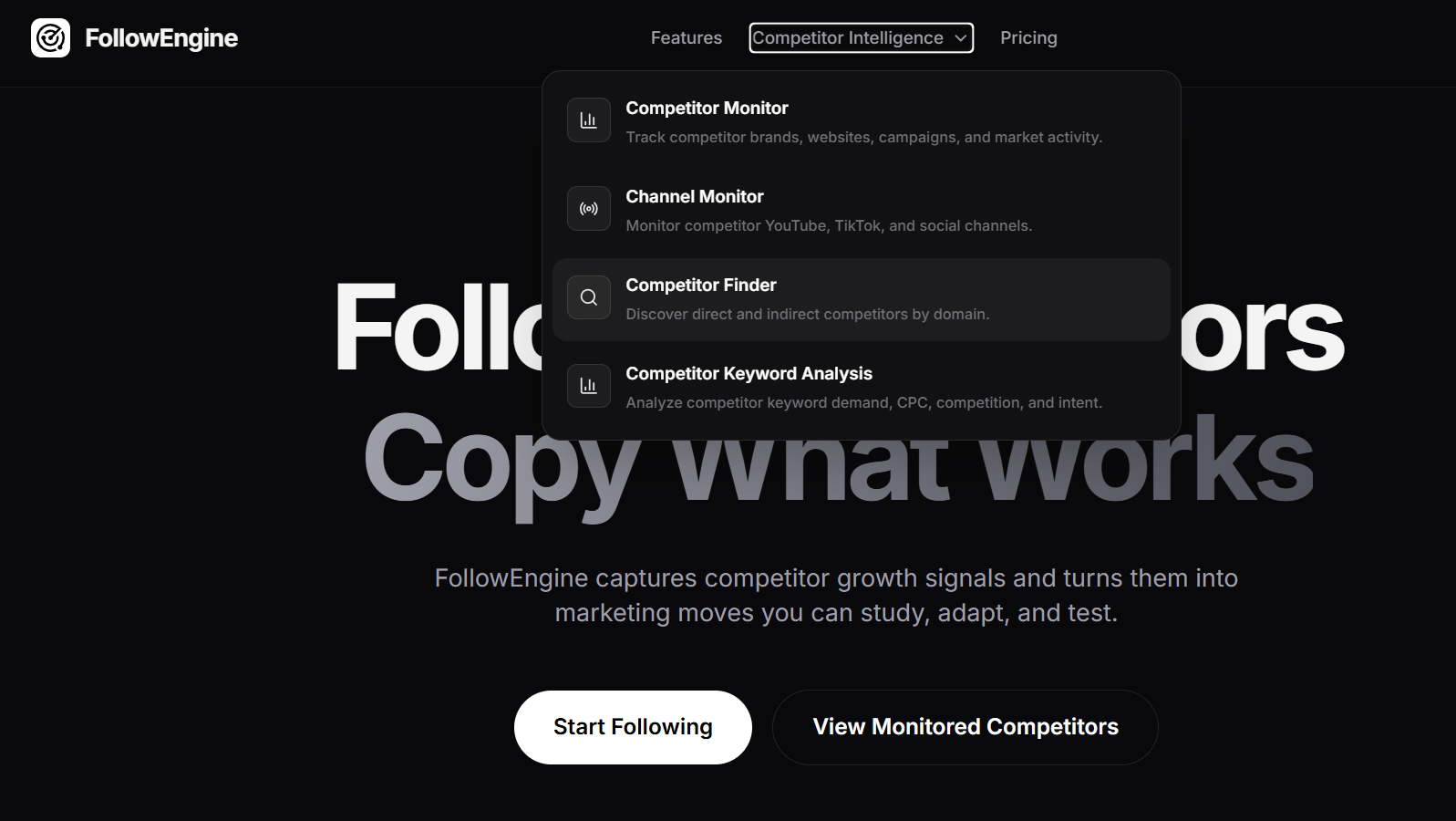
Step 1: Visit FollowEngine
Open the Free AI Competitor Finder on FollowEngine. No software installation is required.
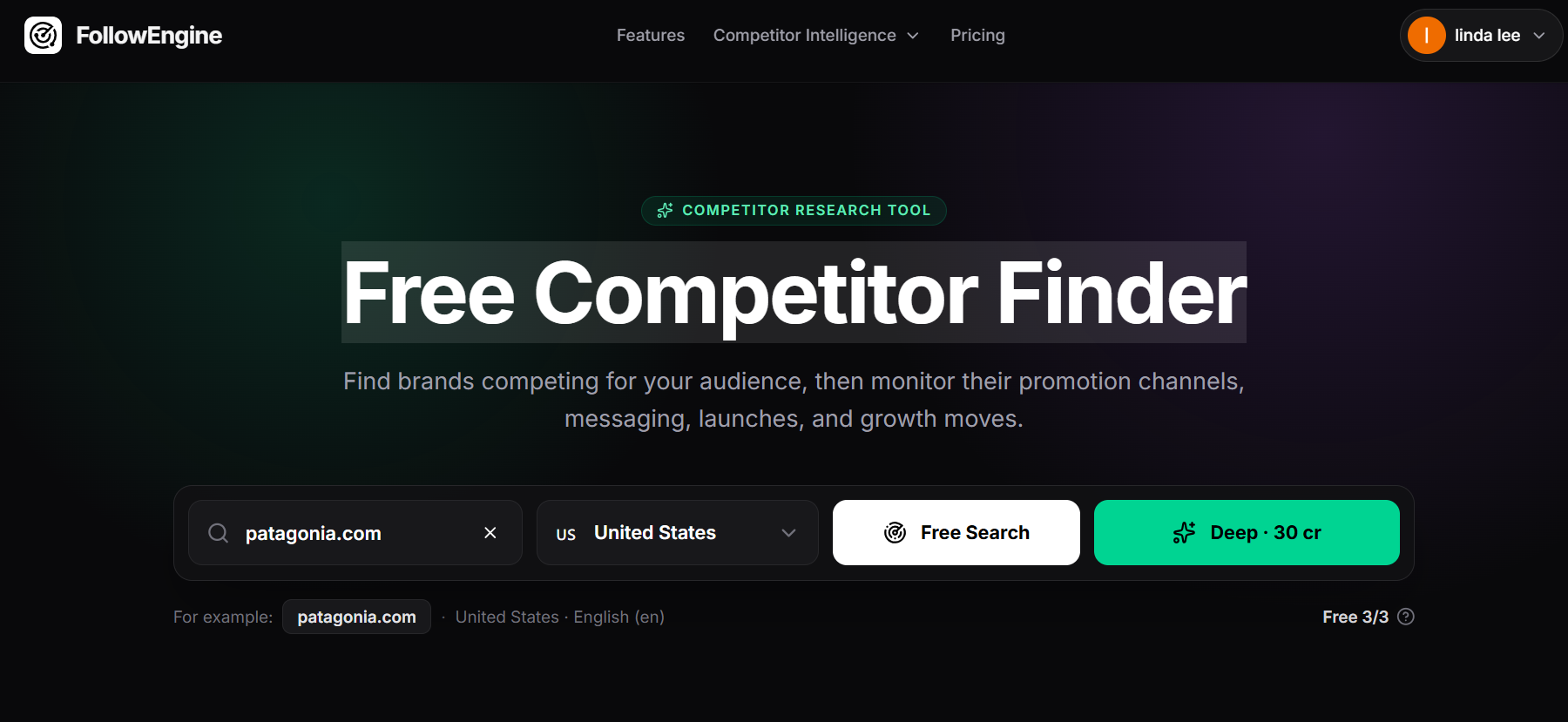
Step 2: Enter a Website URL
Paste a homepage URL (e.g., https://yourwebsite.com). The AI immediately begins analyzing the business. Unlike traditional keyword tools, there is no need to enter dozens of search terms.
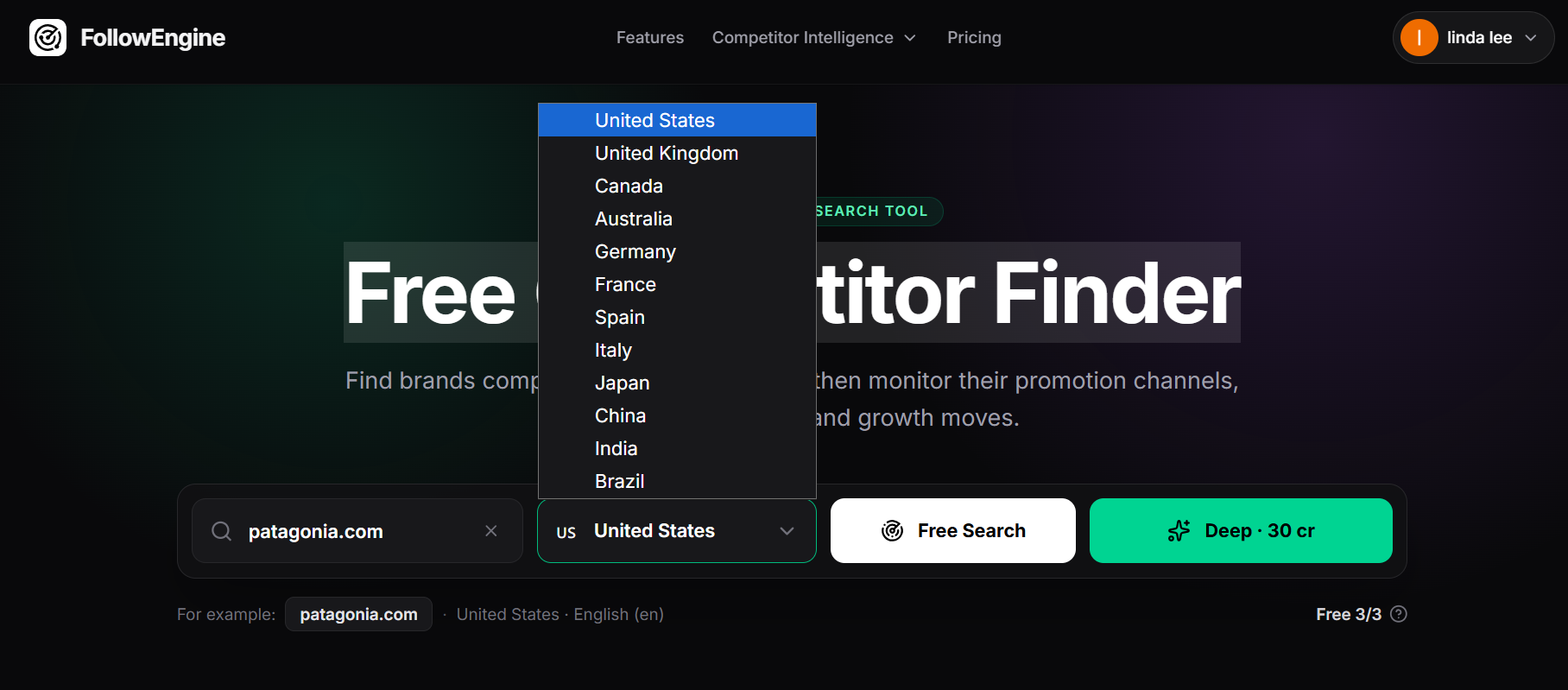
Step 3: Select the Target Country
Choose the market to analyze. Popular options include United States, United Kingdom, Canada, Australia, Singapore, Germany, France, and Japan. Selecting a country helps FollowEngine discover competitors relevant to the target audience.
Step 4: Click Find Competitors
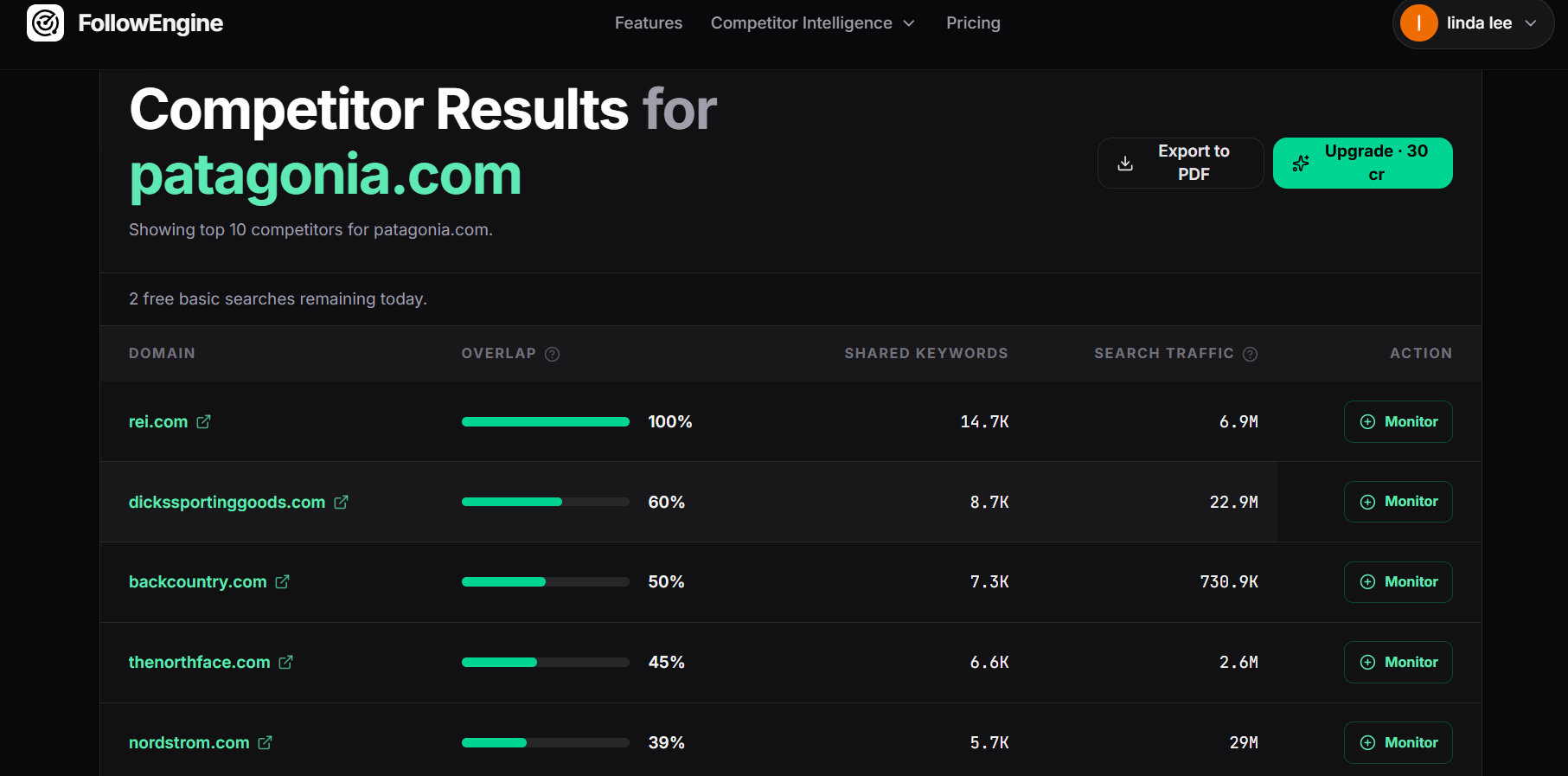
Within seconds, AI generates a list of businesses similar to the analyzed website. Instead of spending hours searching Google, a structured list of competitors is delivered immediately — exportable to PDF.
Step 5: Review the Results
Each competitor provides a starting point for deeper market research. Teams can quickly understand what competitors offer, their positioning, their target audience, and how they compare. This provides a much stronger foundation than starting with a blank spreadsheet.
FollowEngine vs. Manual Competitor Research
| Manual Research | FollowEngine AI Competitor Finder |
|---|---|
| Search one keyword at a time | AI analyzes the entire website |
| Search Google repeatedly | One search generates competitors |
| Miss emerging competitors | Finds direct and hidden competitors |
| Difficult to compare countries | Supports country-specific searches |
| Hours of research | Results in seconds |
| Manual spreadsheets | AI-powered competitor discovery |
Instead of repeating the same research process every few weeks, AI automates the most time-consuming step — finding the right competitors.
A Typical Competitor Research Workflow
Many marketers use FollowEngine as the first step in their competitive research:
- Enter a website URL
- Select the country to target
- Generate a list of competitors
- Review each company's positioning and offerings
- Compare messaging, pricing, SEO, and product strategy
- Use those insights to improve marketing and business strategy
Instead of spending an afternoon researching competitors manually, the discovery process takes only a few minutes.
Benefits of Using FollowEngine
Save Hours Every Week
Manual competitor research often involves searching Google, browsing software directories, opening dozens of tabs, and maintaining spreadsheets. FollowEngine replaces that repetitive work with AI-powered analysis.
Discover Competitors That Were Unknown
Some of the biggest competitors may never appear in Google searches. AI helps uncover emerging startups, niche competitors, regional businesses, alternative products, and fast-growing companies. Understanding these competitors earlier enables response before they become market leaders.
Research Local Markets
Competition changes across countries. By selecting the target country, FollowEngine provides competitor insights relevant to the market instead of returning generic global results. This is especially valuable for international SEO, Google Ads campaigns, market expansion, and country-specific product launches.
Improve Marketing Decisions
Knowing competitors helps prioritize SEO opportunities, understand market positioning, discover content gaps, identify product differentiation, validate business ideas, and benchmark against similar companies. Better competitor data drives better strategic decisions.
To turn that competitor data into ongoing intelligence, see [how to build a competitive intelligence dashboard](/blog/how-to-build-a-competitive-intelligence-dashboard-metrics-kpis-and-real-time-tracking-2026-guide).
Best Practices for Competitor Research
To get the most value from any competitor research tool:
- ✅ Research competitors in the countries actually served
- ✅ Repeat competitor analysis every few months as markets evolve
- ✅ Include both direct and indirect competitors
- ✅ Compare messaging and positioning — not just features
- ✅ Validate important findings using multiple trusted sources
- ✅ Learn from competitors instead of copying them
Competitor research should inspire better decisions, not imitation.
For a complete guide on gathering and using competitive intelligence, see [our competitive insights guide](/blog/competitive-insights-how-to-gather-and-use-competitive-intelligence-2026-guide).
Real Example
A B2B SaaS platform has just launched. The team knows three major competitors. After entering the website into FollowEngine and selecting United States, AI identifies more than a dozen businesses targeting similar customers. Some are established brands. Others are newer startups the team had never heard of.
Instead of spending hours searching Google with different keywords, market research begins with a much more complete competitor list. Less time researching — more time improving product and marketing.
Frequently Asked Questions
Is FollowEngine free?
Yes. The AI Competitor Finder is available for free to discover competitors for any website.
How does AI identify competitors?
AI analyzes website content, products, services, topics, audience, and positioning to find businesses with similar characteristics.
Can competitors be searched in different countries?
Yes. Simply choose the preferred country before starting the analysis.
How long does the analysis take?
Most websites are analyzed within a few seconds.
Is technical knowledge required?
No. Enter a website URL and choose the target country.
Is FollowEngine better than Google Search?
Google is useful for finding competitors related to a specific keyword. FollowEngine analyzes the entire business, making it easier to discover competitors that keyword searches often miss.
Conclusion
The traditional approach to competitor research — searching Google keyword by keyword, building spreadsheets, and repeating the process every few months — is slow and incomplete. AI-powered competitor discovery changes the workflow entirely: enter a website URL, select a country, and receive a structured competitor list in seconds.
For teams that need accurate competitive intelligence without dedicating hours to manual research, the free Competitor Finder tool on FollowEngine provides a faster, more complete starting point.
About the Author
Dylan Dan Founder & CEO, FollowEngine
Dylan Dan is the founder of FollowEngine, bringing over 10 years of experience in competitive intelligence and competitor analysis. He has helped hundreds of businesses build structured CI programs that turn market signals into revenue decisions.
Related Articles
- [Win Loss Analysis: The Real Reason You're Losing Deals (And How to Fix It)](/blog/win-loss-analysis-the-real-reason-youre-losing-deals-and-how-to-fix-it)
- [](/blog/tid0nudx1lpkqx9gjdas)
- [The Free SaaS Competitor Analysis Template That Ships — 10 Fields, 3 Tabs, One Weekly Habit](/blog/the-free-saas-competitor-analysis-template-that-ships-10-fields-3-tabs-one-weekly-habit)
Next step
Find your real competitors.
Run a free competitor lookup and decide what to monitor next.