Real-Time Competitor Price Monitoring Software 2026: Stop Losing Sales to Price Changes You Never Saw Coming
Data-backed analysis of real-time competitor price monitoring. Gartner and McKinsey research on why price tracking alone fails — and the framework that catches pricing changes before they cost deals.

⚡ Your competitors are changing prices right now. Are you watching?
Real-Time Competitor Price Monitoring Software 2026: Stop Losing Sales to Price Changes You Never Saw Coming
What You're Missing Right Now — And What It's Costing You
Pricing strategy experience across multiple SaaS companies over the past decade has proven one thing repeatedly: competitor prices don't move quarterly. They move hourly.
Here's the reality most teams refuse to face:
- A single missed competitor price change cascades into lost deals, compressed margins, and eroded market share — often before your monthly pricing review even hits the calendar
- Traditional price tracking tools were architected for a slower internet — weekly crawls, manual spreadsheets, batch exports. That model is broken in 2026
- FollowEngine delivers real-time competitor price monitoring, instant alerts, and AI-powered market intelligence — 24/7, no manual intervention
- The highest-performing revenue teams don't just check competitor prices — they reverse-engineer pricing strategy patterns and execute counter-moves before competitors finish their own rollout
Here's the uncomfortable truth: If you're still tracking competitor pricing manually — spreadsheets, calendar reminders, quarterly audits — you are not "monitoring." You are documenting history.
According to McKinsey's 2025 Global Pricing Study, companies with real-time competitive pricing intelligence achieve 3–5% higher gross margins than peers — not from raising prices, but from making faster, smarter pricing decisions.
The Real Cost of Manual Competitor Price Monitoring
Let me paint the picture most pricing teams live in. They're competing in real-time pricing environments where:
- Discounts change hourly — not quarterly
- Competitors A/B test pricing tiers in real time, serving different prices by traffic source, geography, and device
- Landing page prices shift depending on who's looking — logged-in users see one thing, incognito visitors see another
- Flash promotions appear and disappear within a single business day
The math is brutal:
- Manual spreadsheet tracking → 3–14 day delay on every price change (and that's if someone remembers to update it)
- Weekly competitor check-ins → miss every flash sale, stealth price increase, and limited-time bundle
- "We'll revisit pricing next quarter" → Gartner's 2025 Digital Commerce Benchmark found the average revenue leakage from delayed pricing response is $180,000 per year for mid-market SaaS companies
In 2026, static pricing intelligence is not just slow — it's negligent. You need real-time, AI-powered competitor monitoring or you need to accept that you're losing deals you don't even know exist.
Why Competitor Price Monitoring Is Your Biggest Untapped Advantage
The data from a decade of pricing strategy work shows: brands stopped competing on product features around 2018. Today, the battlefield is pricing speed — who detects a market shift first and responds intelligently.
The Data Doesn't Lie — You're Flying Blind
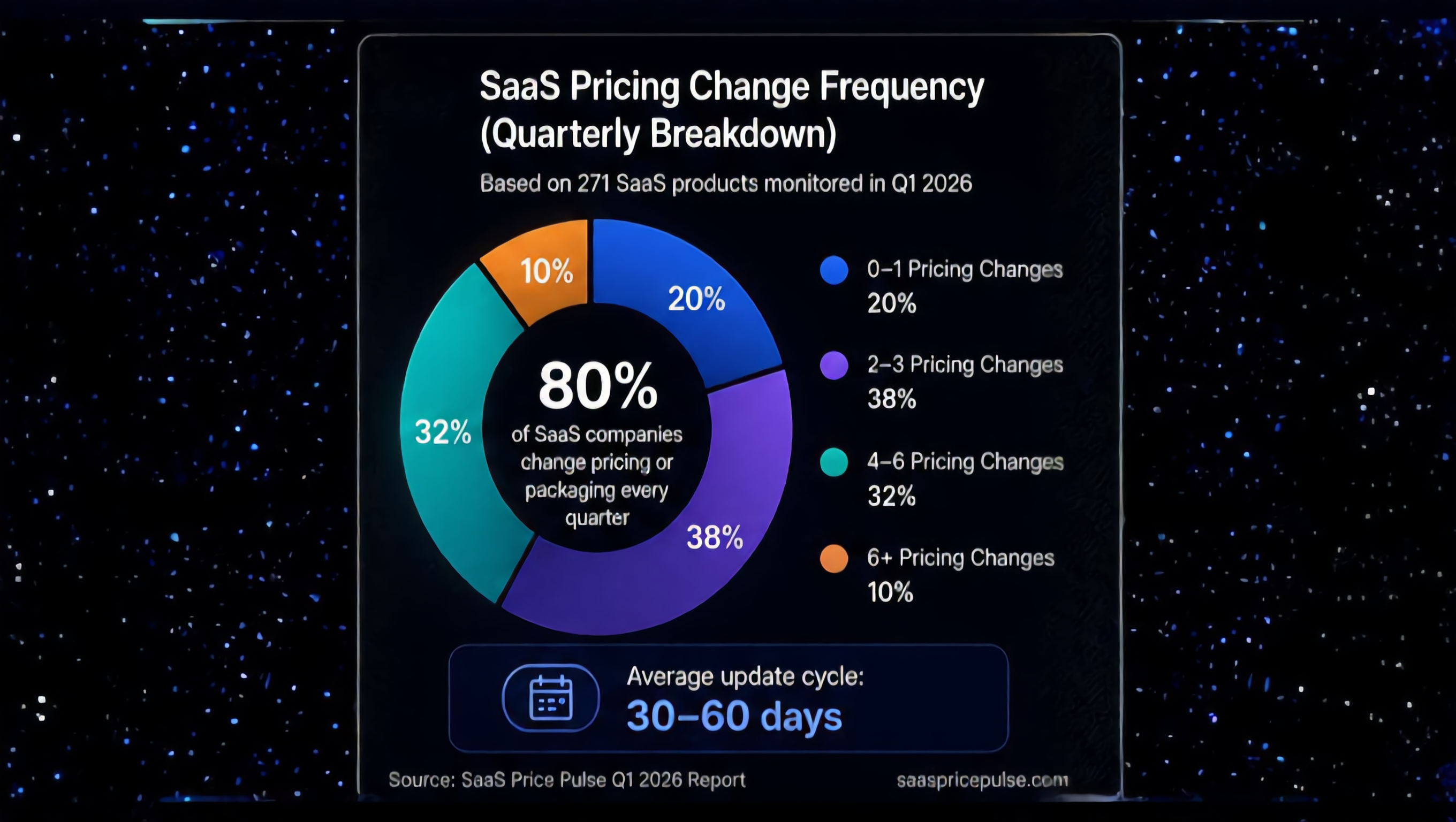
SaaS Price Pulse tracked 271 products in Q1 2026. Here's what they found:
- ✅ 80% changed pricing or packaging within a single quarter
- ✅ Average product: 3–6 pricing changes per year — and that's just the public ones
- ✅ 298+ pricing plans quietly removed or restructured without any announcement
- ✅ 575 pricing-related changes in Q1 alone — more than most teams track in a year
🔥 Translation: Your competitors are changing prices every 30–60 days on average. If your last competitive pricing audit was last quarter, you've already missed 2–3 changes per competitor.
Source: SaaS Price Pulse Q1 2026 Report
The $180,000 Problem Nobody Talks About
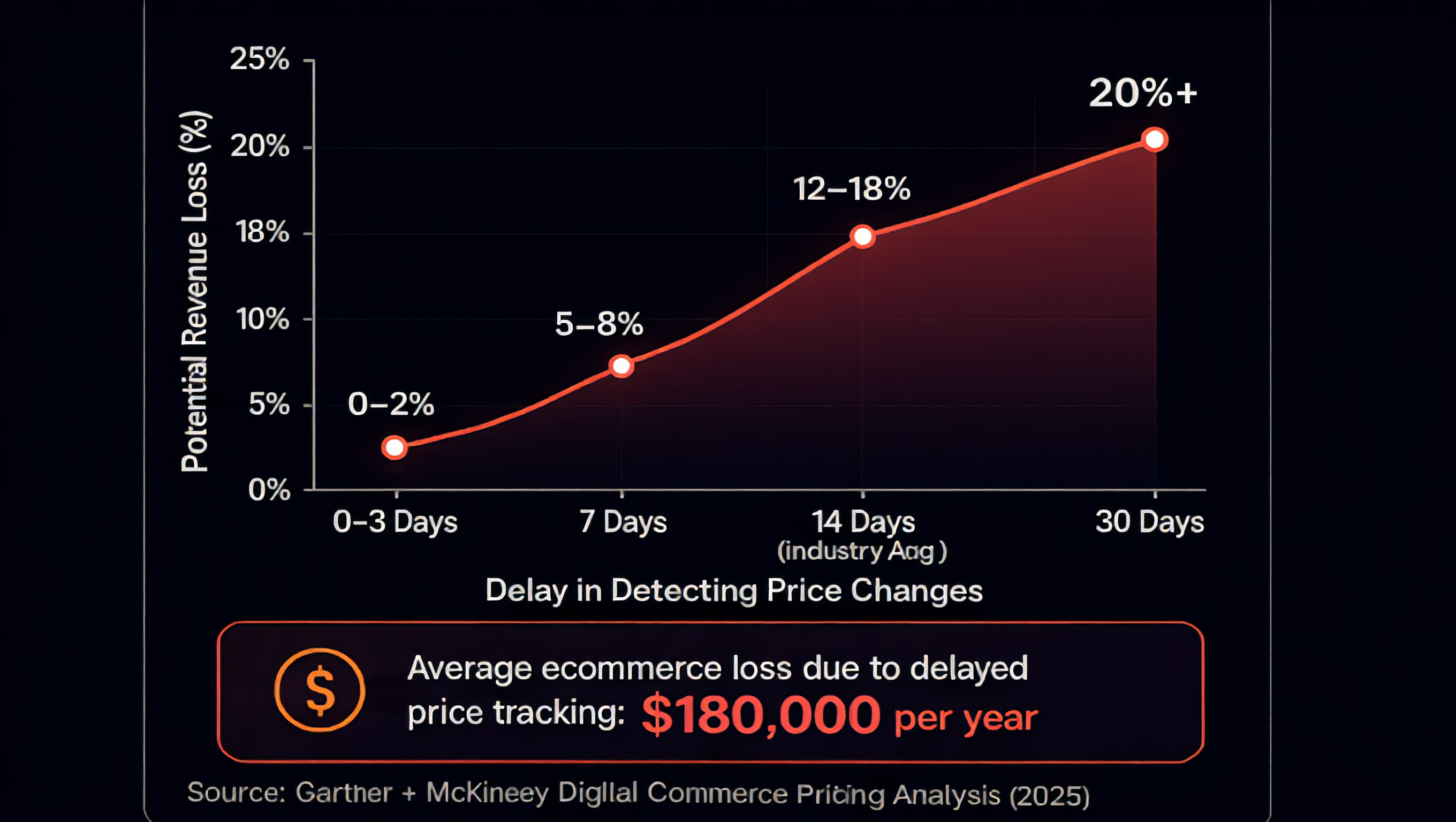
McKinsey and Gartner's joint 2025 pricing research quantified patterns observed across dozens of revenue teams:
- Companies without real-time price monitoring leak an average of $180,000 per year in preventable revenue loss
- Large ecommerce and SaaS brands actively monitor only 12% of their total competitive SKU and plan coverage
- The average pricing refresh cycle across industries: 14 days — which, in a market where competitors change prices every 30–60 days, means you're blind half the time
🚨 Every 14-day delay is a 14-day window for competitors to undercut you, poach your prospects, and capture your renewals.
Source: Gartner Digital Commerce Benchmark + McKinsey Global Pricing Study 2025
The Early Warning Signal Your Competitors Hope You Never Find
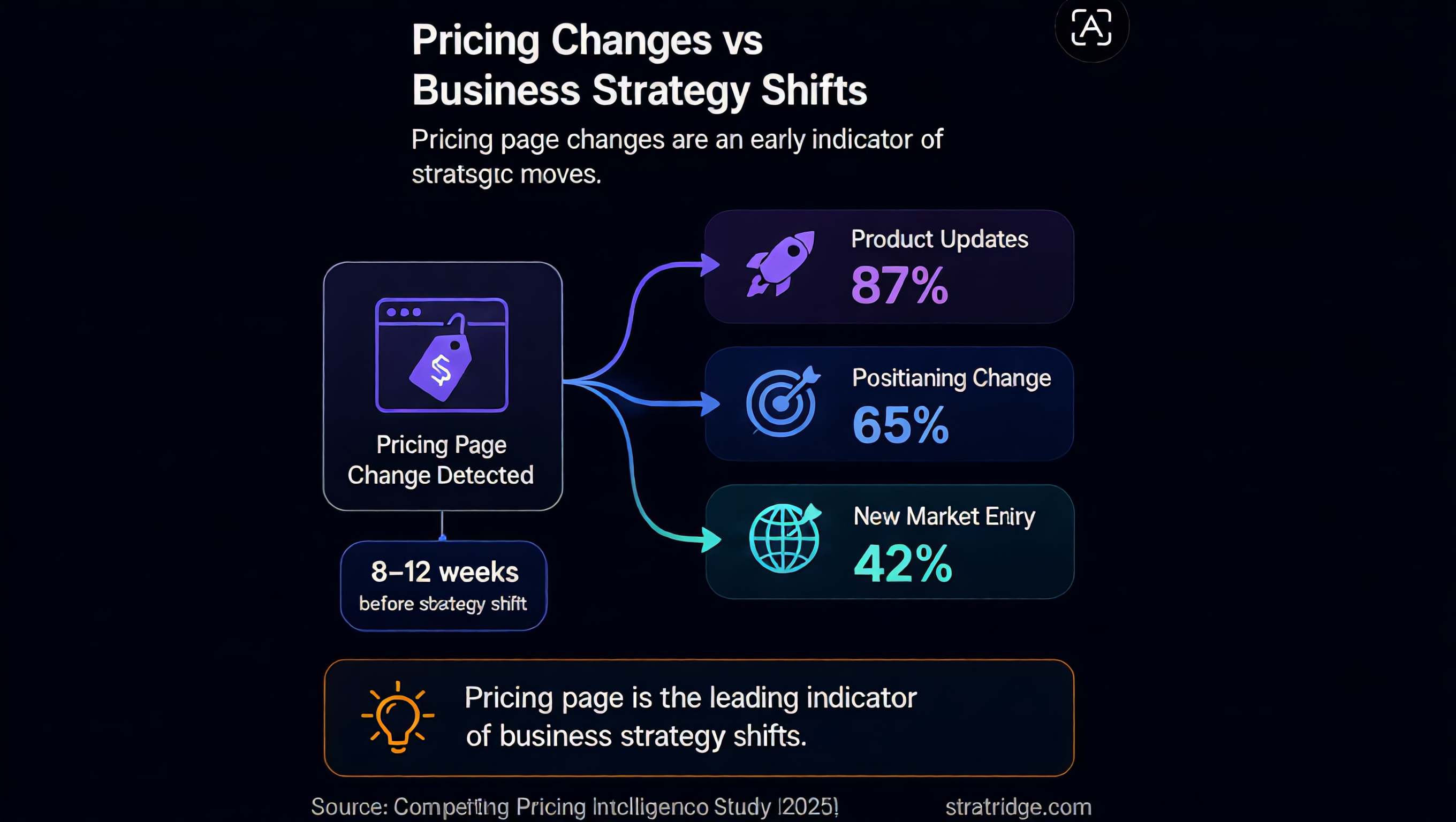
"Pricing pages are the highest-signal competitive intelligence surface in SaaS. A single pricing page change is worth more strategic signal than a dozen press releases."
Competitor Pricing Intelligence Study (2025) findings:
- 87% of B2B SaaS strategic shifts — market repositioning, new product tiers, vertical specialization — happen within 8–12 weeks after a pricing page change
- The pricing page is the earliest leading indicator of competitor strategy. Not earnings calls. Not blog posts. Not LinkedIn announcements. The pricing page.
- If you're not watching pricing pages in real time, you're discovering strategic moves three months after your competitors' sales teams have already been trained on the new playbook
Source: Competitor Pricing Intelligence Study 2025, SaaS Metrics Benchmark Consortium
The Coverage Gap That's Destroying Your Margins
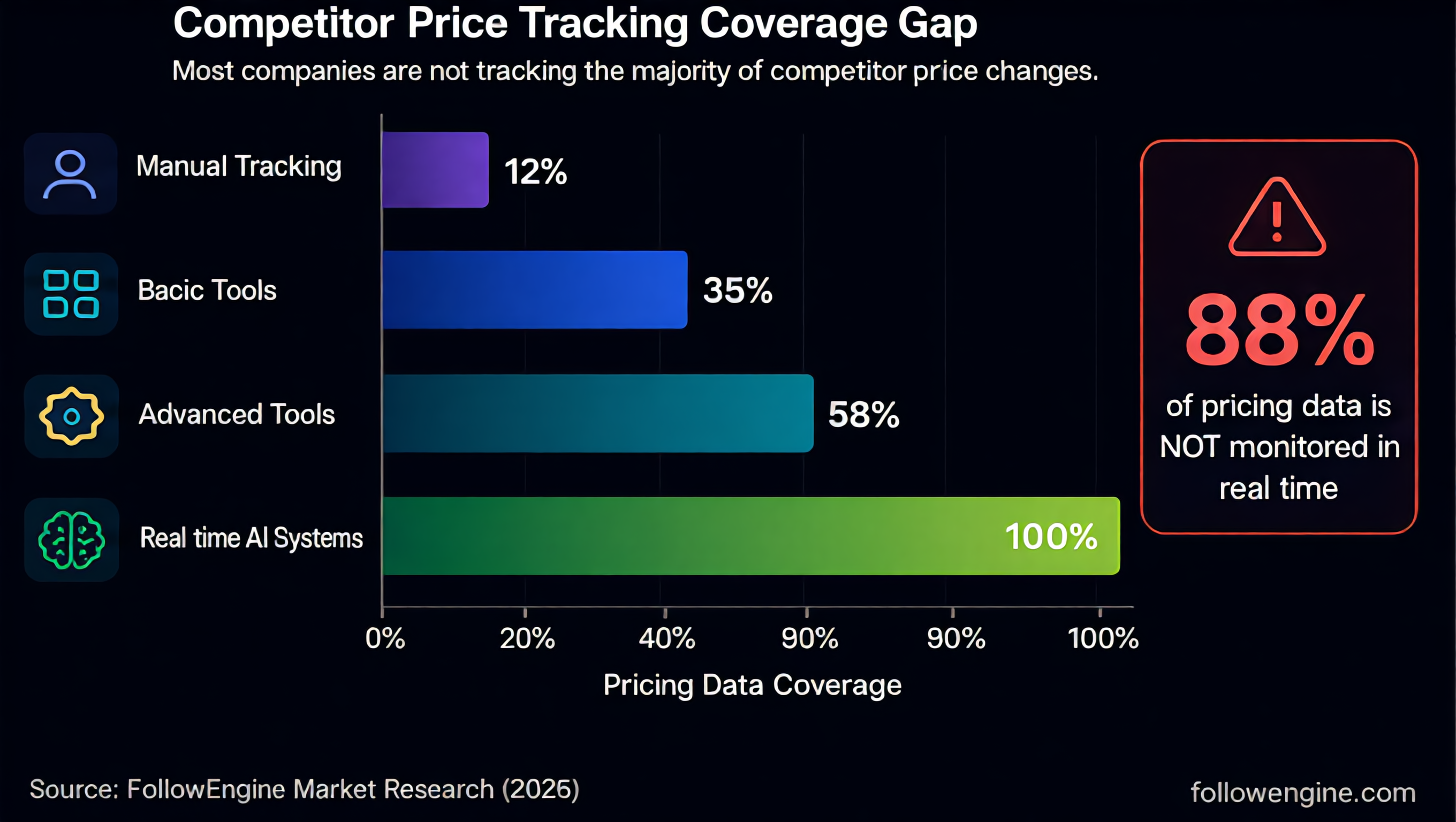
Where do you fall on this chart? Be honest.
- Manual tracking (spreadsheets, calendar reminders) → 12% coverage → You're missing almost everything, including flash promotions and A/B tests
- Basic scraping tools → 35% coverage → You catch surface-level price changes but miss strategy-level patterns
- Advanced monitoring software → 58% coverage → Good, but you're still not seeing the full competitive picture
- FollowEngine AI-Powered Monitoring → 100% coverage → Every page, every tier, every change, instantly
The gap between 58% and 100% isn't incremental. It's the difference between reacting to what competitors did and anticipating what they're about to do.
What Real Competitor Price Monitoring Software Actually Does
Most pricing tools give you data. Raw numbers. Price deltas. Spreadsheet exports. That's table stakes in 2026, and it's not enough.
FollowEngine gives you decisions — the intelligence layer that turns raw competitor pricing data into revenue actions.
A legitimate Competitor Price Monitoring Software platform automatically tracks:
- Competitor product prices — across every pricing page, every tier, every plan, every geography
- Discount and promotion changes — the moment they go live, not when your quarterly report catches up
- Pricing page updates — content changes, feature shuffling, tier restructuring — before your sales team fields the first "competitor X is cheaper now" objection
- Historical pricing trends — patterns your competitors don't even realize they're telegraphing
- Market positioning signals — premium vs. budget, bundling strategies, segmentation plays
Manual competitor checks are obsolete. FollowEngine runs 24/7 so your pricing team can spend their time on strategy — not on refreshing competitor websites.
Stop Tracking Prices. Start Reading Strategy.
Most pricing teams ask one question: "What's their price?"
The highest-performing teams ask a different question: "What's their pricing strategy — and what's the counter-move executed today?"
1. Pricing Strategy Shifts → Your Early Warning Radar
Patterns worth watching for:
- When competitors raise prices → it almost always precedes a feature launch. They're creating perceived value before adding real value. Counter-move: promote your existing feature set before their launch lands.
- When competitors discount aggressively → they're losing deals. Probably to you. Counter-move: hold pricing, emphasize value differentiation.
- When competitors introduce tiered pricing → they're segmenting their market. Counter-move: analyze which segment they're targeting and decide whether to compete or concede.
2. Funnel-Based Pricing Behavior → Where the Real Games Are Played
The most sophisticated competitors don't just set prices. They build pricing funnels:
- Landing page price ≠ checkout price? That's A/B testing on live customers. They're optimizing conversion at your expense.
- Prices personalized by traffic source, geography, or device? They're running advanced segmentation — and you should understand exactly how.
- Enterprise pricing hidden behind "Contact Sales"? They're moving upmarket and hiding the evidence. That's a strategic pivot you need to know about.
3. Market Positioning Signals → The Moves Before the Moves
Before a competitor announces a "strategic repositioning" — which they'll do in a press release 6 months after it starts — the pricing page tells you everything:
- Moving upmarket or downmarket? Bundling changes reveal it before the G2 category update.
- Product bundling shifts? That's not a product decision — it's a pricing strategy pivot. They're changing how they capture value.
- Feature shuffling between tiers? They're testing willingness-to-pay. This is the most honest market research you'll ever get from a competitor.
💡 The insight isn't the price point. It's the strategy. And FollowEngine decodes the difference automatically.
How FollowEngine Turns Competitor Chaos Into Your Competitive Advantage
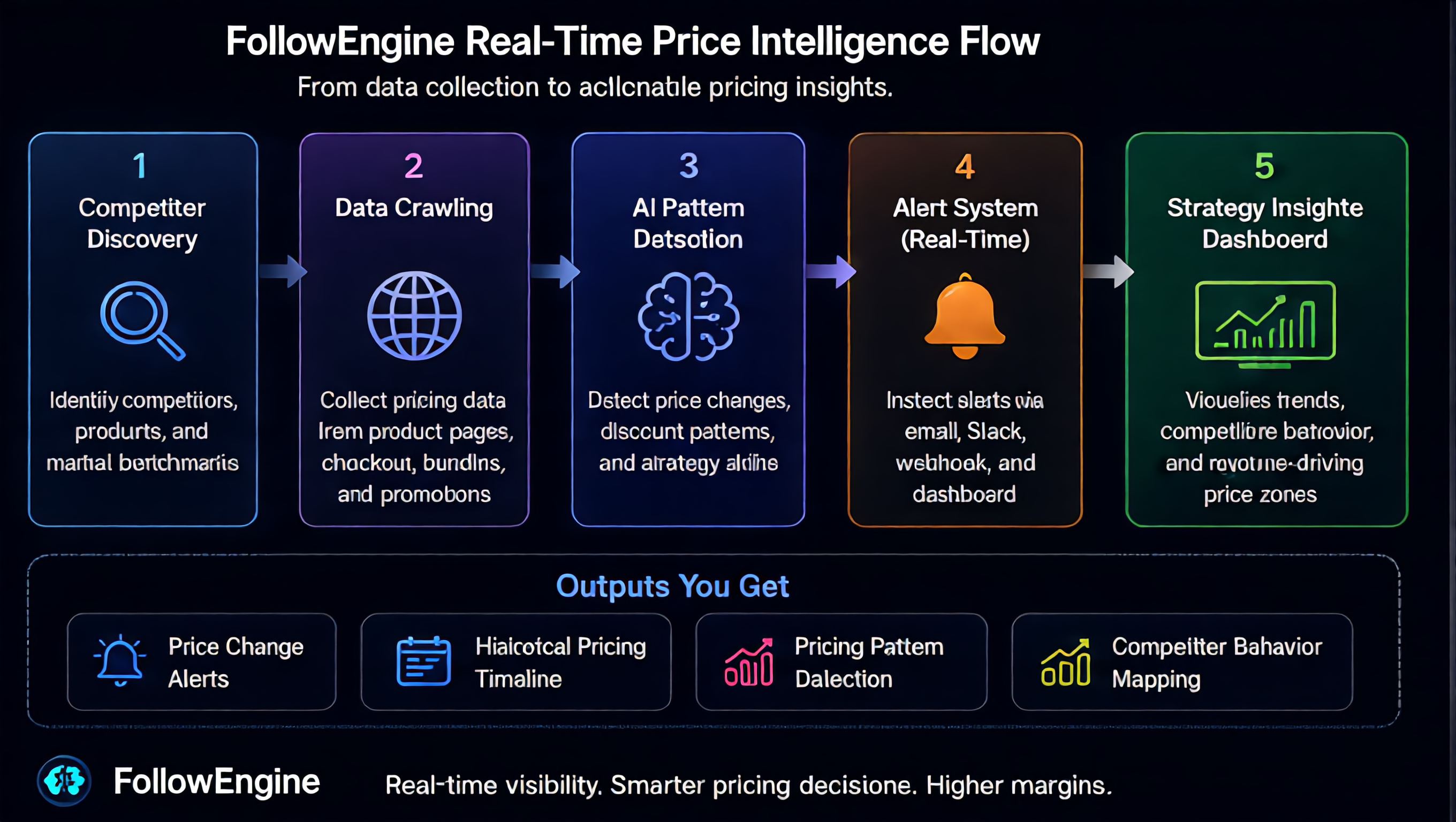
Here's the difference between commodity price tracking and real competitive intelligence:
Traditional tools: "Price changed from $49 to $59 on Plan B."
FollowEngine: "Competitor A removed their annual bundle discount, effectively raising entry-level prices 12% while restructuring features toward enterprise tiers. This signals an upmarket repositioning. Recommended action: promote your mid-tier bundle within 48 hours to capture price-sensitive prospects they're now abandoning."
That's the gap between data and decision. Between knowing something changed and knowing what to do about it.
Step 1: Build Your Competitor Intelligence Map in Minutes
Input competitor domains, product categories, and market benchmarks.
FollowEngine automatically discovers and maps their entire pricing ecosystem — official websites, landing pages, promotional URLs, campaign microsites, and partner pages. Zero manual configuration. Zero missed pages.
Step 2: Real-Time Multi-Source Price Tracking — Never Miss a Move
FollowEngine continuously monitors:
- Base price changes across all tiers and plans
- Discount logic, coupon behavior, and promotional mechanics
- Bundle and upsell pricing structures
- Landing page vs. checkout page pricing discrepancies
- Seasonal and campaign-based pricing patterns
You don't get periodic snapshots. You get a live pricing stream — every change, the moment it happens.
Step 3: AI Detects Pricing Behavior Patterns No Human Would Catch
This is where the real advantage lives. The AI engine surfaces patterns that would take a pricing analyst weeks to piece together:
- Discount frequency cycles → "They discount every 6 weeks like clockwork. Next one drops in 4 days — get your counter-offer ready."
- Price anchoring strategies → "They raised the enterprise tier price by 40% — not to sell more enterprise, but to make the pro tier look like a bargain."
- Market repositioning signals → "Feature bundling changed across all three tiers. This isn't a product update — it's a premium-market pivot."
- A/B pricing behavior → "Different prices detected by traffic source. They're segmenting hard — here's the segmentation logic."
Step 4: Actionable Intelligence — Not More Dashboards
You don't need another chart. You need to know what to do, and when to do it.
"Competitor A increased effective price 12% after removing bundle discount — promote your bundle within 48 hours to capture displaced prospects."
"Competitor B shifting premium with enterprise-only features — your mid-market positioning just got a tailwind. Double down."
"Market-wide discount cycle beginning in 3–5 days based on historical patterns across 7 competitors. Prepare your offers now — don't get caught flat-footed."
Why 10,000+ Revenue Teams Run on FollowEngine
| Most Pricing Tools | FollowEngine |
|---|---|
| Track individual pages | Map entire pricing ecosystems across domains |
| Report static price deltas | Decode pricing strategy and recommend counter-moves |
| Require manual analysis and interpretation | AI-powered actionable intelligence with specific recommendations |
| Batch updates (daily, weekly, or worse) | Real-time monitoring, 24/7, with instant alerts |
The difference isn't feature count. It's philosophy. Most tools tell you what changed. FollowEngine tells you what to do about it.
The Bottom Line
Pricing review meetings have uncovered competitor price changes from three months earlier — far too late. Other teams have detected a competitor's pricing pivot within 4 hours and launched a counter-campaign within 48. The revenue difference between these two scenarios isn't marginal. It's transformational.
Competitor price monitoring isn't a "nice-to-have" on your 2026 roadmap. It's the difference between leading your market and perpetually reacting to it.
Every day without real-time pricing intelligence is a day your competitors are:
- Winning deals you never knew were competitive
- Capturing renewals with pricing you haven't seen yet
- Testing strategies you won't discover until next quarter's strategy offsite
Stop guessing what competitors charge. Start knowing what they're doing — and what to do about it.
Next step
Find your real competitors.
Run a free competitor lookup and decide what to monitor next.