How to Identify Direct and Indirect Competitors: A Complete 2026 Framework
TL;DR
- Most teams only track direct competitors — that leaves half the competitive picture invisible
- A structured six-step framework identifies both direct and indirect competitors across the full ecosystem
- 60%+ of purchase decisions are influenced by alternatives outside a product's direct category (McKinsey 2025)
- Turn competitor identification from a one-time list into a repeatable intelligence practice
Quick Answer
Competitor identification isn't a list-making exercise — it's a structured discipline. This guide provides a six-step framework, used by SaaS and growth teams, to find both direct and indirect competitors, map the full competitive ecosystem, and build a repeatable identification process.
Why Competitor Identification Has Changed
Three shifts have made traditional competitor identification insufficient:
- McKinsey's 2025 consumer behavior research found that over 60% of purchase decisions are influenced by alternatives outside a product's direct category — meaning indirect competitors shape outcomes as much as direct ones.
- Ahrefs 2025 content research showed that 68% of high-ranking pages align with competitive demand signals beyond keywords: market positioning, content depth, and advertising activity.
- Semrush's 2025 State of Search report documented that over 50% of growth teams now combine keyword research with real-time competitor tracking — a shift from periodic analysis to continuous intelligence.
The implication is clear: competitor identification must account for who competes on product features, who competes on search visibility, and who competes by offering a different path to the same outcome.
Defining Direct and Indirect Competitors
Direct Competitors
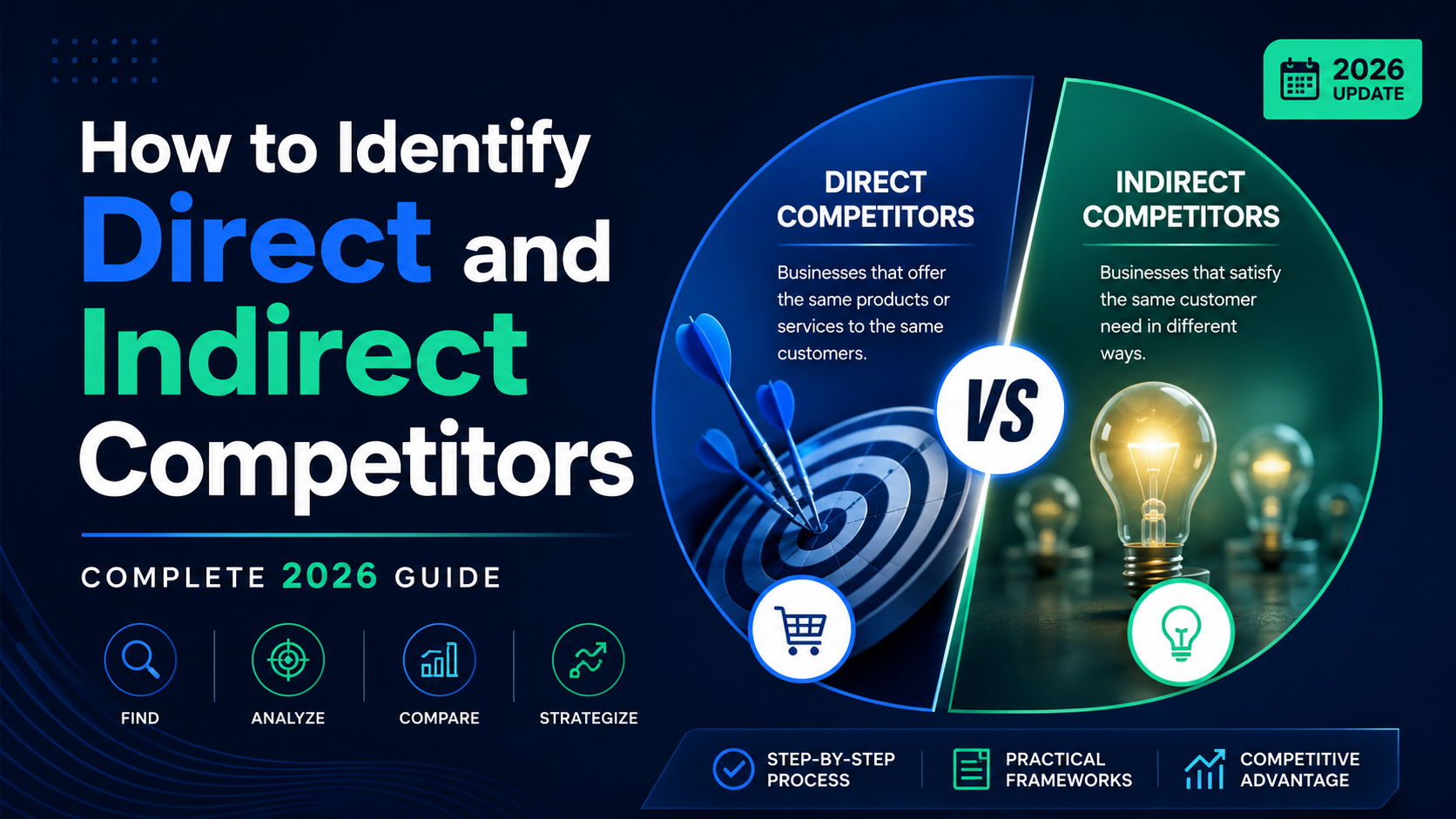
Direct competitors offer a similar product or service to the same target audience. They compete on features, pricing, and positioning. Users compare them side by side during the buying process.
Examples from established markets:
- Netflix vs. Disney+ (streaming subscriptions)
- Shopify vs. BigCommerce (ecommerce platforms)
- Ahrefs vs. Semrush (SEO tooling)
- Uber vs. Lyft (ride-hailing)
Direct competitors matter most for pricing analysis, feature benchmarking, SEO keyword competition, and market positioning strategy.
Indirect Competitors
Indirect competitors solve the same customer problem through a different product, category, or approach. They do not appear on a feature comparison checklist, but they compete for attention, time, and budget.
Examples:
- Netflix vs. YouTube (entertainment consumption via different models)
- Uber vs. public transportation (mobility solved differently)
- Zoom vs. email (asynchronous vs. synchronous communication)
- Starbucks vs. energy drinks (caffeine delivery, different format)
Forrester's 2025 Competitive Strategy Benchmark found that indirect competitors account for approximately 40% of lost deals in SaaS — not because the product is worse, but because the buyer chose a different category altogether. Ignoring indirect competitors means missing the reason many users never enter the evaluation funnel.
The Four Competitive Layers
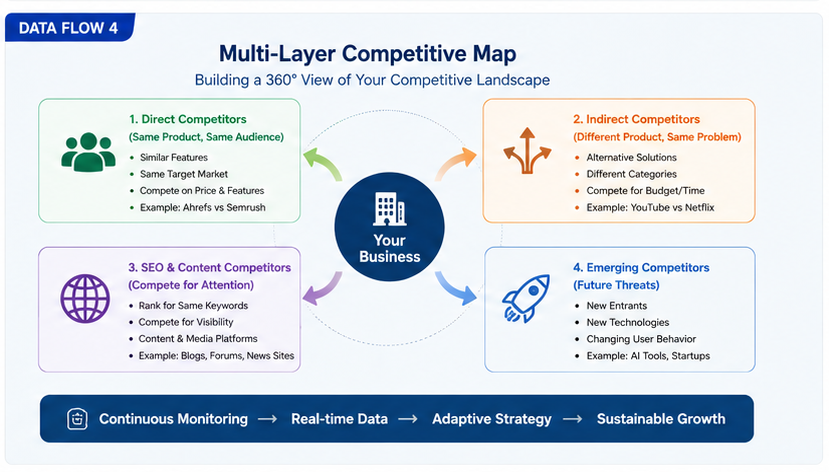
A complete competitive map includes four layers, not two:
| Layer | Definition | Examples |
|---|---|---|
| Direct | Same product, same audience | Shopify vs. BigCommerce |
| Indirect | Different product, same problem | Shopify vs. WordPress + WooCommerce |
| Substitute | Completely different category replacing the need | Ecommerce platform vs. social commerce (Instagram Shops) |
| Emerging | New entrants or technologies disrupting the category | AI-native commerce tools entering the market |
Each layer requires different monitoring signals and strategic responses. A competitive intelligence system that only tracks direct competitors leaves three layers of competitive risk unmonitored.
The Six-Step Identification Framework
This framework is used by growth teams, product marketers, and competitive intelligence analysts to build dynamic competitive maps that reflect real market behavior rather than internal assumptions.
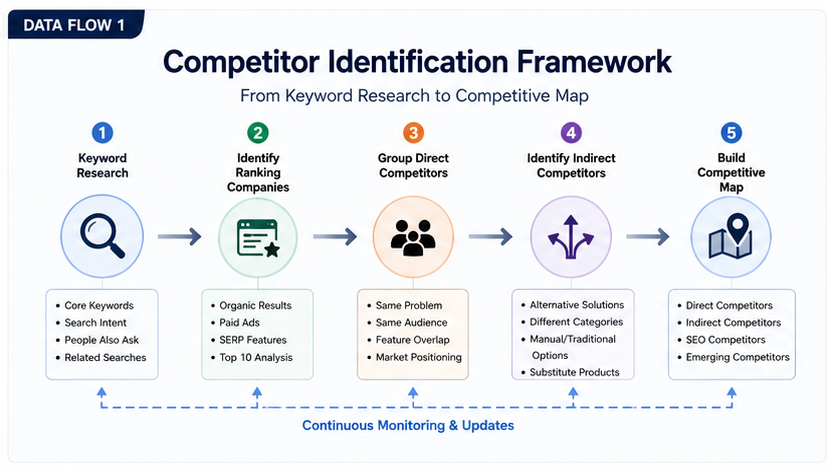
Step 1: Search the Keywords Your Customers Use
Begin with real user intent. Search the exact queries customers type:
- "competitor analysis tools"
- "SEO tracking software"
- "AI marketing platforms"
Analyze the full search results page: the top 10 organic listings, Google Ads placements, "People also ask" questions, and related searches. Each element reveals a different competitive signal — organic results show content competitors, paid ads reveal commercial competitors, and related searches expose how users frame the problem.
Step 2: Identify the Companies That Appear Consistently
Extract every company that appears across multiple keyword variations and across both organic and paid results. These companies are not coincidental — consistent presence indicates validated market demand, active SEO investment, and established positioning. This becomes the working competitive pool.
Step 3: Classify Direct Competitors
A company qualifies as a direct competitor when it satisfies two conditions: it solves the same core problem, and it targets the same customer segment.
Evaluate each company in the pool against four criteria: feature overlap with the product, pricing model comparison, keyword competition intensity, and market positioning. Companies that score high across all four are direct competitors.
Step 4: Identify Indirect Competitors
Shift the question from "who sells a similar product?" to "what would users do if this product didn't exist?"
The answer often includes: manual workflows (spreadsheets, in-house tools), content platforms (YouTube tutorials, blog guides replacing software), adjacent software categories, and non-digital solutions (agencies, consultants). These alternatives define the default behavior a product must displace.
According to McKinsey 2025, indirect alternatives influence more than 60% of purchase decisions during the consideration phase — before a user ever compares features.
Step 5: Map the User Decision Path
Users follow a structured decision sequence:
- Problem awareness — Recognizing a need exists
- Solution search — Exploring possible approaches
- Direct comparison — Evaluating similar products
- Alternative consideration — Weighing different categories
- Final decision
Direct competitors dominate stage 3. Indirect competitors dominate stage 4. Many products lose users at stage 4 — not to a better competitor, but to a different solution entirely. Mapping this path reveals where competitive pressure actually applies.
Step 6: Build and Maintain the Competitive Map
A competitive map answers three ongoing questions: who competes for users today, what alternatives are users considering, and how is the market evolving?
The map should be updated quarterly at minimum, with real-time signals feeding weekly adjustments. Static competitor lists decay within months in fast-moving categories like SaaS and AI.
For the bigger picture, see our [competitive landscape analysis guide](/blog/competitive-landscape-analysis-the-complete-2026-guide).
How SaaS and Growth Teams Apply This Framework
The framework is widely adopted because it replaces subjective judgment with evidence-based classification. Three outcomes that teams consistently report:
- Discovery of hidden competitors — Indirect and substitute competitors that traditional "top 5 competitor" lists miss entirely
- Early detection of market shifts — Emerging competitors identified before they appear on analyst radars
- Better resource allocation — Competitive intelligence investment directed at the layers that actually threaten revenue
Gartner's 2025 Digital Marketing Survey found that organizations using structured competitor identification frameworks react to market changes 30–50% faster than those relying on ad-hoc competitor lists.
For a hands-free approach, learn how FollowEngine [automatically finds your competitors](/blog/how-followengine-automatically-finds-your-competitors-for-free).
Frequently Asked Questions
What is a direct competitor?
A direct competitor is a company that offers a substantially similar product or service to the same target audience. It competes on features, pricing, and positioning, and appears in side-by-side buyer comparisons.
What is an indirect competitor?
An indirect competitor solves the same customer problem through a different product category, approach, or business model. It does not appear in feature comparisons but influences purchase decisions by offering an alternative path to the same outcome.
What is the difference between direct and indirect competitors?
Direct competitors sell similar products to the same audience. Indirect competitors offer different solutions to the same problem. The distinction matters because each type requires different strategic responses: feature and pricing responses for direct competitors, positioning and category education for indirect competitors.
What are the four types of competitors in business?
Direct competitors (same product, same audience), indirect competitors (different product, same problem), substitute competitors (different category entirely), and emerging competitors (new entrants or technologies). A complete competitive strategy monitors all four.
How do teams identify competitors for SEO?
SEO competitor identification combines keyword research with competitive analysis. Search core keywords, extract domains that appear consistently across organic and paid results, then classify by product similarity and audience overlap. SEO competitors are often different from product competitors — a SaaS company may compete with a media publication for the same keywords.
Why do indirect competitors matter for SaaS companies?
Because Forrester data indicates indirect competitors account for roughly 40% of lost SaaS deals. Users often abandon a software category entirely before choosing a different vendor — they choose a spreadsheet, an agency, or a manual process instead. Understanding these alternatives is essential for positioning and conversion strategy.
Once identified, track competitors in a [CI dashboard](/blog/how-to-build-a-competitive-intelligence-dashboard-metrics-kpis-and-real-time-tracking-2026-guide) for ongoing visibility.
Conclusion
Competitor identification is not a one-time audit. It is a continuous intelligence practice.
Direct competitors define the feature and pricing battlefield. Indirect competitors define whether users enter that battlefield at all. Substitute and emerging competitors define how the battlefield shifts over time.
The six-step framework — search real queries, identify consistent players, classify direct competitors, surface indirect alternatives, map the decision path, and maintain the competitive map — turns competitor identification from an ad-hoc list into a structured system.
In markets where the average SaaS category gains 3–5 new entrants per quarter (Gartner 2025), a static competitor list is obsolete within 90 days. The competitive advantage belongs to teams that identify new competitors before they appear in search results.
About the Author
Dylan Dan Founder & CEO, FollowEngine
Dylan Dan is the founder of FollowEngine, bringing over 10 years of experience in competitive intelligence and competitor analysis. He has helped hundreds of businesses build structured CI programs that turn market signals into revenue decisions.
Related Articles
- [Win Loss Analysis: The Real Reason You're Losing Deals (And How to Fix It)](/blog/win-loss-analysis-the-real-reason-youre-losing-deals-and-how-to-fix-it)
- [](/blog/tid0nudx1lpkqx9gjdas)
- [The Free SaaS Competitor Analysis Template That Ships — 10 Fields, 3 Tabs, One Weekly Habit](/blog/the-free-saas-competitor-analysis-template-that-ships-10-fields-3-tabs-one-weekly-habit)
Next step
Find your real competitors.
Run a free competitor lookup and decide what to monitor next.