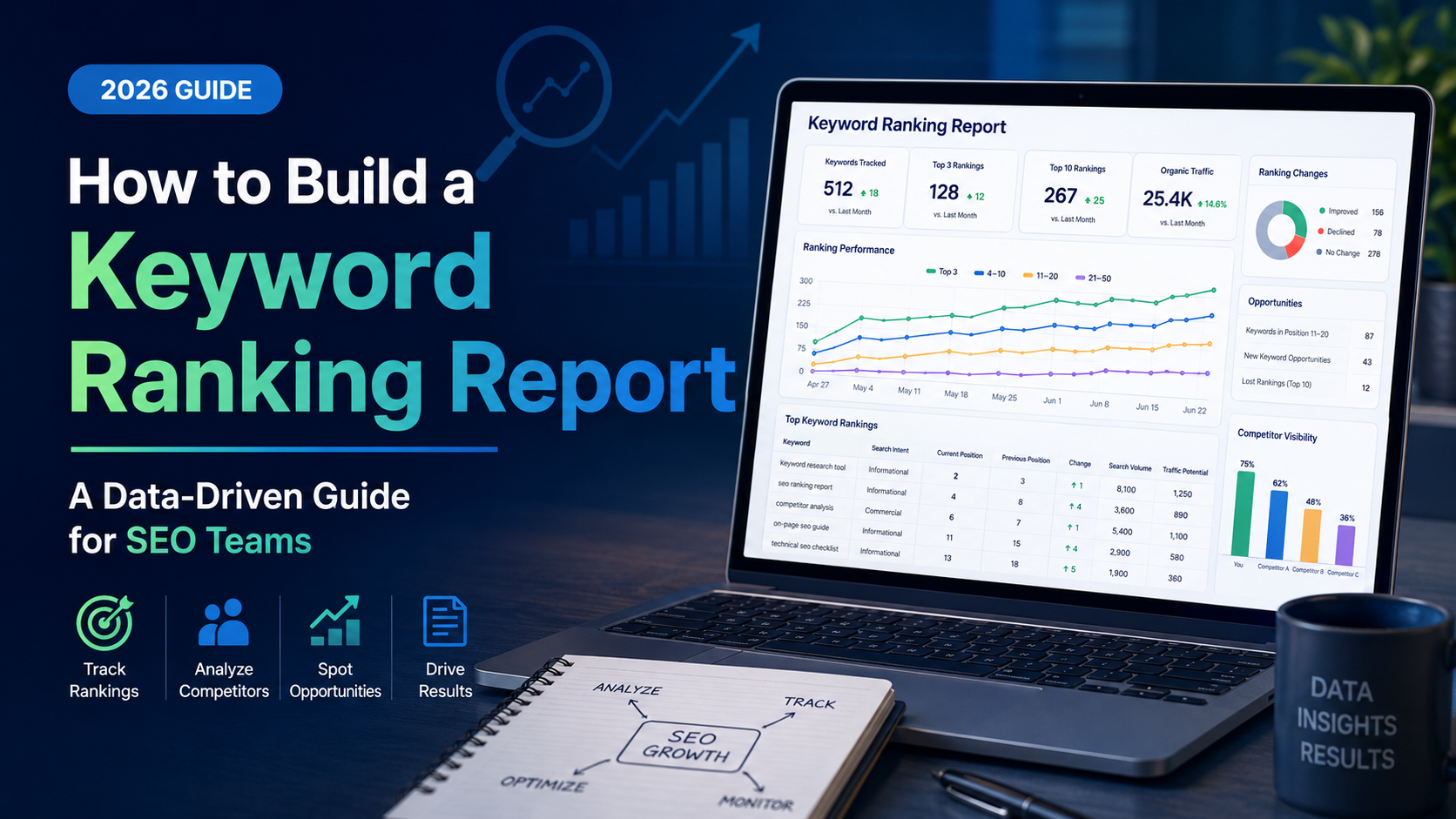
How to Build a Keyword Ranking Report: A Data-Driven Guide for SEO Teams (2026)
Quick Answer
A keyword ranking report tracks how a website and its competitors perform in search results over time. According to BrightEdge, 68% of all online experiences begin with a search engine, and research from Backlinko confirms the first organic result captures significantly more clicks than any lower position. A properly structured report moves beyond listing positions — it surfaces why rankings shift, flags untapped opportunities, and prioritizes SEO work by traffic potential and revenue impact. The free keyword ranking tools available today make building these reports faster than the spreadsheet era.
TL;DR
- Track rankings weekly or monthly — daily fluctuations create noise, not insight
- Include competitor keyword rankings alongside your own data
- Prioritize keywords by business value, not search volume alone
- Combine Google Search Console data with third-party SEO tools
- Pair ranking reports with competitor website monitoring to answer why changes happen
Why Keyword Ranking Reports Matter
Keyword rankings remain one of the clearest leading indicators of SEO performance. Unlike traffic metrics — which lag behind ranking changes by days or weeks — position shifts signal what is happening right now.
BrightEdge reports that 68% of all online experiences begin with a search engine, and organic search drives 53.3% of all website traffic. This makes search visibility the single largest customer acquisition channel for most businesses.
Backlinko's analysis of 4 million Google search results found the first organic position earns roughly 10× more clicks than position 10. Every position gained on page one represents measurable traffic growth.
Without a structured ranking report, teams operate blind to questions that matter:
- Which keywords are climbing toward page one?
- Which pages are quietly losing visibility?
- Which competitors are overtaking key positions?
- Where should the next content investment go?

What Should a Keyword Ranking Report Include?
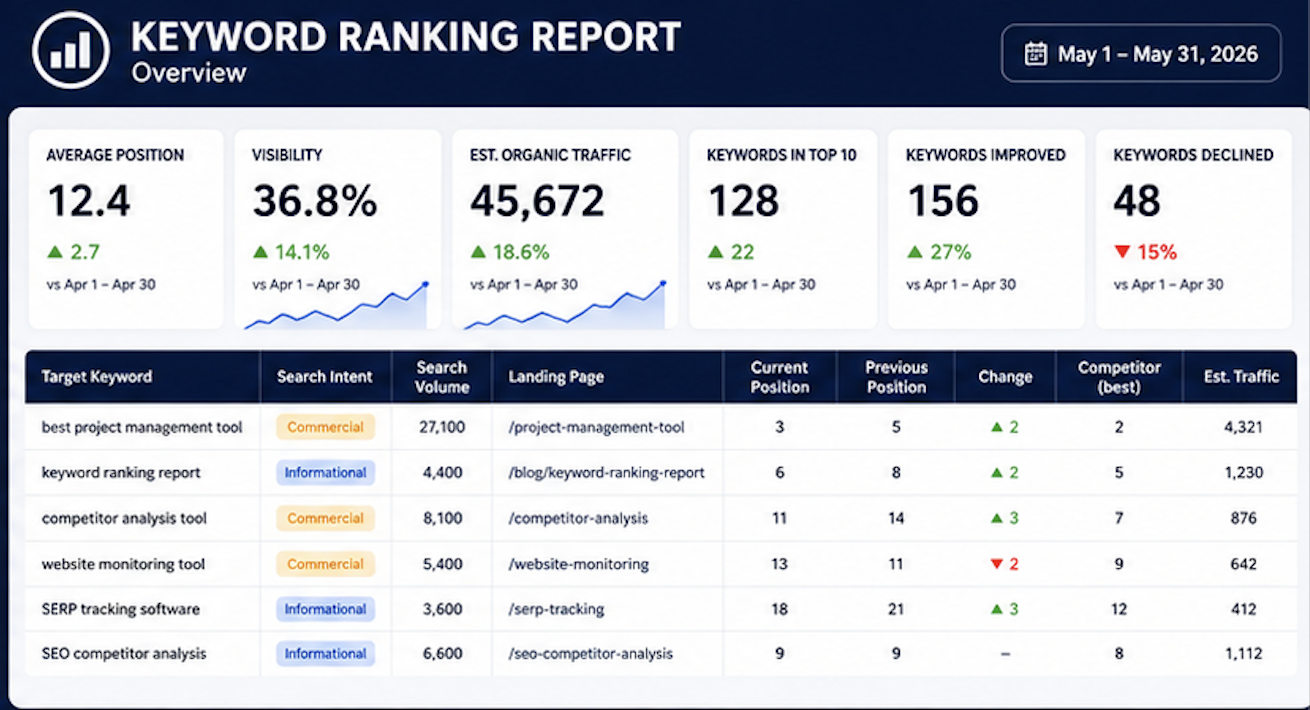
A ranking report earns its place in a weekly meeting when it explains movement — not just reports it. The most useful reports include:
- Target Keyword — the exact search term being tracked
- Current Position — latest ranking (desktop and mobile separately, where relevant)
- Previous Position — enables week-over-week or month-over-month comparison
- Change — direction and magnitude of the shift
- Search Volume — monthly search demand (country-specific)
- Search Intent — informational, commercial, transactional, or navigational
- Landing Page URL — the specific page ranking for that query
- Competitor Position — benchmarks performance against the competitive set
- Estimated Traffic — connects ranking data to actual business outcomes
Semrush's 2025 Ranking Factors study found that pages ranking in the top 3 positions tend to satisfy multiple search intents simultaneously. A report that includes intent data helps teams understand why certain pages outperform others — not just that they do.
Step 1: Choose Keywords That Matter
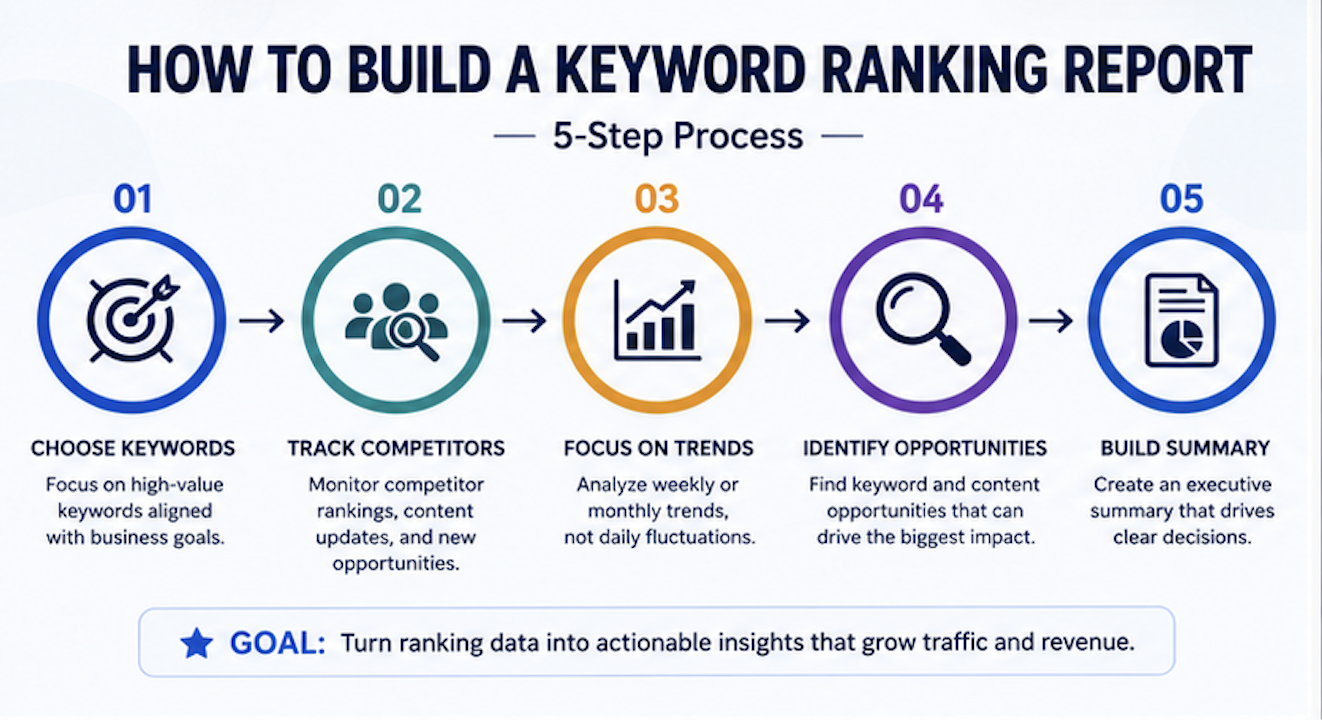
One of the most common SEO mistakes is tracking too many keywords — and too few of the right ones.
Ahrefs research shows that 90.63% of all pages get zero organic traffic from Google. Among the pages that do receive traffic, a small handful of keywords typically drive the majority of visits. Tracking hundreds of irrelevant terms dilutes focus.
Prioritize keywords that align with business outcomes:
- High-converting commercial and transactional queries
- Core product and category terms
- Branded keywords (your own and competitor brands)
- Long-tail queries with clear purchase intent
- Keywords where the site already ranks on page two (positions 11–20)
- Terms with growing search demand based on Google Trends data
A Gartner 2025 Sales Practice Survey found that organizations using intent data to prioritize accounts saw 43% higher pipeline conversion rates. The same principle applies to keyword selection — fewer, better-chosen keywords outperform sprawling lists.
Step 2: Track Competitor Rankings
A ranking report focused solely on one domain tells a dangerously incomplete story.
According to McKinsey's 2025 Revenue Operations benchmark, companies that systematically monitor competitive movements respond to market shifts 2.3× faster than those relying on periodic manual checks.
Competitor ranking data reveals:
- Which keywords competitors newly target
- Pages that recently entered the top 10
- Featured Snippet ownership changes
- AI Overview visibility shifts
- Content refreshes that triggered ranking jumps
When a competitor gains five positions on a high-value keyword overnight, the right response isn't panic — it's investigation. Did they publish a new page? Update existing content? Earn new backlinks? The competitor monitoring platform provides the context ranking data alone cannot.
For a deeper analysis of competitor SEO patterns, see [how to use ChatGPT for competitive SEO analysis](/blog/how-to-actually-use-chatgpt-for-competitive-seo-analysis-2026).
Step 3: Focus on Ranking Trends, Not Daily Noise
Google's algorithm makes thousands of updates annually. Daily position fluctuations are normal — reacting to every wiggle wastes time.
The Semrush 2025 Ranking Factors study documented that only sustained position changes over 2–4 weeks reliably predict traffic impact. Short-term volatility — especially around algorithm updates — often reverses within days.
What to watch in trend analysis:
- Keywords steadily climbing from page two to page one
- Positions that dropped from the top 3 and haven't recovered
- Consistent upward movement across a keyword cluster
- Seasonal ranking patterns (e.g., e-commerce holiday spikes)
- Pages experiencing gradual visibility erosion over multiple weeks
A monthly trend report surfaces patterns invisible in daily snapshots.
Step 4: Identify Optimization Opportunities
The most valuable output of a ranking report isn't the data — it's the action items.
Research from Forrester's 2024 Revenue Operations study found that B2B teams using structured opportunity identification frameworks closed 28% more pipeline than those operating from ad-hoc data reviews.
Scan every ranking report for:
- Keywords sitting at positions 11–20 — often one content refresh away from page one
- Pages with declining traffic despite stable rankings (intent shift signal)
- High-volume keywords where rankings lag below position 20
- Competitor keywords the site doesn't target at all
- Pages missing internal links from higher-authority pages
- Content last updated more than 12 months ago
These opportunities consistently deliver the fastest SEO wins because the foundation already exists — the gap is optimization, not creation.
Related: Download [the free SEO competitor analysis template](/blog/the-free-seo-competitor-analysis-template-for-2026) to structure your competitive keyword research.
Step 5: Build an Executive Summary
Decision-makers rarely review raw keyword tables. A concise summary upfront makes ranking data accessible and actionable.
Example executive summary structure:
- Organic visibility increased 14% month-over-month
- Eight keywords entered the top 10 for the first time
- Three competitors published new content around high-value topics
- Two landing pages lost rankings following a March 2026 core update
- Five page-two keywords are within striking distance of page one
The Salesforce State of Sales report noted that 72% of sales leaders expect data-driven recommendations, not just raw reports. An executive summary transforms a data dump into a decision-making tool.
Best Tools for Keyword Ranking Reports
| Tool | Primary Strength |
|---|---|
| Google Search Console | Free, first-party ranking and click data |
| Google Analytics 4 | Organic traffic measurement and conversion attribution |
| FollowEngine | Competitor monitoring and website intelligence |
| Semrush | Enterprise rank tracking and competitive keyword discovery |
| Ahrefs | Keyword research, backlink analysis, and ranking history |
Each tool fills a different gap. First-party ranking data from Google Search Console tells a team what happened on its own site. Third-party tools reveal what happened across the competitive landscape. Together, they provide a complete picture.
BrightEdge research shows that combining first-party performance data with competitive intelligence produces 35% more accurate SEO forecasts than relying on either source alone.
How FollowEngine Strengthens Ranking Reports
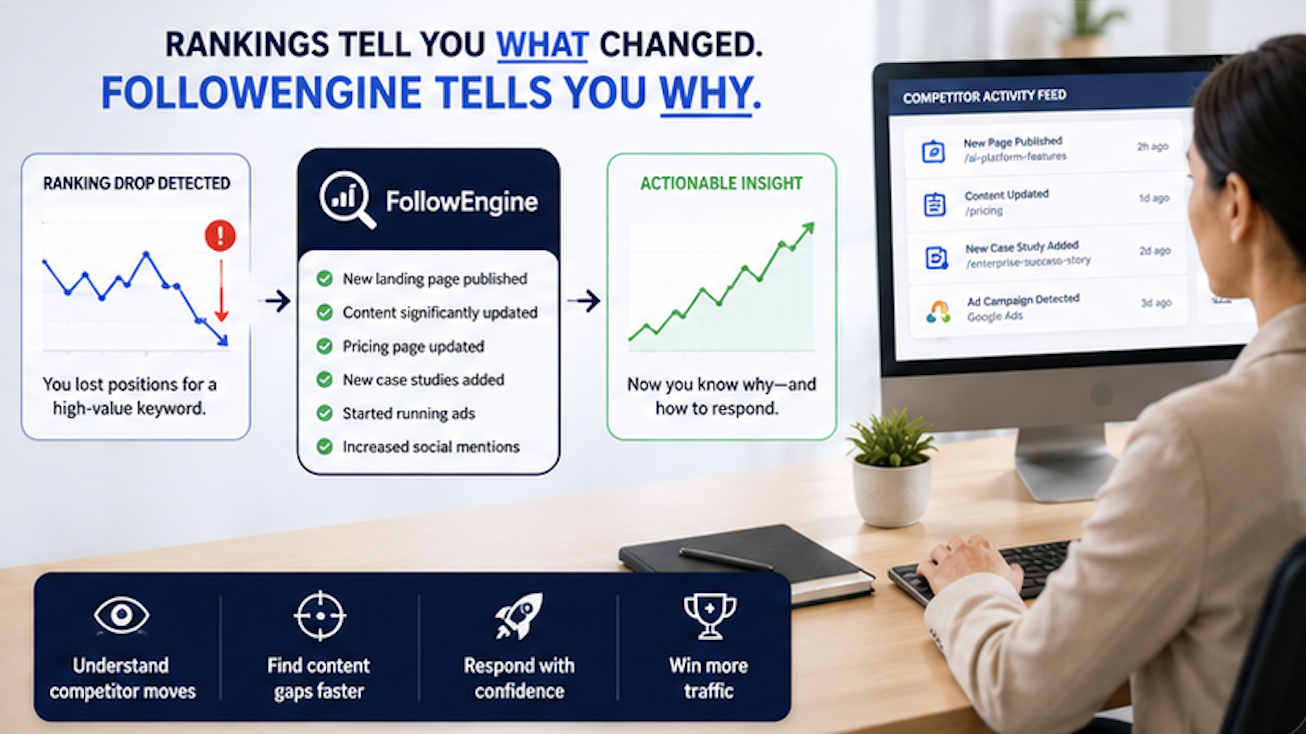
Traditional ranking reports answer what changed. FollowEngine fills in why it changed.
When a competitor suddenly outranks a page, FollowEngine surfaces the likely cause:
- A new landing page targeting the same keyword
- Updated pricing or product positioning
- Fresh feature releases that attracted coverage
- Increased promotional activity around the page
- Content rewrites that better matched search intent
- Backlink acquisitions from high-authority domains
Combining ranking data with website change monitoring transforms competitive analysis from reactive to proactive. Teams understand competitor movements as they happen — not weeks later when the ranking damage is already visible.
Common Mistakes to Avoid
Even experienced SEO teams fall into these reporting traps:
- Tracking too many low-value keywords — volume without intent produces noise. Ahrefs data shows the top 10 keywords for most sites drive 50–80% of organic traffic. Track those obsessively; monitor the rest lightly.
- Reporting rankings without competitor context — a position 5 ranking looks fine until the data shows three competitors jumped ahead that month. Competitor benchmarks are essential, not optional.
- Measuring rankings instead of business outcomes — a number 1 ranking for a keyword that generates zero leads is a vanity metric. The McKinsey 2025 Revenue Operations report emphasizes connecting every marketing metric to pipeline and revenue impact.
- Ignoring search intent — a page optimized for informational intent will not hold a transactional ranking long-term, regardless of authority.
- Checking only position, never visibility trends — a site can hold position 3 while overall organic visibility declines because the keyword's search volume dropped. Visibility-weighted reporting catches what position-only reporting misses.
For paid search teams, combining ranking data with [keyword bidding intelligence](/blog/how-to-see-who-is-bidding-on-your-keywords-a-complete-2026-guide) creates a complete search strategy spanning both organic and paid channels.
Frequently Asked Questions
How often should a keyword ranking report be created?
Weekly or monthly reporting is sufficient for most businesses. Semrush's 2025 data indicates that rank positions for non-news queries typically stabilize over 14–21 day windows. Daily tracking is only warranted for highly volatile industries — news, crypto, major e-commerce events — where hour-level changes affect revenue.
Which keywords should be included in the report?
Focus on keywords that directly connect to revenue: high-intent commercial queries, branded terms, product category names, and competitor brand keywords. The Gartner 2025 Sales Practice Survey found that organizations aligning keyword priorities with pipeline stages achieved 2.1× higher marketing-attributed revenue.
Why do rankings fluctuate so much?
Google processes over 8.5 billion searches daily and runs thousands of algorithm updates each year. Ranking changes can stem from core algorithm updates, competitor content improvements, shifts in search intent, technical SEO issues (crawl budget, page speed), or content freshness signals. The competitor intelligence platform helps isolate whether a drop is algorithmic or competitive.
Should competitor rankings be monitored?
Monitoring competitor rankings surfaces content gaps, keyword opportunities, and emerging market trends before they erode visibility. Forrester's 2024 Revenue Operations study found that organizations with formal competitive intelligence programs grew pipeline 2.1× faster than those without.
Which tool is best for keyword ranking reports?
Google Search Console provides authoritative first-party ranking and click data — it should anchor every report. Platforms like Semrush and Ahrefs offer broader keyword discovery and competitor tracking. FollowEngine complements both by monitoring competitor website changes, content updates, and marketing activity — providing the context behind ranking shifts.
How long does it take to see ranking improvements?
Ahrefs research on 2 million keywords found the average top-10 ranking page is 2+ years old. However, pages targeting low-competition long-tail keywords can rank within weeks. Position 11–20 keywords often reach page one fastest — these represent low-hanging optimization opportunities where the foundation already exists.
Key Takeaways
A keyword ranking report is not a data artifact — it is a decision-making instrument.
By combining keyword positions, search intent analysis, competitor benchmarking, and website change monitoring, SEO teams surface the opportunities with the greatest organic growth impact.
The strongest reports move beyond documenting where rankings stand. They explain why shifts occurred and what to do next — transforming raw position data into competitive advantage.
About the Author
Dylan Dan Founder & CEO, FollowEngine
Dylan Dan is the founder of FollowEngine, bringing over 10 years of experience in competitive intelligence and competitor analysis. He has helped hundreds of businesses build structured CI programs that turn market signals into revenue decisions.
Related Articles
- [Win Loss Analysis: The Real Reason You're Losing Deals (And How to Fix It)](/blog/win-loss-analysis-the-real-reason-youre-losing-deals-and-how-to-fix-it)
- [](/blog/tid0nudx1lpkqx9gjdas)
- [The Free SaaS Competitor Analysis Template That Ships — 10 Fields, 3 Tabs, One Weekly Habit](/blog/the-free-saas-competitor-analysis-template-that-ships-10-fields-3-tabs-one-weekly-habit)
Next step
Find your real competitors.
Run a free competitor lookup and decide what to monitor next.