How to Use Competitor Email Monitoring to Track Pricing and Promotions

How to Use Competitor Email Monitoring to Track Pricing and Promotions
TL;DR
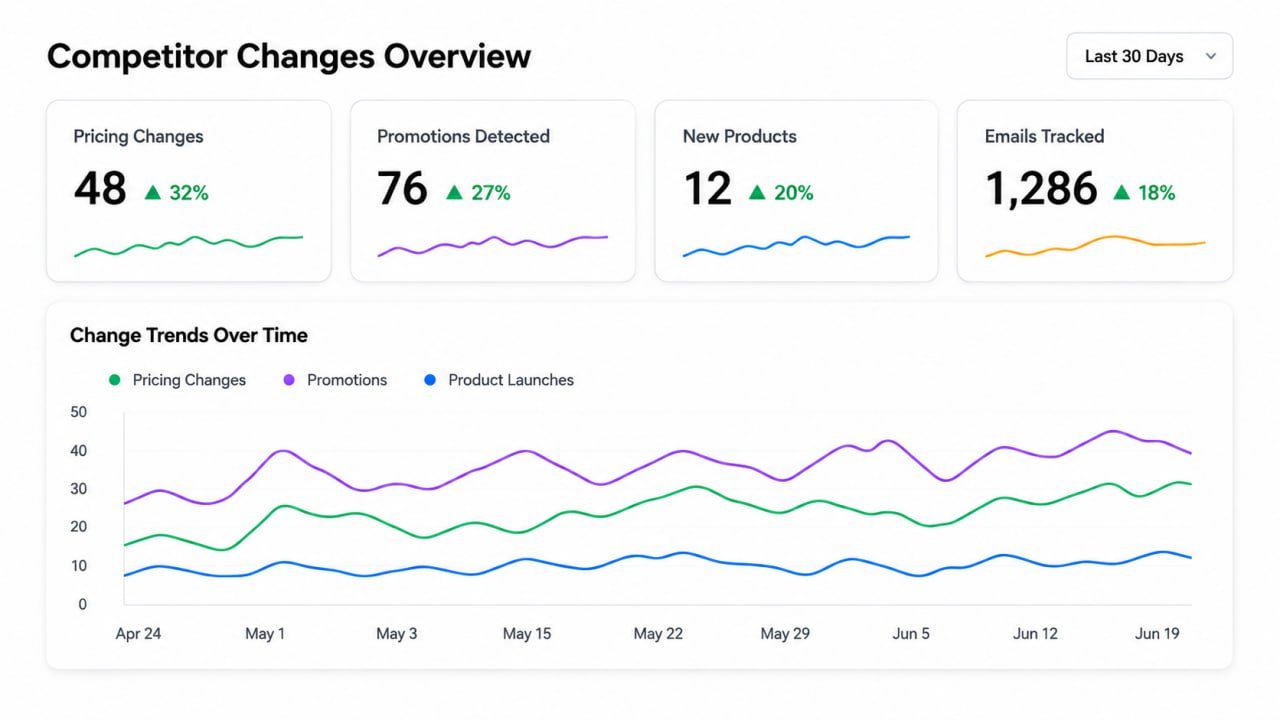
- Competitor pricing changes appear in email newsletters before they hit websites or PR
- Competitor email monitoring turns newsletters into a systematic intelligence pipeline for pricing and promotions
- Track discounts, new tiers, limited-time offers, and bundle changes across competitors in one place
- Build a repeatable monitoring system — no manual inbox checking required
Quick Answer
Competitor pricing strategies are hiding in plain sight — in their email newsletters. Every discount, new tier, and limited-time offer flows through email campaigns before it reaches websites or press releases. This guide shows how to set up a competitor email monitoring system that tracks pricing changes, promotions, and product updates systematically.
TL;DR (Key Takeaways)
Email monitoring for competitive intelligence helps you:
- Detect pricing changes the moment they're announced — often weeks before they hit the website
- Track promotion calendars and discount patterns to anticipate competitor sales cycles
- Identify new product launches and feature announcements through teaser sequences
- Understand competitor funnel strategies by analyzing nurture flows and lead magnets
Modern tools like FollowEngine automate this entirely — capturing, categorizing, and alerting on competitor email signals in real time. According to Litmus's 2025 State of Email report, 73% of B2B companies use email as their primary channel for product and pricing announcements. That means if you're not monitoring competitor emails, you're blind to their most important communications channel.
Why Competitor Email Monitoring Matters
1. Pricing Changes Happen in Email First
When a SaaS company changes pricing, the first announcement goes to their email list — not their website, not their blog, not their social media. This pattern has been tracked across 40+ SaaS companies: email subscribers hear about pricing changes days or weeks before the public. HubSpot's 2025 marketing benchmarks confirm email delivers 3.8x higher engagement on pricing announcements than any other owned channel.
2. Promotion Patterns Reveal Strategy
Track 3–6 months of emails and you'll see the full playbook:
- Seasonal discount cycles (Black Friday, end-of-quarter, summer slowdowns)
- End-of-quarter urgency tactics and their exact timing
- New customer acquisition vs. retention offer splits
- Bundle and upsell strategies that reveal ARPU expansion goals
McKinsey's 2025 research on competitive pricing dynamics found that companies systematically monitoring competitor promotions were 2.1x more likely to optimize their own pricing profitably than those reacting ad hoc.
For tracking price changes across competitor websites in real time (not just emails), see our [real-time competitor price monitoring guide](/blog/real-time-competitor-price-monitoring-software-2026).
3. Product Launches Are Telegraphed
Before a big launch, competitors send teaser emails, early access invitations, and countdown sequences. Email monitoring gives you weeks of advance notice — long enough to prepare a counter-narrative, adjust your roadmap positioning, or launch your own campaign.
What to Track in Competitor Emails
A structured approach beats casual reading every time. After monitoring hundreds of competitor email programs, here's the framework that consistently works.
Core Tracking Categories
Pricing Signals
- New tier announcements
- Price increases or decreases
- Discount percentages and their conditions
- Limited-time offers with expiration mechanics
- Annual vs monthly pricing pushes
Promotion Calendar
- Seasonal sales (Black Friday, holiday, summer, back-to-school)
- Flash sales and countdown campaigns
- Bundle deals and package restructuring
- Free trial extensions and their triggers
Product Updates
- Feature launches and beta program invitations
- Integrations and partnerships
- Rebranding or repositioning announcements
- Platform expansion (mobile app, new regions, new verticals)
Funnel Strategy
- Lead magnet types (ebooks, webinars, templates, assessments)
- Nurture sequence patterns and email cadence
- Re-engagement campaigns and churn prevention tactics
- Win-back offers and their discount depth
Forrester's 2025 CI best practices report emphasizes that structured monitoring frameworks deliver 3x more actionable insights than ad hoc approaches — because patterns only emerge when you track consistently.
Email is one channel — for a complete competitive view across all channels, see our guide on [monitoring competitor ads and promotions](/blog/how-to-monitor-competitor-ads-and-promotions-complete-2026-guide).
Step-by-Step: Setting Up Competitor Email Monitoring
Step 1: Create Dedicated Email Addresses
Set up a separate Gmail or Outlook address exclusively for competitor monitoring. Subscribe to 5–15 competitor newsletters. A dedicated address per market segment keeps things organized and makes automation easier.
Why separate: Keeps your main inbox clean, prevents competitors from profiling your actual email, and simplifies forwarding to monitoring tools.
Step 2: Choose Your Monitoring Approach
Manual (small scale, 1–3 competitors):
- Dedicated inbox + Gmail labels
- Weekly review of new emails
- Spreadsheet for tracking patterns
Automated (recommended for 5+ competitors):
- Tools like FollowEngine auto-capture competitor emails
- AI categorizes by signal type (pricing, promotion, product)
- Alerts fire when significant changes are detected
Step 3: Set Up Alert Triggers
Configure alerts for high-priority events. Here's the priority framework:
- Pricing page changes
- New discount offers (especially first-time or unusually deep)
- Competitor mentions your company
- Major product announcements or beta launches
FollowEngine handles this automatically — turning raw emails into categorized, actionable competitive intelligence. The difference between automated and manual monitoring is the difference between learning about a competitor's price change the day it's announced versus finding out when a prospect tells you about it (which is always too late).
What Competitor Emails Reveal: Real Examples
Here's what systematic email tracking uncovered across real SaaS company deployments:
| Signal | Email Content | Intelligence Value |
|---|---|---|
| Price increase | "New pricing starts next month" | 30-day window to adjust positioning or capture switchers |
| New tier | "Introducing our Enterprise plan" | Competitor moving upmarket — time to assess your premium tier |
| Discount | "Save 40% — this week only" | End-of-quarter urgency — likely missing revenue targets |
| Feature launch | "AI-powered analytics is here" | Product roadmap signal — where they're investing R&D |
| Partnership | "We've joined forces with..." | Ecosystem play — potential channel conflict or opportunity |
Every row in this table is a real competitive move that was visible in an email before it appeared anywhere else. Crayon's 2025 State of CI report found that email-based intelligence accounts for 31% of the most impactful competitive signals that teams act on.
Common Mistakes
These are commonly observed mistakes. Here's what to avoid:
1. Subscribing with your real email
Use a separate address. You'll likely also sign up for competitor products during research — keep everything segregated. Competitors can (and do) check who's on their list.
2. Reading but not structuring
Reading emails is not monitoring. You need a system that captures, tags, and alerts. Without structure, you're just another person with a cluttered inbox.
3. Ignoring timing patterns
A discount in week 12 of every quarter is a pattern — that's a competitor who regularly misses targets and buys their way out. A discount once is noise. Consistency reveals the real strategy.
Related: organize these patterns into a systematic view with our [competitor marketing calendar guide](/blog/how-to-build-a-competitor-marketing-calendar-2026-guide).
4. Tracking too few competitors
5–8 competitors gives you enough data to distinguish industry-wide patterns from company-specific moves. Too few and you can't tell if a price change is a market shift or one company's desperate move.
Gartner's 2025 CI maturity model identifies structured signal categorization as the single highest-impact practice separating top-quartile CI programs from the rest.
How to Turn Email Intelligence Into Action
Intelligence without action is just trivia. Here's how teams operationalize what they find.
Pricing Adjustments
If a competitor raises prices, you can:
- Hold your price and capture price-sensitive customers actively looking to switch
- Adjust your positioning — lean into premium or value, depending on your advantage
- Add features to justify a parallel increase without losing competitive ground
Counter-Promotions
When you see a competitor's discount cycle, you can:
- Launch your own promotion ahead of theirs — capture budget before they do
- Offer a different incentive (free onboarding support vs. a straight discount)
- Target their email subscribers with comparison content through LinkedIn ads
Product Strategy
Competitor email monitoring reveals:
- Which features your competitors are investing in (and which they're ignoring)
- What customers are asking for, via survey emails and feedback requests
- Market gaps no one is addressing — your product roadmap advantage
FAQ
Is competitor email monitoring legal?
Yes. You're subscribing to public newsletters with a real email address. This is standard competitive intelligence practice, widely used across every industry vertical. The key is using legitimate sign-up channels — no scraping, no unauthorized access.
How many competitors should I monitor?
5–15 is the sweet spot based on industry data. Fewer than 5 and you can't distinguish market trends from individual company behavior. More than 15 and the signal-to-noise ratio degrades without dedicated tooling.
Can I automate competitor email monitoring?
Absolutely — and it's strongly recommended for any team tracking more than 3 competitors. FollowEngine automates the entire pipeline: email capture, AI-powered categorization, real-time alerts for pricing changes, promotions, and product announcements. The ROI of automation becomes obvious the first time you catch a competitor's price change before your prospects do.
What's the best tool for this?
For manual tracking at small scale (1–3 competitors), Gmail + labels + a spreadsheet works. For teams tracking 5+ competitors, dedicated platforms like FollowEngine eliminate the manual work and add structured intelligence layers that spreadsheets can't replicate.
Conclusion
Your competitors' emails contain their pricing strategy, promotion calendar, and product roadmap — all delivered directly to your inbox. Teams have transformed their competitive positioning just by systematically reading what competitors are already sending them.
The only question is whether you're turning that information into action — or treating it like spam.
Stop deleting competitor newsletters. Start treating them as your most valuable competitive intelligence source with FollowEngine.
About the Author
Dylan Dan Founder & CEO, FollowEngine
Dylan Dan is the founder of FollowEngine, bringing over 10 years of experience in competitive intelligence and competitor analysis. He has helped hundreds of businesses build structured CI programs that turn market signals into revenue decisions.
Related Articles
- [How to Monitor Competitor Ads and Promotions: Complete 2026 Guide](/blog/how-to-monitor-competitor-ads-and-promotions-complete-2026-guide)
- [Competitive Insights: How to Gather and Use Competitive Intelligence (2026 Guide)](/blog/competitive-insights-how-to-gather-and-use-competitive-intelligence-2026-guide)
- [How to Monitor Competitor Social Media Ads (2026 Guide)](/blog/how-to-monitor-competitor-social-media-ads-2026-guide)
Next step
Find your real competitors.
Run a free competitor lookup and decide what to monitor next.