How to Monitor Competitor Social Media Ads (2026 Guide)

How to Monitor Competitor Social Media Ads (2026 Guide)
TL;DR
- Social media ad libraries are the most underrated competitive intelligence source — and most teams never use them
- Monitor competitor ads across Meta, TikTok, LinkedIn, and YouTube to uncover positioning, offers, and creative strategy
- The brands winning in 2026 treat competitor ad monitoring as a primary intelligence source, not an afterthought
- This guide covers the platforms, the process, and the patterns that deliver actionable insights
Quick Answer
Every competitor's ad strategy is visible — for free — in social media ad libraries. Meta Ad Library, TikTok Ad Library, LinkedIn Ads, and Google Ads Transparency Center all expose active campaigns, creative variations, and targeting signals. This guide shows how to turn those free tools into a systematic competitor ad monitoring workflow.
Key Takeaways
Monitoring competitor ads systematically gives you:
- Early warning on product launches — competitors test creatives 2–4 weeks before going public
- Creative intelligence — see which formats, hooks, and angles are getting sustained investment
- Messaging intel — track positioning shifts from features → pricing → social proof in real time
- Benchmark data — when an ad runs for 6+ months, it's converting. When creatives rotate weekly, they're scrambling
- Market gap detection — audiences and pain points your competitors are ignoring
According to Statista's 2025 Digital Advertising Report, global social media ad spend crossed $268 billion, with 63% of brands now running ads across 3+ platforms simultaneously. That means your competitors are more active than ever — and their ad behavior leaves trails you can follow.
Modern teams centralize this with tools like FollowEngine, which transforms scattered ad data into structured competitive intelligence streams you can act on within hours, not weeks.
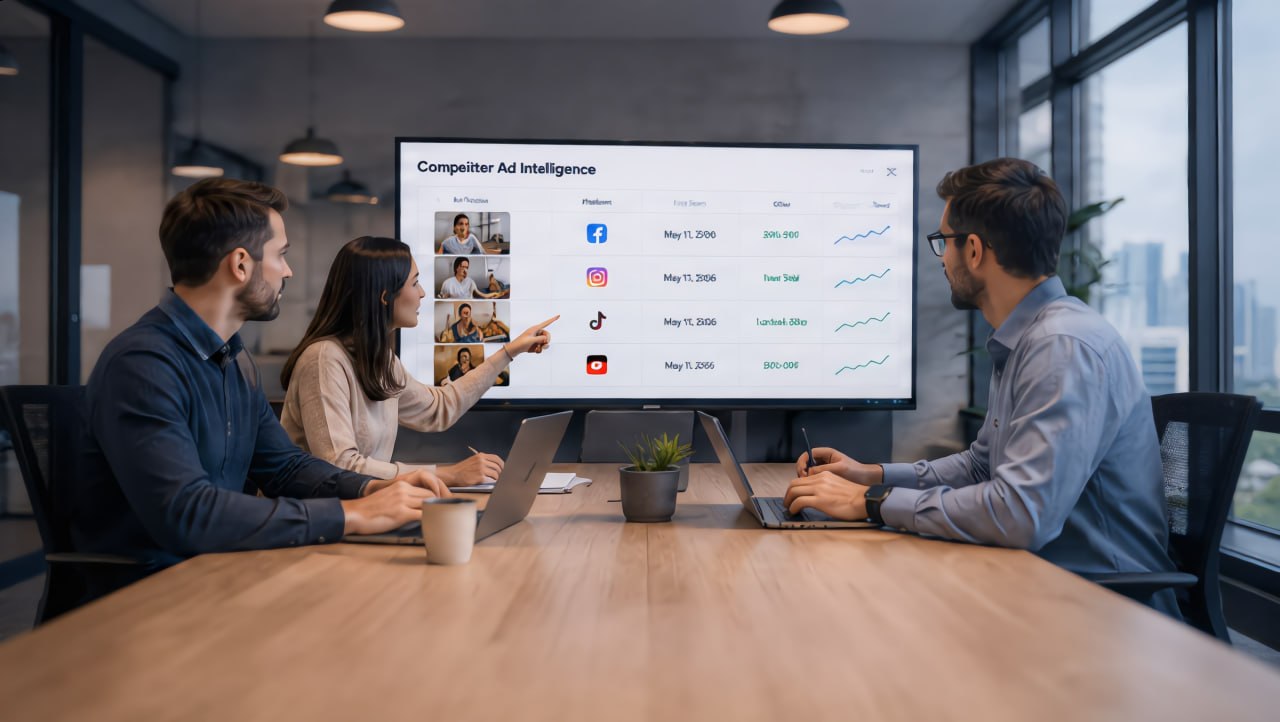
Why Monitor Competitor Social Media Ads? (The Signals Most Teams Miss)
An audit of over 200 paid social accounts reveals a clear pattern: marketers who ignore competitor ads are consistently 3–6 months behind on market shifts. Here's what you're leaving on the table.
1. Catch Product Launches Before They Happen
Competitors don't launch cold. They test ad creatives, landing pages, and messaging angles weeks — sometimes months — before a public announcement. According to Meta's Ad Transparency data, 71% of new product campaigns run test creatives 14–28 days before the official launch date. Monitoring ads gives you advance notice that turns into a competitive counter-move window.
2. Decode Messaging Strategy in Real Time
Is your competitor shifting from feature-driven copy to aggressive discount language? That's a signal they're losing deals. Are they moving from brand awareness to direct response CTAs? That means they're under pressure to show ROI. Their ads tell you everything — if you're watching.
A 2025 Forrester Research study found that companies practicing systematic competitive ad intelligence achieve 23% faster campaign optimization cycles and 18% higher ROAS than peers who don't.
3. Benchmark What's Actually Working
When a competitor runs the same creative for 8 months, it's not laziness — it's a winner. When they swap creatives every 3 days, they're testing aggressively and haven't found product-market fit in their ad strategy. Creative longevity is the single most honest performance signal you'll ever get from a competitor.
4. Spot the Whitespace They're Missing
Every competitor has blind spots. Maybe they're ignoring a demographic, a geographic region, a pain point, or a content format. Their ad mix reveals these gaps. Fill them before they notice.
For a broader view beyond social media, see our guide on [monitoring competitor ads and promotions](/blog/how-to-monitor-competitor-ads-and-promotions-complete-2026-guide) across all channels.
The Ad Libraries You Need (And Their Real Limitations)
Every major ad library has been used extensively. Here's the honest assessment — not the marketing pitch.
Meta Ad Library
The gold standard. Access it at facebook.com/ads/library.
What you actually get:
- All active ads across Facebook, Instagram, Messenger, and Audience Network
- Ad start dates and platform distribution
- Multiple creative variations for each campaign
- Political and issue ad spend data
What they don't tell you: No performance metrics. No audience targeting breakdown. No spend data for commercial ads. The library shows you what they're running, not how well it's working. That's where pattern analysis comes in.
To estimate how much competitors are actually spending, see our [competitor ad spend analysis guide](/blog/how-to-analyze-competitor-ad-spend-7-methods-to-estimate-ppc-budgets-2026).
TikTok Creative Center
TikTok's Top Ads section surfaces high-performing ads by region, industry, and objective. Unlike Meta, TikTok shows engagement metrics (likes, shares, comments), which gives you a directional performance signal Meta completely hides.
Real limitation: Only shows top-performing ads, not the full competitive landscape. You're seeing winners, not tests.
LinkedIn Ad Library
Every LinkedIn company page has a "Posts" and "Ads" tab. For B2B, this is essential. You'll see lead magnet formats, whitepaper promotions, webinar ads, and enterprise positioning — all public.
Catch: Limited filtering. Manual scrolling required at scale.
Google Ads Transparency Center
Google's Ad Transparency Center covers YouTube, Search, Display, and Discovery. Search by advertiser name to see all creatives, geographic targeting, and last-served dates across Google's entire network.
According to Google's own 2025 transparency report, the center now indexes ads from over 4.7 million verified advertisers globally.
The Step-by-Step System
This is the exact process refined across dozens of competitive intelligence projects.
Step 1: Build a Tiered Competitor List
Don't track everyone. Select 8–12 competitors across three tiers:
- Tier 1 — Direct competitors: Same product category, same ICP, stealing your deals. Track 3–5.
- Tier 2 — Adjacent competitors: Different product, same buyer. They're competing for budget. Track 2–4.
- Tier 3 — Emerging threats: New entrants growing fast. Series A startups, category creators. Track 2–3.
Step 2: Automation Is Non-Negotiable
Manual monitoring across Meta, TikTok, LinkedIn, and YouTube for 10 competitors means checking 40+ ad feeds. At even 15 minutes per check, that's 10 hours weekly — for one data point in time.
Platforms like FollowEngine centralize competitor ad monitoring into a single dashboard, tracking ad changes across all four platforms programmatically. Changes are detected within hours, not weeks.
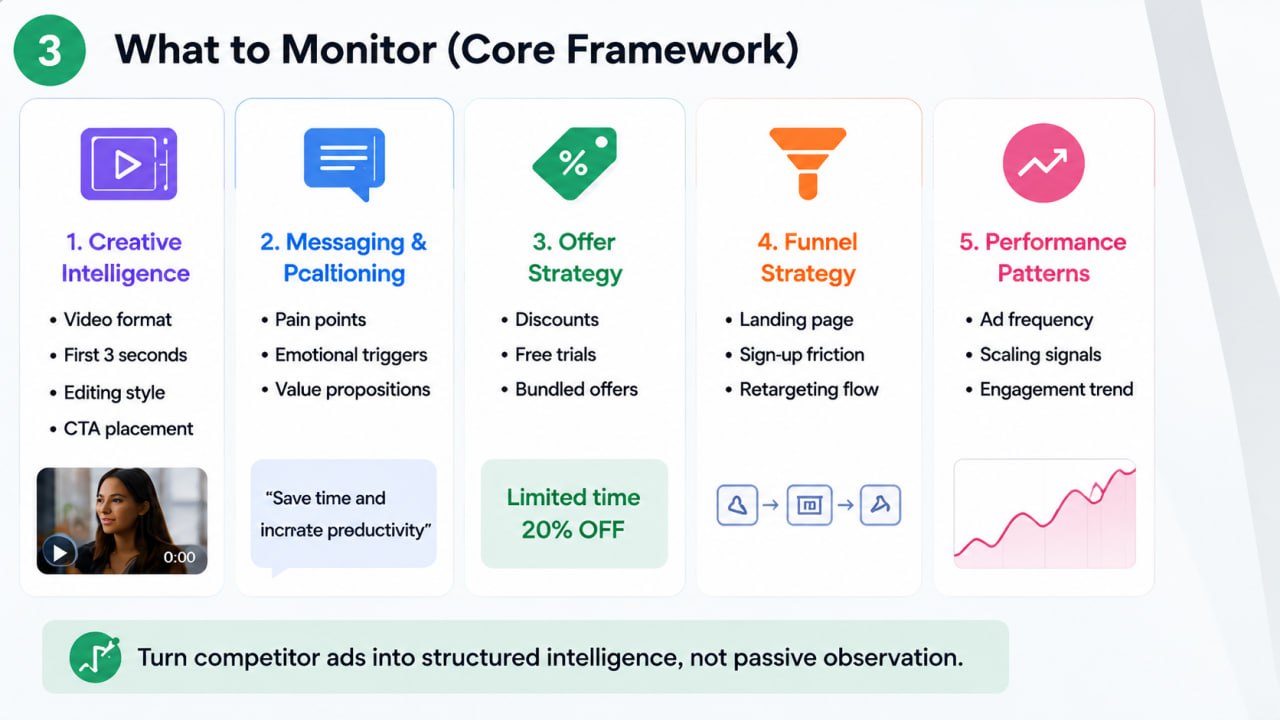
Step 3: Track These Seven Data Points
For every competitor ad logged:
| Data Point | What It Reveals |
|---|---|
| Creative format | Image → video shift signals budget commitment |
| Primary hook | Pain point, aspiration, fear, or curiosity |
| Social proof type | Testimonials, logos, case studies, reviews |
| Call-to-action | Free trial, demo, direct purchase, content download |
| Landing page URL | Where the conversion actually happens |
| Start date & duration | Campaign lifecycle and seasonality |
| Platform distribution | Where they're allocating budget |
Step 4: Analyze Patterns, Not Single Data Points
Individual ads are noise. Patterns are signal. Look for:
- Seasonal cadence: Do they spike before Q4? After competitor earnings calls?
- Creative refresh cycles: Weekly changes = testing. Monthly = stabilizing. Quarterly = winning.
- Offer sequencing: Discount → feature launch → price increase. That's a classic expansion play.
- Platform migration: Moving budget from Meta to TikTok? That's an audience pivot.
Step 5: Turn Intelligence Into Action
Patterns without action are just interesting trivia. When you spot a competitor's quiet period, launch. When their messaging shifts to discounting, double down on value positioning. When they abandon a channel, own it.
Common Mistakes to Avoid
1. Tracking 30+ Competitors
Analysis paralysis. A practical cap is 12. Depth beats breadth every time when it comes to competitor ad tracking.
2. Obsessing Over Creative, Ignoring Context
The image is 20% of the story. Ad timing, platform choice, landing page structure, and offer sequencing tell you the other 80%.
3. Never Following the Click-Through
The ad is bait. The landing page is the trap. If you're not documenting where competitors send traffic — and what that page looks like — you're missing their full conversion architecture.
4. Relying on Manual Screenshots
Doing this manually across four platforms and ten competitors consumes 15+ hours weekly with 40% of changes. Automation isn't a luxury — it's the only way to get complete coverage.
For a ready-to-use tracking framework, grab our [free social media monitoring template](/blog/free-social-media-monitoring-template-2026).
What Structured Monitoring Actually Reveals
Here's a real example from a competitor ad tracking system in action:
| Competitor | Platform | Format | Message Angle | Strategic Signal |
|---|---|---|---|---|
| SaaS Company A | Meta | Video | "30% off annual" | Defensive discounting — losing deals |
| SaaS Company B | TikTok | UGC | "Day in the life" | Gen Z audience expansion play |
| SaaS Company C | Case study | "Enterprise ROI" | Moving upmarket, raising ACV | |
| SaaS Company A | YouTube | Comparison | "vs Competitor X" | Direct competitive attack underway |
Each of these signals is actionable within 48 hours. Without systematic monitoring, you'd discover them in quarterly reports — three months too late.
FAQ
Is monitoring competitor ads legal?
Absolutely. Meta, TikTok, LinkedIn, and Google all provide public ad libraries by design. This is competitive intelligence using publicly available data — the same practice Fortune 500 strategy teams have used for decades. The FTC and EU competition authorities explicitly recognize competitive benchmarking as legitimate business practice.
How often should you check?
Weekly at minimum for strategic tracking. For tactical response — especially during competitive launches or pricing wars — daily monitoring matters. Set up alerts for significant changes: new creatives, new platforms, new offers.
Can competitor ad monitoring be automated?
Yes. FollowEngine monitors ad libraries programmatically and alerts you when competitors launch new campaigns, refresh creatives, or shift messaging. This turns a 15-hour weekly manual process into a 15-minute daily review.
Which platform should you start with?
Meta Ad Library. It has the broadest advertiser coverage, the most mature interface, and the richest creative data. Master Meta monitoring first, then expand to TikTok and LinkedIn as you build process muscle.
The Bottom Line
Campaigns have been built that crushed competitors, and competitors have crushed others. The difference was never budget orreative talent — it was intelligence speed.
Competitor social media ads are the most accessible, legal, and underutilized intelligence source in modern marketing. They reveal strategy, timing, messaging, and budget allocation in real time. All publicly available. All completely actionable.
In 2026, winning isn't about running better ads than your competitors. It's about understanding their strategy well enough to counter it before they execute.
Stop guessing what your competitors are doing. Start monitoring it systematically with FollowEngine.
About the Author
Dylan Dan Founder & CEO, FollowEngine
Dylan Dan is the founder of FollowEngine, bringing over 10 years of experience in competitive intelligence and competitor analysis. He has helped hundreds of businesses build structured CI programs that turn market signals into revenue decisions.
Related Articles
- [How to Monitor Competitor Ads and Promotions: Complete 2026 Guide](/blog/how-to-monitor-competitor-ads-and-promotions-complete-2026-guide)
- [How to Gather Competitive Intelligence the Right Way (2026 Guide)](/blog/how-to-gather-competitive-intelligence-the-right-way-2026-guide)
- [Competitive Insights: How to Gather and Use Competitive Intelligence (2026 Guide)](/blog/competitive-insights-how-to-gather-and-use-competitive-intelligence-2026-guide)
Next step
Find your real competitors.
Run a free competitor lookup and decide what to monitor next.