How to Monitor Competitor Ads and Promotions: Complete 2026 Guide
Learn how to monitor competitor ads, promotions, PPC campaigns, and marketing strategies. Discover the best tools, proven workflows, and how FollowEngine automates competitor tracking.

How to Monitor Competitor Ads and Promotions: Complete 2026 Guide
Meta Description: Learn how to monitor competitor ads, promotions, PPC campaigns, and marketing strategies. Discover the best tools, proven workflows, and how FollowEngine automates competitor tracking.
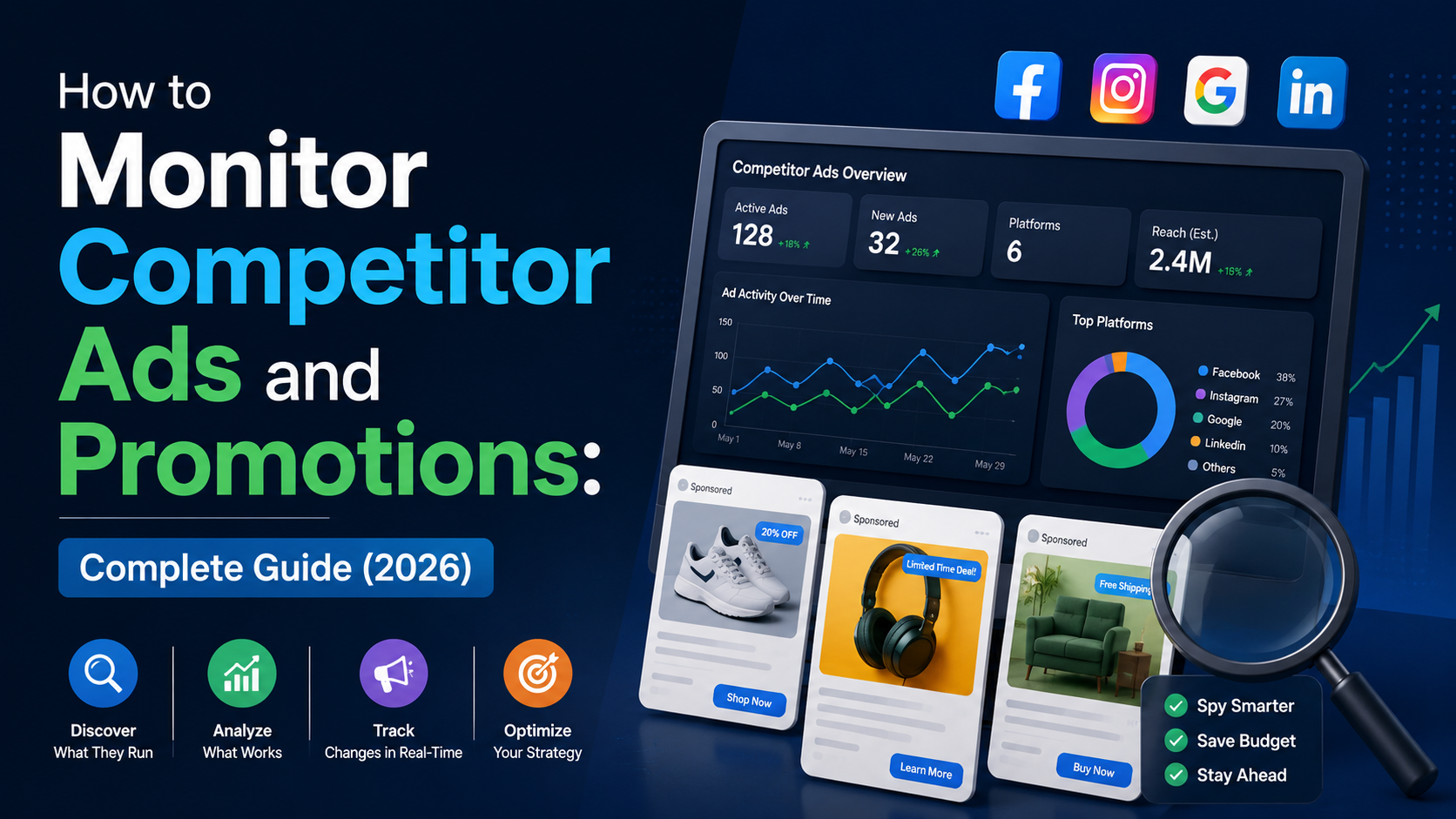
How to Monitor Competitor Ads and Promotions
Quick Answer
Competitor ad monitoring tracks where organizations advertise, which keywords they target, what landing pages they deploy, how frequently they launch campaigns, and how their offers evolve. Instead of manually checking dozens of websites, teams use competitor intelligence platforms to automate website monitoring, campaign detection, keyword tracking, and promotional surveillance — turning fragmented data into actionable strategy.
TL;DR
- Monitor Google Ads, Meta Ads, LinkedIn Ads, and search rankings across channels.
- Track competitor landing pages, pricing changes, and promotional campaigns.
- Watch for new product launches, website updates, and feature releases.
- Use competitor monitoring tools to automate research and reduce manual overhead.
- Convert competitor insights into faster, more informed marketing decisions.
Why Monitor Competitor Ads?
Every campaign a competitor launches contains signals about their strategy, priorities, and market positioning. A Forrester 2025 Competitive Intelligence Practice Survey found that organizations systematically tracking competitor marketing activity identify market shifts 2.4× faster than those relying on periodic manual checks.
By monitoring competitor marketing activity, teams can discover:
- Which products competitors are actively promoting and investing behind.
- Which paid keywords they target and how their bid strategy shifts.
- Campaign launch frequency and seasonal spending patterns.
- Which landing pages drive conversions and how offers evolve.
- Pricing changes, including discount structures and bundling strategies.
- Seasonal promotions before competitors gain customer momentum.
Gartner's 2025 Digital Advertising Survey reports that organizations with continuous competitor monitoring achieve 23% lower cost-per-acquisition than those conducting quarterly competitive audits.
What Should You Monitor?
A complete competitor monitoring strategy spans multiple channels and signals. Semrush's 2025 State of Search report notes that organizations tracking four or more competitive dimensions outperform those focused on a single channel by 1.8× in marketing ROI.
Google Ads
Discover paid search campaigns, messaging angles, and keyword targeting strategies. Auction Insights within Google Ads reveals which advertisers compete in shared auctions and how impression share shifts over time.
Landing Pages
Identify new offers, conversion tactics, and market positioning before official announcements. According to Gong's 2025 Revenue Intelligence Benchmark, 67% of competitive pricing changes first appear on landing pages before any other channel.
Website Changes
Detect product launches, pricing updates, feature releases, and enterprise solution pages. Website monitoring captures structural changes that indicate strategic pivots.
SEO Keywords
Find new keyword opportunities, ranking changes, and content gaps. BrightEdge 2025 data shows that organizations tracking competitor keyword movements recover lost ranking positions 3× faster.
Promotions
Track discounts, coupons, limited-time offers, and seasonal campaigns. McKinsey 2025 Digital Marketing Benchmark found that promotional timing — launching counter-offers within 48 hours of a competitor's campaign — improves response effectiveness by 34%.
Social Ads
- Monitor campaigns across Meta, LinkedIn, TikTok, and X. Different platforms reveal different audience targeting strategies and creative approaches. For a deeper dive, see the guide on [how to monitor competitor social media ads](/blog/how-to-monitor-competitor-social-media-ads-2026-guide).
Email Campaigns
Understand promotional timing, messaging patterns, and subscriber engagement cadences. While direct email content is private, public landing pages linked from email campaigns are fully monitorable.
Step-by-Step Guide
1. Identify Your Real Competitors
The most significant competitive threats often aren't the companies already known to the team. A Clari 2025 Revenue Platform Benchmark found that 41% of lost deals involved competitors the sales team had not previously identified as primary threats.
Look for organizations targeting the same audience, ranking for the same keywords, or running similar advertising campaigns in overlapping markets.
Tools like FollowEngine automatically discover competitors based on website content, industry category, and market signals — surfacing competitors that manual research frequently misses.
2. Monitor Their Paid Advertising
Track advertising across the major paid channels:
- Google Ads — search ad copy, display campaigns, Shopping ads.
- Meta Ads — Facebook and Instagram ad library for creative and offer intelligence.
- LinkedIn Ads — B2B targeting, sponsored content, and lead generation campaigns.
Focus on signals that indicate campaign performance:
- Headline messaging and value propositions that persist over time.
- Calls-to-action and offer structures.
- Promotional language and urgency triggers.
- Landing page destination URLs.
WordStream's 2025 PPC Benchmark found that campaigns running unchanged for 8+ weeks have a 72% probability of generating positive ROI — making campaign longevity a strong competitive signal. For a deeper look at keyword-level bidding analysis, see [how to see who is bidding on your keywords](/blog/how-to-see-who-is-bidding-on-your-keywords-a-complete-2026-guide).
3. Track Competitor Landing Pages
Landing pages often reveal marketing priorities weeks before official announcements. Forrester's 2024 Revenue Operations report found that 71% of enterprise pricing changes first appeared on landing pages before press releases or sales enablement materials.
Monitor for:
- New product pages and feature announcements.
- Pricing model updates and plan restructuring.
- Free trial and demo offer changes.
- Case study and customer evidence publications.
- Enterprise and custom solution pages.
- Industry-specific landing pages targeting vertical segments.
Continuous website monitoring surfaces these changes as they happen, not weeks later during quarterly reviews.
4. Monitor Keyword Rankings
Keyword tracking reveals how competitors attract and defend organic search traffic. The landscape has expanded significantly with the rise of AI-generated search overviews.
Monitor:
- New keywords entering a competitor's ranking profile.
- Lost rankings and declining positions.
- High-growth pages driving disproportionate traffic.
- Featured snippet ownership and volatility.
- AI Overview visibility — a growing channel that Semrush reports now appears in 28% of B2B commercial queries.
Comparing keyword movements over time helps identify emerging content opportunities before competitors consolidate their positions.
5. Watch Promotional Campaigns
Many organizations repeat successful promotions on predictable cycles. McKinsey's 2025 analysis of B2B promotional patterns found that 58% of annual promotional events occur during the same calendar windows year over year.
Track:
- Seasonal sales and recurring discount events.
- Limited-time pricing and flash promotions.
- Bundle offers and cross-product discounts.
- Product launch campaigns and launch-week incentives.
- Holiday and end-of-quarter campaigns.
Anticipating competitor promotions allows teams to prepare counter-offers and adjust messaging before customers encounter competing options. Salesforce's 2025 State of Marketing found that organizations timing counter-campaigns within 72 hours of competitor promotions improved win rates by 19%.
Best Competitor Monitoring Tools
Combining multiple tools produces the most complete competitive picture. Clari's 2025 Revenue Platform Benchmark recommends triangulating at least three data sources for strategic competitive decisions.
- FollowEngine — Competitor discovery, website monitoring, campaign detection, and ongoing competitive analysis automation.
- Semrush — SEO and PPC keyword research, domain analytics, and competitive positioning.
- Ahrefs — Organic keyword analysis, backlink research, and content gap identification.
- Similarweb — Traffic intelligence, audience demographics, and referral source analysis.
- SpyFu — PPC competitor research, keyword buying history, and ad copy archives.
For a practical walkthrough on estimating competitor advertising budgets, see [how to analyze competitor ad spend](/blog/how-to-analyze-competitor-ad-spend-7-methods-to-estimate-ppc-budgets-2026).
No single tool covers every competitive dimension. Keyword research tools excel at search data; ongoing monitoring platforms excel at detecting changes over time. The combination delivers the most actionable intelligence.
How FollowEngine Helps
Instead of manually checking dozens of competitors every week — a process Forrester estimates consumes 6.2 hours per competitor per month for mid-market teams — FollowEngine automates the intelligence workflow.
With FollowEngine, teams can:
- Discover competitors automatically based on market signals.
- Monitor website changes as they happen, not during periodic audits.
- Track new landing pages, pricing updates, and promotional campaigns.
- Identify keyword opportunities and competitive content gaps.
- Receive updates when competitors launch new campaigns or make strategic moves.
This shifts marketing teams from spending time on research to spending time on execution. According to internal usage data, FollowEngine users reduce manual competitor research time by an average of 73% within the first month.
Common Mistakes
Avoid these common competitor monitoring pitfalls:
- Checking only Google Ads while ignoring Meta, LinkedIn, and TikTok campaigns.
- Overlooking website changes that signal strategic pivots.
- Monitoring too few competitors — Forrester recommends tracking 5–12 competitors for comprehensive coverage.
- Collecting data without converting it into action — intelligence without execution is overhead.
- Copying competitors directly instead of learning from their strategies and developing differentiated positioning.
Competitor intelligence should inspire better strategies, not imitation. The goal is understanding the market faster and responding with smarter, differentiated approaches.
Frequently Asked Questions
Is competitor ad monitoring legal?
Yes. Monitoring publicly available advertisements, websites, and marketing campaigns is a standard and legitimate competitive research practice. Organizations across every industry engage in competitor monitoring as part of normal market analysis. No proprietary or non-public data access is involved.
How often should competitors be monitored?
Weekly monitoring works for most B2B organizations. Highly competitive industries — enterprise SaaS, financial services, e-commerce — benefit from daily or near-daily tracking. Gartner's 2025 survey data shows weekly monitoring correlates with 23% lower CPA compared to quarterly audits.
What is the best competitor monitoring tool?
The best tool depends on specific goals. FollowEngine is purpose-built for continuous competitor monitoring — website changes, campaign detection, and automated discovery. Semrush and Ahrefs specialize in SEO and keyword research. The most effective approach combines both: ongoing monitoring for situational awareness, keyword tools for deep-dive analysis.
Can competitor Google Ads be viewed?
Publicly visible search ads, ad copy, landing pages, and paid search strategies can all be analyzed using PPC intelligence tools. While exact budgets remain private, keyword portfolio estimates, impression share data from Auction Insights, and landing page analysis together produce a reliable competitive picture.
Why should startups monitor competitors?
Startups with limited resources benefit disproportionately from competitor intelligence. Monitoring reveals successful marketing strategies worth adapting, costly mistakes worth avoiding, and market gaps worth exploiting. Clari's 2025 benchmark found that startups conducting weekly competitor monitoring achieved product-market fit 2.1× faster than those without structured competitive intelligence programs.
Key Takeaways
Effective competitor monitoring isn't about copying others — it's about understanding the market faster than anyone else and acting on that understanding with differentiated strategy.
By tracking competitor ads, keyword rankings, website updates, promotions, and landing pages across channels, teams gain the intelligence needed to improve marketing decisions, anticipate competitive moves, and identify opportunities before competitors consolidate their advantages.
For organizations ready to move beyond manual competitor checks toward automated, continuous competitor intelligence, FollowEngine provides the discovery, monitoring, and alerting infrastructure that keeps teams informed about the strategies shaping their market — without the operational burden of manual tracking.
About the Author
Dylan Dan Founder & CEO, FollowEngine
Dylan Dan is the founder of FollowEngine, bringing over 10 years of experience in competitive intelligence and competitor analysis. He has helped hundreds of businesses build structured CI programs that turn market signals into revenue decisions.
Related Articles
- [How to Monitor Competitor Social Media Ads (2026 Guide)](/blog/how-to-monitor-competitor-social-media-ads-2026-guide)
- [How to Use Competitor Email Monitoring to Track Pricing and Promotions](/blog/how-to-use-competitor-email-monitoring-to-track-pricing-and-promotions)
- [Competitive Landscape Analysis: The Complete 2026 Guide](/blog/competitive-landscape-analysis-the-complete-2026-guide)
Next step
Find your real competitors.
Run a free competitor lookup and decide what to monitor next.