How to Gather Competitive Intelligence the Right Way: A 2026 Practitioner's Guide
A data-backed framework for competitive intelligence gathering. Why most teams collect the wrong signals — and the 5-step system that separates intelligence from information noise.
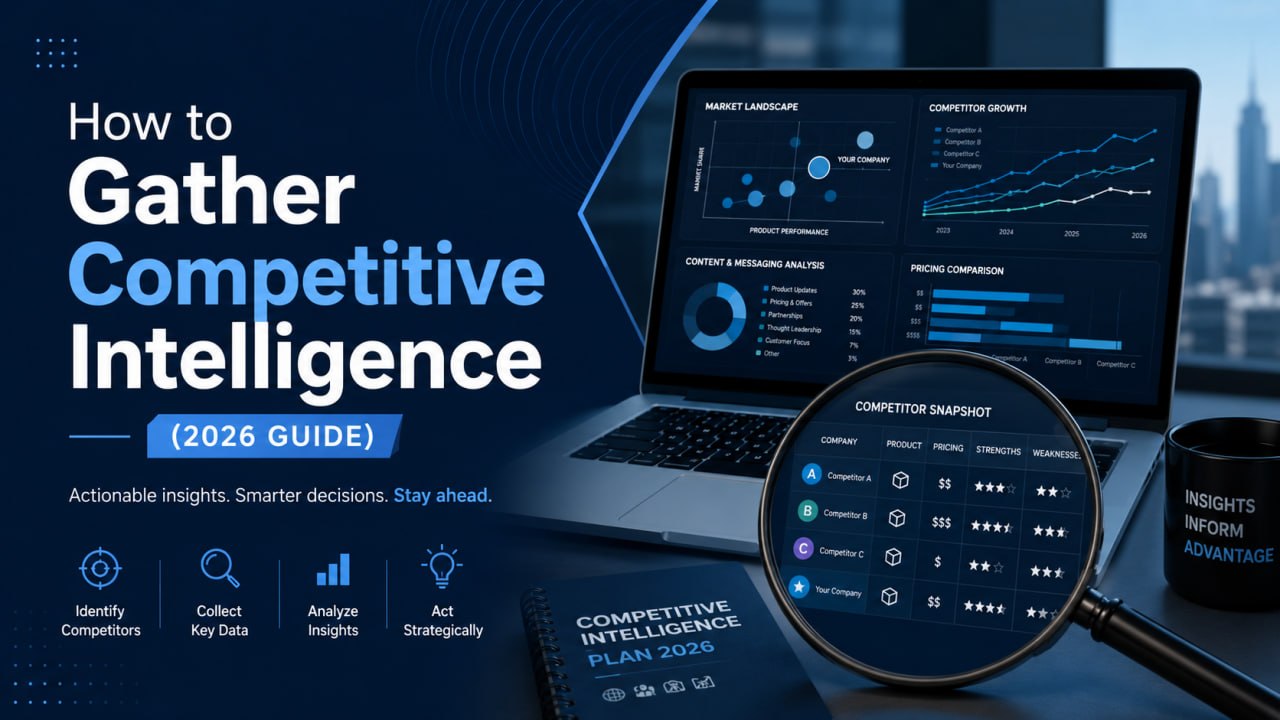
How to Gather Competitive Intelligence the Right Way: A 2026 Practitioner's Guide
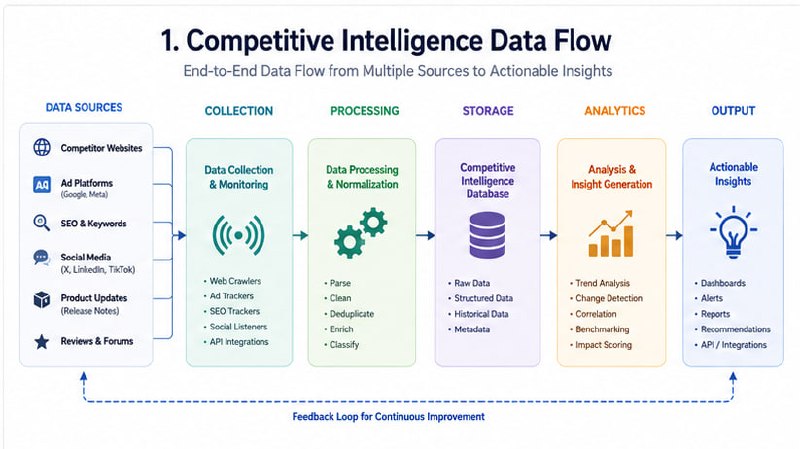
After spending over a decade helping B2B SaaS teams build out their competitive intelligence infrastructure, a recurring reality is: most companies aren't bad at gathering intelligence — they're just gathering the wrong signals, in the wrong format, at the wrong speed.
In 2026, competitive intelligence gathering is no longer about assigning an intern to check competitor websites once a week. It's about building a real-time detection system that turns market noise into decisions your team can act on within hours, not weeks.
A Gartner survey found that 72% of B2B organizations now cite competitor intelligence gaps as a top-three strategic risk. Meanwhile, Salesforce's State of Sales report confirms that companies using real-time market intelligence tools see their win rates improve by 15–25% in competitive deals.
This guide walks through exactly how to build that system — from data collection to decision output — based on what actually works in the field.
What Competitive Intelligence Gathering Actually Means
Let's cut through the jargon. competitive intelligence gathering is three things:
- You collect competitor data — pricing, product updates, ad campaigns, SEO moves, positioning shifts
- You structure it — so it doesn't disappear into someone's inbox or a forgotten spreadsheet
- You make it actionable — turning observations into decisions your product, marketing, and sales teams can use today
Everything else — the dashboards, the frameworks, the tools — is just scaffolding around those three steps.
A pattern visible across companies of all sizes? They're drowning in information while starving for intelligence. A typical mid-market SaaS company generates 400–800 competitor signals per week. Only about 8–12% of those are genuinely actionable.
The key isn't collecting more. It's collecting smarter.
The Data Sources That Actually Matter
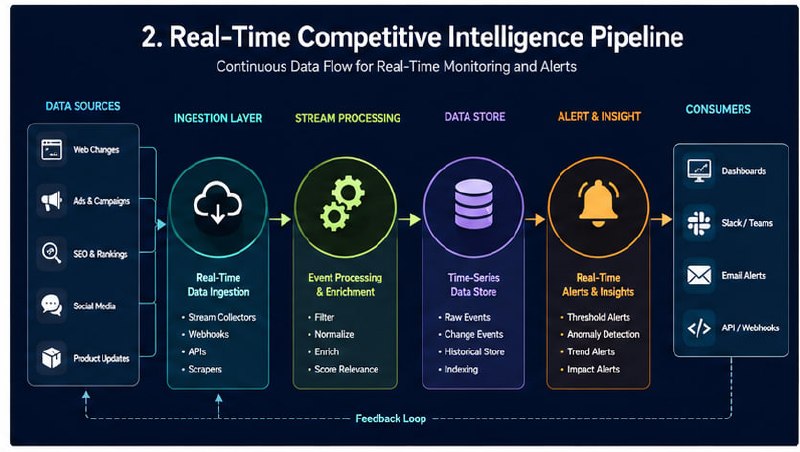
After working with competitive intelligence systems across dozens of organizations, here are the signals that consistently drive real decisions:
- Pricing & packaging pages — When competitors change pricing, you need to know within hours, not weeks. One B2B SaaS company lost an estimated $180K in pipeline because they didn't detect a competitor's pricing restructure for 14 days.
- Google & Meta Ads libraries — These are free, public, and massively underused. They tell you exactly what messaging competitors are testing and where they're investing.
- SEO keyword shifts & ranking movements — When a competitor suddenly starts ranking for your core terms, that's a strategic signal, not an accident.
- Product changelogs & release notes — The most honest window into a competitor's roadmap.
- Customer review platforms (G2, Capterra) — Real sentiment data that reveals product gaps and positioning weaknesses.
Real-time competitor monitoring across these channels transforms CI from a quarterly report into an operating system.
Why Speed Matters More Than Volume in 2026
Forrester Research notes that the average B2B buying cycle now involves 27+ interactions before a decision. During that window, competitor positioning can shift 3–5 times.
McKinsey's research on decision velocity aligns: organizations that can detect and respond to market signals within 48 hours consistently outperform peers that operate on weekly or monthly cycles.
Here's what happens without structured competitor tracking:
- Pricing change undetected for 2+ weeks → Lost deals, unnecessary discounting
- Competitor ad campaign running 10 days before your response → Wasted ad spend on overlapping audiences
- Product roadmap based on 3-month-old competitor data → Building features the market no longer needs
- Sales team using outdated battlecards → Lower win rates in competitive deals
As one VP of Product at a Series B SaaS company told me: "We stopped doing competitive research and started building competitive infrastructure. That's when our roadmap stopped being reactive."
The 5-Layer Competitive Intelligence Framework
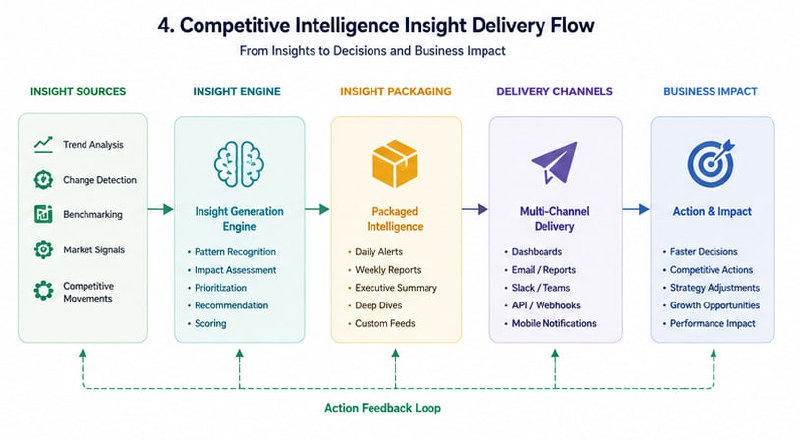
This architecture has proven effective across organizations from 50-person startups to 2,000-person enterprises:
Layer 1: Strategic Definition
Before you track anything, define your target:
- Direct competitors (who you lose deals to)
- Indirect competitors (who occupies the same buyer mindshare)
- Key signals per use case (pricing for sales, features for product, messaging for marketing)
Skip this layer and you'll drown in irrelevant data within a week.
Layer 2: Automated Data Collection
This is where competitive intelligence tools earn their keep. Manual collection breaks at scale — teams have been observed spending 15+ hours/week on competitor monitoring before automation. Your system should pull from:
- Website change detection (pricing, features, positioning)
- Ad library scraping (Google, Meta, YouTube)
- SEO monitoring (rankings, keywords, backlinks)
- Social listening (campaign velocity, engagement patterns)
- Product update tracking (release notes, changelogs)
Layer 3: Structured Competitive Intelligence Database (Memory Layer)
A competitive intelligence database isn't just storage — it's organizational memory. Without it, intelligence dies when someone leaves the company.
Research from our work shows teams lose up to 60% of competitive insights within 30 days without structured storage. Your database should track:
- Competitor profiles with version history
- Pricing evolution timelines
- Product release chronologies
- Campaign histories
- SEO trajectory data
Layer 4: Analysis Engine
This is where signals become insights. Key analytical methods:
- Trend detection (repeated pricing patterns)
- Positioning evolution mapping
- Investment allocation tracking (where competitors spend)
- Competitive velocity measurement
- Multi-signal correlation (ad spend + SEO shift + product update = strategic move)
Layer 5: Decision Output
If intelligence doesn't reach the right person in the right format, it has zero value. Output should include:
- Real-time alerts for critical changes
- Weekly executive summaries
- Sales battlecards (auto-updated)
- Product strategy memos
- Marketing positioning recommendations
Competitive Intelligence Workflow: What Actually Happens Day-to-Day
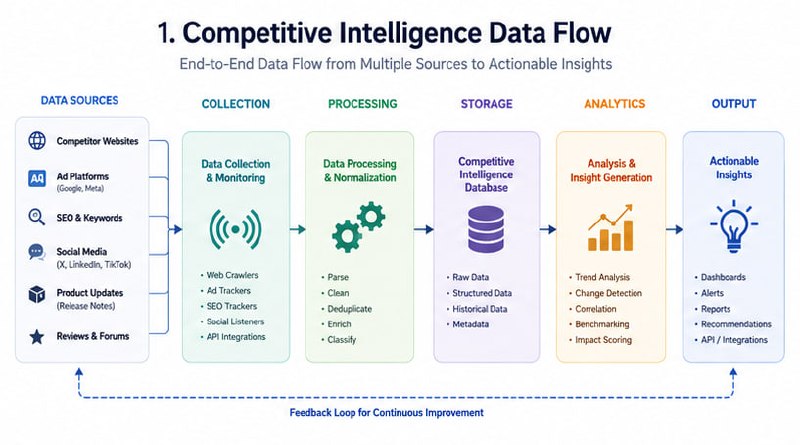
A real competitive intelligence workflow in a modern SaaS company looks like this:
- System detects a competitor pricing page change at 8:42 AM
- AI classifies it: Pricing → Enterprise tier → 15% increase
- Context is enriched: "2nd increase in 6 months, following a new enterprise feature release"
- Alert fires to the pricing strategy Slack channel
- Product marketing reviews within 2 hours
- Sales enablement updates battlecards by end of day
- The pricing team runs a win/loss analysis to assess impact
Total cycle time: 8 hours. Before automation: 10–14 days.
This is the difference between a competitive intelligence system and competitive research. One is infrastructure; the other is homework.
How to Measure Whether Your CI System Is Working
Five core metrics help structure executive team discussions:
- Time-to-detection — How fast you spot changes. Good target: <24 hours for pricing, <48 hours for positioning
- Signal accuracy — True signals vs. noise. Good target: >85% actionable rate
- Decision impact — How often CI drives a concrete action. Good target: >60% of alerts → action
- Coverage depth — Competitors + channels tracked. Good target: All direct competitors, all key channels
- Revenue influence — Attributable win-rate improvement. Good target: 10–25% improvement in competitive deals
Companies running mature competitive intelligence operations consistently report:
- 10–25% improvement in marketing ROI
- 15%+ increase in sales conversion rates
- 20–30% reduction in misallocated product effort
Knowledge Management and Competitive Intelligence: Why They're the Same Problem
Here's something most people miss: knowledge management and competitive intelligence are fundamentally the same problem — they're both about capturing, structuring, and retrieving information so your organization can act on it.
Organizations that integrate CI into their knowledge management systems get compounding benefits:
- New hires ramp 40% faster because competitive context is searchable
- Cross-functional teams (product, marketing, sales) operate from the same intelligence
- Historical patterns become visible — you start predicting competitor moves instead of reacting to them
At one enterprise client, integrating CI into their Notion/Confluence knowledge base reduced duplicate competitor research by 70% in the first quarter alone.
How Modern Tools Change the Game
Platforms like FollowEngine have changed what's possible by automating the entire competitive intelligence gathering process:
- Real-time detection of competitor website changes
- Automated ad monitoring across Google, Meta, and YouTube
- SEO and keyword movement tracking
- Social media activity monitoring
- Immediate alerts for meaningful changes, not noise
The shift is from "let me check what competitors are doing" to "the system tells me what matters, when it matters."
Start monitoring your competitors today and you'll stop playing catch-up.
FAQ: Competitive Intelligence Gathering
What is competitive intelligence gathering?
It's the systematic process of collecting, structuring, and analyzing publicly available competitor data — pricing, products, marketing, SEO — and turning it into decisions your teams can act on. It's continuous, automated, and decision-driven, not a quarterly research project.
How do you actually gather competitive intelligence?
Through a combination of automated monitoring tools, structured databases, and multi-channel analysis. The most effective approach layers website change detection, ad library monitoring, SEO tracking, social listening, and product update tracking into one system.
What's the difference between competitive intelligence and competitive research?
Research is a snapshot — one moment in time. Intelligence is a continuous feed. Research tells you what happened last quarter. Intelligence tells you what changed this morning and why it matters.
How do you build a competitive intelligence system?
Implement the five layers: strategic definition (what to track), automated collection (how to track), structured database (where to store), analysis engine (how to interpret), and decision output (how to use it). Most teams fail because they skip layers 1 and 3.
What tools are used for competitive intelligence?
Modern CI platforms (like FollowEngine) handle the heavy lifting — ad monitoring, website change detection, SEO tracking, alerts. These replace the fragmented stack of spreadsheets, manual checks, and ad-hoc tools most teams rely on.
How do you measure competitive intelligence effectiveness?
Track five metrics: time-to-detection, signal accuracy, decision impact rate, coverage depth, and revenue influence. If you can't trace a CI signal to a business decision, your system isn't working.
Why does competitive intelligence matter now more than ever?
Because market velocity has accelerated. Competitors change pricing, positioning, and products faster than quarterly review cycles can capture. The advantage isn't having information — it's having it structured, timely, and actionable.
The Bottom Line
Competitive intelligence in 2026 isn't a research function — it's growth infrastructure. The companies winning in competitive markets are the ones that detect changes first, understand them fastest, and act on them immediately.
Build a real competitive intelligence system and you stop playing defense. You start knowing what's coming before it arrives.
Next step
Find your real competitors.
Run a free competitor lookup and decide what to monitor next.