How to Create Battle Cards That Actually Win Deals (2026)

How to Create Battle Cards That Actually Win Deals (2026)
TL;DR
- A battle card is an internal one-pager that arms reps to win against specific competitors — not a slide deck, not a forgotten PDF
- Covers positioning, pricing gaps, top 3 objections, and exact response talk tracks
- The best battle cards pull from real-time competitive data, not a quarterly PowerPoint from six months ago
- Start by finding your real competitors with FollowEngine's free competitor finder
Quick Answer
A sales battle card is your rep's cheat sheet — built for speed, pulled up mid-call when the prospect says "we're also looking at Competitor X." It covers positioning, pricing gaps, the three objections reps hear most, and exactly how to respond. The best battle cards today draw from real-time competitive data, not outdated quarterly decks.
What a Battle Card Actually Is
Forget the jargon. A battle card is your rep's cheat sheet.
It's built for speed — glance at it during a live conversation and find the answer in seconds. The moment a competitor's name comes up, your rep should know:
- How they position themselves
- Where you beat them on product
- Where they'll try to undercut you on price
- The exact words to say when the prospect brings up a concern
In practice, here's what belongs on every battle card:
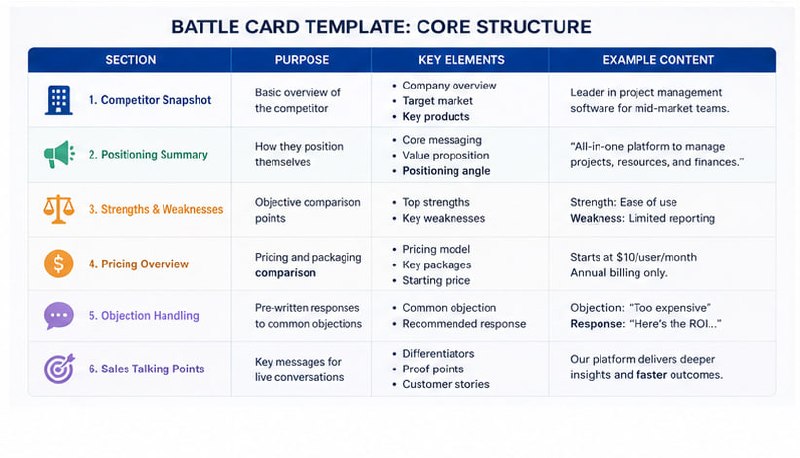
- Competitor snapshot — Who they are, what they sell, who they sell to
- Positioning — How they describe themselves vs. how you describe them
- Strengths and weaknesses — Honest, actionable comparison points — not marketing fluff
- Pricing — Real pricing intel, not list prices from their website
- Objection handling — Pre-written responses to the objections your reps actually hear
- Talking points — Messaging your team can use verbatim on calls
This isn't a training document. It's a deal-time decision sheet. Write it that way.
Why Sales Battle Cards Move the Needle
The numbers from sales enablement research are consistent across industries:
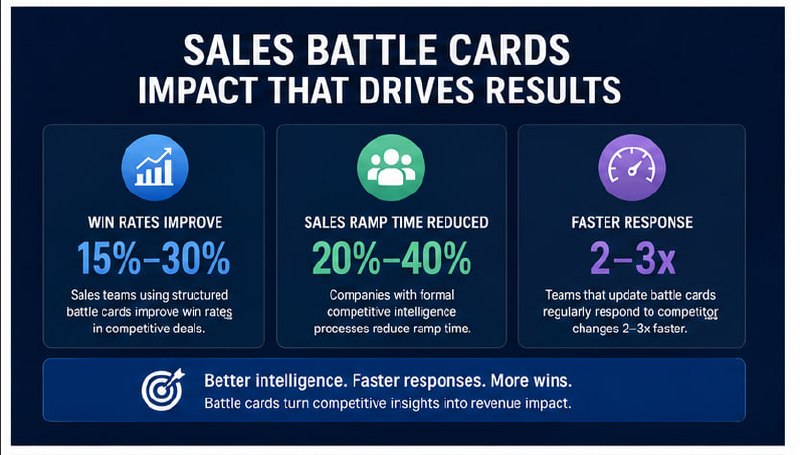
- Teams using structured battle cards see win rates improve 15–30% in competitive deals (Salesforce State of Sales, 2024)
- Formal competitive intelligence programs cut sales ramp time by 20–40% (Gartner, 2023)
- Reps with regularly updated battle cards respond to competitor moves 2–3x faster than those relying on static docs (Forrester, 2024)
The mechanism is straightforward: faster objection handling and consistent messaging across your entire sales org. When every rep knows exactly what to say about Competitor X, you stop losing deals to confusion and hesitation.
Understanding why deals are lost is the foundation — see our [win loss analysis guide](/blog/win-loss-analysis-the-real-reason-youre-losing-deals-and-how-to-fix-it) for a detailed framework.
Step 1: Pick the Right Competitors
Don't build battle cards for every company in your space. Start with the ones that actually show up in your pipeline.
Pull data from three sources:
- CRM win/loss records — which competitors appear most in closed-lost deals?
- Sales call transcripts — which names come up organically during discovery?
- Deal notes — what alternatives are prospects evaluating?
Focus your first batch on the 3–5 competitors that matter most. You can expand later. Not sure who your real competitors are? Use FollowEngine's free tool to discover them automatically.
Step 2: Gather Real Competitive Intelligence
A battle card is only as good as the data behind it. Don't guess — pull from:
- Win/loss interviews with prospects who chose a competitor
- Gong/Chorus transcripts where competitors came up
- Customer feedback from accounts you won from competitors
- Public sources: pricing pages, product updates, press releases, job listings
- Competitive intelligence platforms that automate monitoring
This is where modern tools change the game. Instead of manually checking competitor websites every week, platforms like FollowEngine track changes automatically across:
- Website updates and messaging shifts
- Pricing page modifications
- Product launches and feature announcements
- Positioning changes
- Marketing campaigns
The result: your battle cards stay current without someone spending Friday afternoons on competitor research.
For a centralized view of all competitor signals, learn how to [build a competitive intelligence dashboard](/blog/how-to-build-a-competitive-intelligence-dashboard-metrics-kpis-and-real-time-tracking-2026-guide).
Step 3: Build a Template That Scales
You need one standard format that works for every competitor. Here's a battle-tested structure:
- Competitor Profile — Company overview, funding, key markets
- Positioning Summary — How they describe themselves / how you reframe the comparison
- Strengths & Weaknesses — Be honest — reps will discover the truth anyway
- Pricing Comparison — Actual pricing intelligence, not website list prices
- Objection Handling — Top 3–5 objections with scripted responses
- Sales Talking Points — Ready-to-use messaging for live calls
Most teams use PowerPoint or Google Slides for battle card templates because they're easy to distribute, update, and present during internal training.
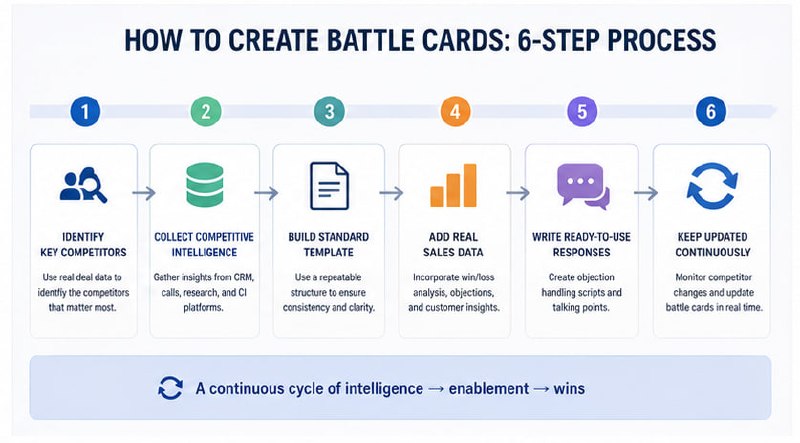
Step 4: Ground Everything in Real Deal Data
This is where most battle cards fail. They're built from marketing assumptions rather than what actually happens on sales calls.
Pull directly from your deal data:
- The three objections your reps hear most often about this competitor
- The specific reasons prospects chose the competitor in closed-lost deals
- What competitors said about you during the sales process
- Recurring customer concerns that came up in discovery
When your battle cards reflect reality instead of wishful thinking, reps trust them. When reps trust them, they use them.
Step 5: Write Scripts Reps Will Actually Use
Don't write essays. Write scripts — short, natural, conversational responses your team can deliver without sounding robotic.
If the prospect says the competitor is cheaper:
"Totally fair — price matters. What we've found with customers who compared us is that the total cost of ownership usually flips once you factor in implementation time, missing features, or integration costs. Want me to walk through a quick comparison?"
If the prospect questions a feature gap:
"Good catch — they do have that feature. Here's what's interesting though: our customers who switched from them told us that it didn't scale well past about 50 users. What does your team size look like over the next year?"
If the prospect is unsure about trust or reliability:
"Let me share a case study from a customer in your industry who had the same concern. They've been with us for 18 months now and here's what happened..."
The value of a battle card is speed — reducing the mental load during live conversations so reps can focus on listening, not scrambling for an answer.
Step 6: Keep Them Fresh (Or They Become Useless)
A static battle card is a liability. Competitors change constantly:
- New pricing models (usage-based, tiered, freemium pivots)
- Feature launches that close gaps or create new ones
- Messaging rebrands after funding rounds or leadership changes
- Product repositioning into adjacent markets
This is why competitive intelligence battle cards are evolving from quarterly PDFs into continuously-updated systems.
Platforms like FollowEngine automate this by detecting competitor changes — website updates, pricing shifts, new product pages — and surfacing them as structured intelligence your team can act on.
For broader strategic context, pair your battle cards with a [complete competitive landscape analysis](/blog/competitive-landscape-analysis-the-complete-2026-guide).
The Three Types of Battle Cards (And When to Use Each)
Sales Battle Cards Built for live deals. Focused on objection handling, pricing comparison, and closing tactics. Your reps use these on calls.
Marketing Battle Cards Built for positioning consistency. Used by product marketing to align messaging across sales, content, and campaigns.
Competitive Battle Cards Built for strategic comparison. Used by leadership and product teams to understand differentiation and plan roadmap priorities.
All three feed into a broader sales enablement battle card system. Start with sales battle cards — they deliver the fastest ROI.
What a Good Battle Card Looks Like
After working with dozens of sales teams, here's what separates the cards that get used from the ones that collect dust:
- Bad: 8–12 pages of product descriptions, marketing assumptions, quarterly updates, dense paragraphs
- Good: 1–2 pages of objection scripts, real deal intelligence, continuous updates, scannable bullets
If your rep can't find the answer in 10 seconds, it's not a battle card. It's a research paper.
AI-Ready Structure: Why Formatting Matters for Visibility
Modern search behavior has shifted. Your battle card content now competes for visibility across:
- Google AI Overviews — the summary box at the top of search results
- ChatGPT — users asking "how do I create a sales battle card?"
- Perplexity — AI-powered research queries
- Gemini — Google's integrated answer engine
These systems favor content that is structured, factual, and entity-clear. Specific patterns that improve citation likelihood:
- Clear definitions in the opening paragraph
- Bullet-point breakdowns instead of wall-of-text paragraphs
- Structured comparison tables
- Repeated clarity on key entities (battle card, sales battle cards, competitive intelligence)
- References to real tools and industry data sources
This article is structured specifically to perform across all four AI surfaces while remaining genuinely useful for human readers.
FAQ
What is a sales battle card? A structured one-page reference that helps sales teams win competitive deals by providing objection handling scripts, positioning guidance, and real pricing comparison data.
What's the difference between a battle card and a competitor profile? A competitor profile describes the competitor. A battle card tells your rep exactly what to say about them during a live sales conversation. Profiles educate; battle cards execute.
How do I create battle cards? Start with CRM data to identify your top competitors, gather real intelligence from deal records and monitoring tools, build a standardized template, and write scripted responses based on actual sales conversations — not marketing assumptions.
What format works best? PowerPoint and Google Slides are the most common formats because they're easy to distribute, update, and use during internal training. Some teams also use Notion or Confluence for always-accessible web versions.
How often should battle cards be updated? Monthly at minimum, ideally in real time. Websites, pricing pages, and competitive positioning change frequently. If your battle card is more than 90 days old, there's a good chance it contains outdated information.
Can AI tools help create battle cards? Yes. Competitive intelligence platforms like FollowEngine automate the monitoring of competitor changes — websites, pricing, product updates — so your battle cards stay current without manual research. Some teams use AI to draft initial cards, then have product marketing refine them.
Bottom Line
Building effective battle cards isn't a content project. It's an operational capability.
The best sales organizations treat battle cards as living assets — connected to real competitive data, updated continuously, and designed for reps to use in the 30 seconds before they say "great question, let me address that."
Companies that operationalize battle cards well consistently report better win rates, faster rep ramp time, and more confident sales conversations.
If your battle cards are still static PDFs updated once a quarter, your competitors are probably already ahead of you. Start building smarter battle cards with FollowEngine's free competitor intelligence tools.
About the Author
Dylan Dan Founder & CEO, FollowEngine
Dylan Dan is the founder of FollowEngine, bringing over 10 years of experience in competitive intelligence and competitor analysis. He has helped hundreds of businesses build structured CI programs that turn market signals into revenue decisions.
Related Articles
- [Win Loss Analysis: The Real Reason You're Losing Deals (And How to Fix It)](/blog/win-loss-analysis-the-real-reason-youre-losing-deals-and-how-to-fix-it)
- [How to Actually Use ChatGPT for Competitive SEO Analysis (2026)](/blog/how-to-actually-use-chatgpt-for-competitive-seo-analysis-2026)
- [How to Use Competitor Email Monitoring to Track Pricing and Promotions](/blog/how-to-use-competitor-email-monitoring-to-track-pricing-and-promotions)
Next step
Find your real competitors.
Run a free competitor lookup and decide what to monitor next.