How to Actually Use ChatGPT for Competitive SEO Analysis (2026)
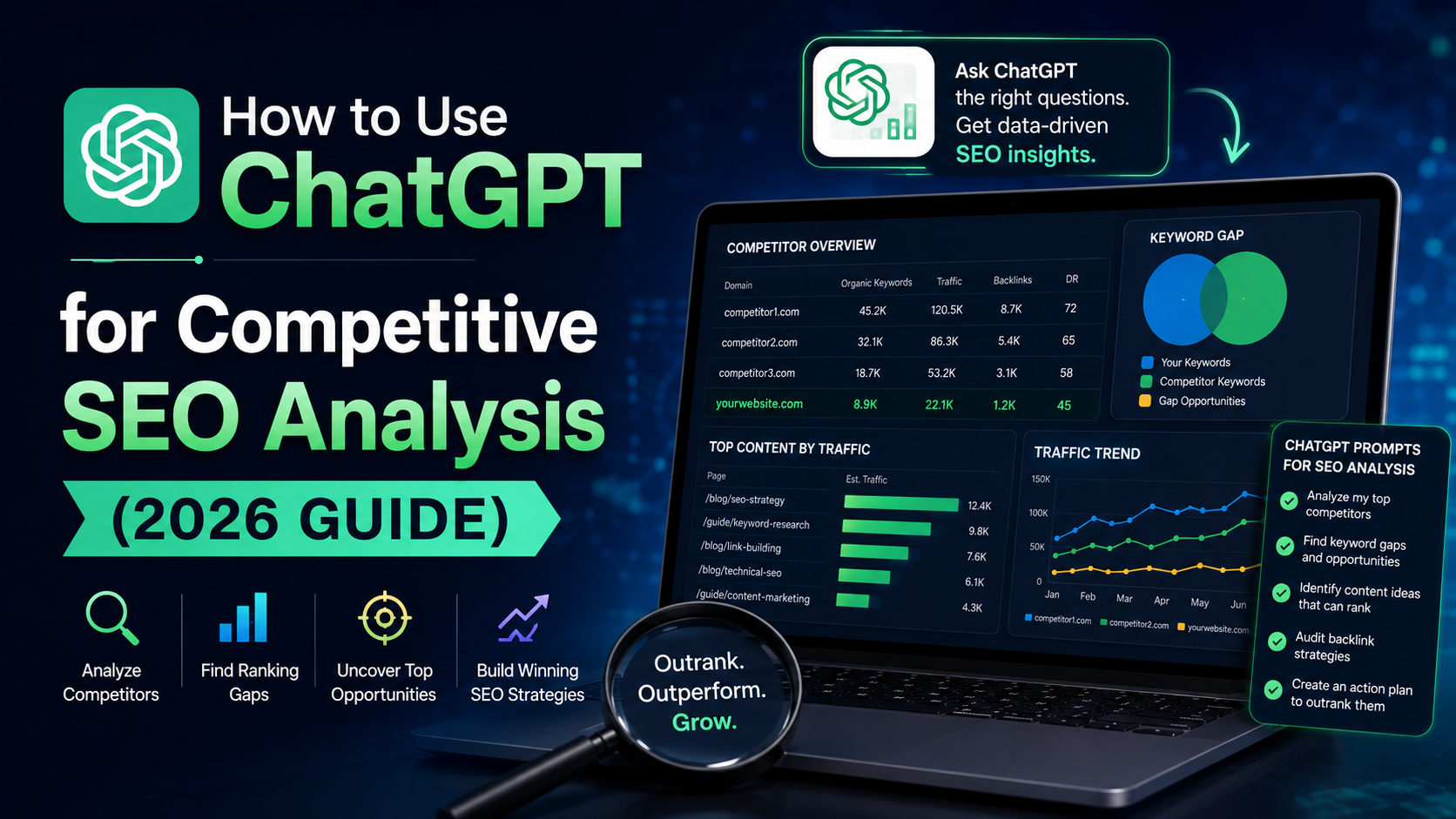
How to Actually Use ChatGPT for Competitive SEO Analysis (2026)
TL;DR
- ChatGPT can help with SEO strategy — but it can't tell you what competitors are doing right now
- 70%+ of competitive market signals first appear in ads and website changes, not SEO rankings (Gartner 2025)
- 53% of growth teams now monitor competitor ad activity weekly (Semrush State of Search 2025)
- Use ChatGPT for analysis and strategy — use real-time monitoring tools for actual competitive intelligence
Quick Answer
ChatGPT is a powerful SEO analysis tool — but it has a critical blind spot: it can't see what competitors are doing today. This guide shows where ChatGPT excels (strategy, content gap analysis, keyword clustering) and where you need real-time competitor monitoring tools to fill the gaps that LLMs can't cover.
Among SaaS growth teams working on SEO strategy, the most common question is: "Can ChatGPT handle competitive analysis without the expensive tools?"
The honest answer: you can use ChatGPT for strategy. You can't use it for reality.
According to Gartner's 2025 Digital Marketing Report, over 70% of competitive market signals show up first in ads and website changes — not in SEO rankings, and definitely not in an LLM's training data. Semrush's State of Search 2025 adds another data point: 53% of growth teams now monitor competitor ad activity weekly because that's where the action is.
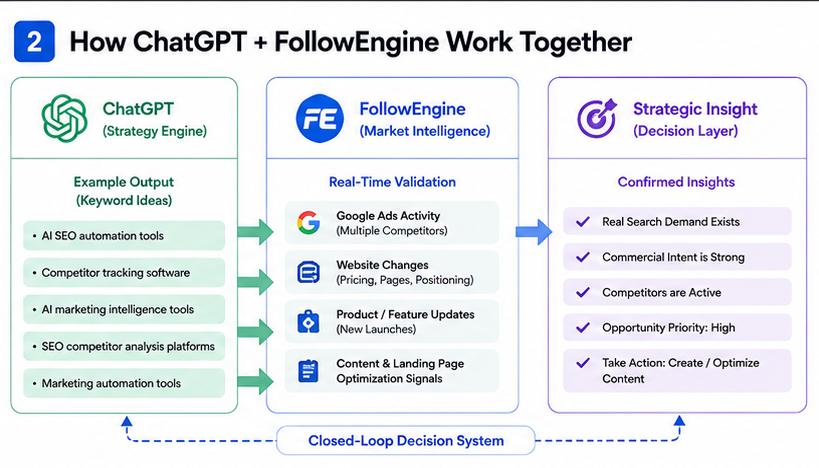
The framework that consistently delivers results: ChatGPT for strategy, FollowEngine for signals, and human judgment for decisions.
What ChatGPT Actually Does Well for SEO
To be clear — ChatGPT is a powerful tool when used for what it does best:
- Keyword expansion — Give it 3 seed keywords and it'll generate 30 you hadn't considered
- Topic cluster design — Structuring pillar pages and supporting content logically
- Search intent analysis — Classifying whether a query is informational, commercial, or transactional
- Content framework design — Building outlines that cover a topic comprehensively
- Competitor structure analysis — Paste a competitor's content and ask ChatGPT to map their argument flow
McKinsey's 2025 AI in Marketing Study confirms this: generative AI is primarily used for content ideation, structural optimization, and strategic planning — not real-time data analysis. ChatGPT is a strategy partner, not a market radar.
Once you have your AI-powered strategy, ground it with our [free SEO competitor analysis template](/blog/the-free-seo-competitor-analysis-template-for-2026).
AI-powered SEO strategy works best when you understand exactly where the AI stops and the real world begins.
Where ChatGPT Falls Short
Here's what ChatGPT cannot tell you, and pretending otherwise will cost you:
- Is your competitor currently running Google Ads for your target keywords? ChatGPT has no idea.
- Did your competitor change their pricing page yesterday? It can't know.
- Is a competitor suddenly investing in a new product category? Silence.
- What SEO keywords are actually moving in real time? It's frozen at its training cutoff.
A documented case: one Series A SaaS company wasted $40K in ad spend after building their keyword strategy entirely on ChatGPT recommendations — without verifying whether competitors already dominated those terms. The BrightEdge 2025 report puts it bluntly: "Over 68% of organic traffic comes from continuously updated and deeply optimized content pages" — continuously updated being the operative phrase.
The gap is simple: ChatGPT generates strategy but cannot validate market reality. That's not a flaw — it's just not the right tool for that job.
The Three-Layer Competitive SEO System
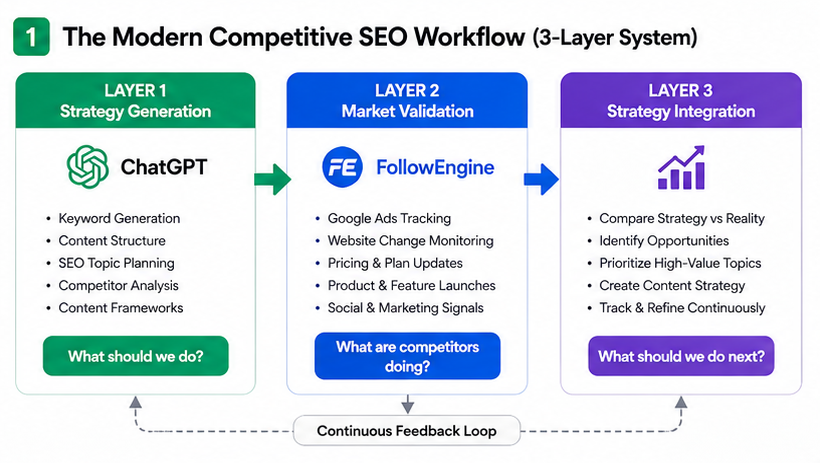
After implementing this across multiple teams, here's the architecture that works:
Layer 1: ChatGPT — Strategy Engine
Answers: What should we be doing?
- Keyword ideation and expansion
- Content structure design
- Competitor positioning frameworks
- Topic authority mapping
Layer 2: FollowEngine — Signal Detection
Answers: What are competitors actually doing right now?
- Real-time ad monitoring (Google, Meta, YouTube)
- Website change detection (pricing, features, positioning)
- SEO keyword movement tracking
- Product launch detection
Layer 3: Your Team — Decision Layer
Answers: What do we do about it?
- Validate ChatGPT strategies against real market data
- Prioritize keywords where competitors show commercial intent
- Adjust content plans based on actual competitor activity
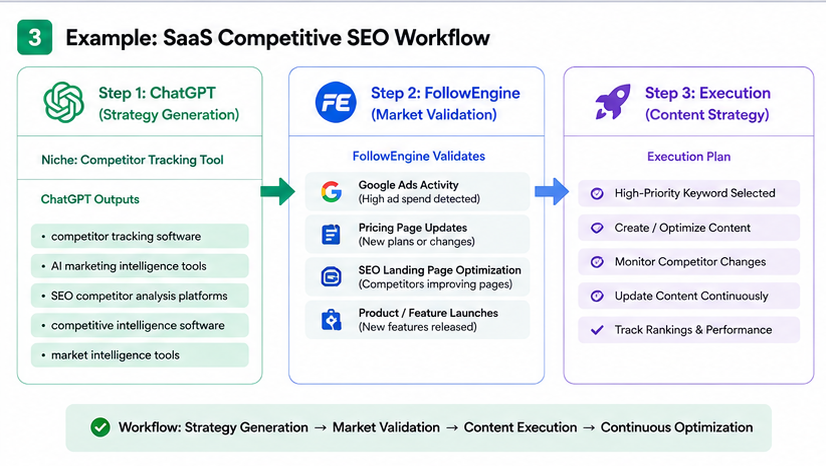
Here's a concrete example. ChatGPT identified "AI SEO automation tools" as a keyword cluster. When we ran it through FollowEngine, we discovered 4 competitors actively bidding on Google Ads for that exact phrase. That's not just demand validation — it's confirmation that commercial intent exists AND that competitors are willing to pay for it. The keyword went from "interesting idea" to "priority one" in five minutes.
To go further, see our guide on [how to see who is bidding on your keywords](/blog/how-to-see-who-is-bidding-on-your-keywords-a-complete-2026-guide).
The Workflow That Replaces Guesswork
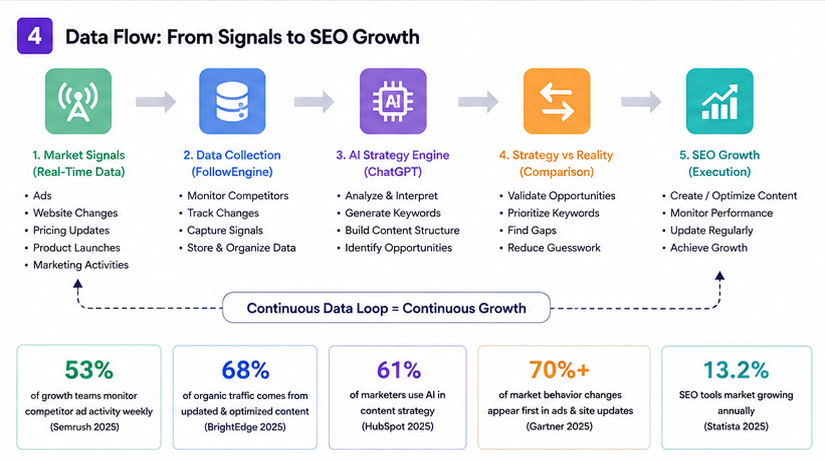
High-performing teams follow this rhythm:
- Strategy Monday — ChatGPT generates keyword maps and content clusters
- Validation check — FollowEngine shows which keywords competitors are actually investing in (ads, content, SEO)
- Priority ranking — Keywords with both AI validation AND real market signals go to the top
- Content production — Write for keywords that matter now, not hypotheticals
- Continuous monitoring — FollowEngine alerts when competitors shift strategy
Ahrefs 2025 data backs this up: 68% of high-ranking pages come from continuously updated content that reflects real market conditions, not static keyword research.
Related: learn how to [build a data-driven keyword ranking report](/blog/how-to-build-a-keyword-ranking-report-a-data-driven-guide-for-seo-teams-2026) to track your SEO performance systematically.
Real-time competitive SEO stops being a guessing game when you connect strategy to signals.
Where FollowEngine Fits
FollowEngine isn't an SEO tool. It's a competitive behavior monitoring system — it tells you what competitors are doing, not what keywords to target.
What it replaces: manual competitor checks, spreadsheet-based tracking, ad-hoc Slack messages, quarterly reports that are outdated before they're read.
What it adds: detection within hours, historical timelines, ad intelligence without expensive tool stacks.
FAQ
Can ChatGPT replace SEO tools?
No. ChatGPT lacks access to real-time data — it can't tell you who's running ads, who changed pricing, or what keywords are actually moving.
How accurate is ChatGPT for keyword research?
Good for generating ideas and understanding intent. Terrible for search volume, competition level, or actual ranking difficulty. Always validate with real data.
What's the fastest way to improve SEO analysis accuracy?
Combine AI strategy generation (ChatGPT) with real-time market validation (FollowEngine).
Why does real-time competitive intelligence matter for SEO?
Because most competitive moves — ad campaigns, pricing changes, product launches — happen long before they show up in SEO rankings.
How do you know if your SEO strategy is based on reality?
If your keyword priorities don't change when you check what competitors are actually investing in, you're operating on assumptions.
The Bottom Line
Competitive SEO in 2026 isn't about who has the best keywords — it's about who understands market changes fastest. ChatGPT gives you the map. FollowEngine shows you where everyone else is moving. Your team decides the route.
About the Author
Dylan Dan Founder & CEO, FollowEngine
Dylan Dan is the founder of FollowEngine, bringing over 10 years of experience in competitive intelligence and competitor analysis. He has helped hundreds of businesses build structured CI programs that turn market signals into revenue decisions.
Related Articles
- [How to Create Battle Cards That Actually Win Deals (2026)](/blog/how-to-create-battle-cards-that-actually-win-deals-2026)
- [Competitive Insights: How to Gather and Use Competitive Intelligence (2026 Guide)](/blog/competitive-insights-how-to-gather-and-use-competitive-intelligence-2026-guide)
- [Best SEO Tool for Competitor Site Analysis (2026)](/blog/best-seo-tool-for-competitor-site-analysis-2026)
Next step
Find your real competitors.
Run a free competitor lookup and decide what to monitor next.