Competitive Landscape Analysis: The Complete 2026 Guide

Competitive Landscape Analysis: The Complete 2026 Guide
TL;DR
- Competitive landscape analysis maps competitors across products, pricing, marketing, and customer positioning
- 57% of sales reps say competitive intelligence is critical — but only 28% get it consistently (Salesforce)
- A structured 7-step framework turns scattered observations into a repeatable decision-making process
- Covers direct competitors, indirect competitors, product features, pricing, and market positioning
Quick Answer
Most teams know their top competitors by name but have no systematic way to track what they're actually doing. Competitive landscape analysis fills that gap — it's the ongoing practice of identifying competitors, mapping their products, pricing, and marketing, then turning those insights into business decisions. This guide provides a complete 7-step framework.
Quick Definition: What Competitive Landscape Analysis Actually Means
competitive landscape analysis is the ongoing practice of identifying who you're up against, mapping what they sell, how they price, how they market, and how they talk to customers—then turning those observations into decisions that move your business forward.
Here's the problem most teams don't admit: they know their top two or three competitors by name, but they have no systematic way to track what those competitors are actually doing. A Salesforce State of Sales report found that 57% of sales reps say competitive intelligence is critical to winning deals—yet only 28% say their organizations provide it consistently. That gap is where deals are lost.
A modern competitive landscape analysis covers these dimensions:
- Direct competitors: companies selling essentially the same thing to the same buyers
- Indirect competitors: businesses solving the same problem with a different approach
- Product features and pricing: what's shipping, at what cost, for which segments
- Website and messaging changes: positioning shifts often show up on homepages before anywhere else
- SEO visibility and content strategy: which keywords are competitors investing in
- Paid advertising: Google Search Ads, social ads, and retargeting campaigns
- Social media activity: frequency, tone, engagement, campaign launches
- Brand positioning and customer messaging: how they describe themselves to the market
The most effective companies don't treat this as an annual project. They continuously monitor competitors using platforms designed for the job. Start by running the Competitor Finder free tool—you might discover competitors you didn't know existed.
Executive Summary: What You'll Walk Away With
- You'll understand your market position relative to every meaningful competitor—not just the ones you already know.
- Manual spreadsheets break down quickly in fast-moving industries. Gartner predicts that by 2026, over 60% of competitive intelligence functions will be partially or fully automated.
- Modern analysis must span websites, pricing pages, advertising, SEO, social media, and positioning—surface-level comparisons miss what matters.
- Visual mapping (matrices, quadrants, positioning charts) makes competitive dynamics obvious at a glance.
- Continuous monitoring consistently outperforms quarterly snapshot reviews. Forrester research shows that firms practicing ongoing competitive tracking respond to market shifts 2-3x faster than peers.
- Platforms like FollowEngine eliminate the manual grind of checking dozens of competitor sites by surfacing changes automatically.
What Is Competitive Landscape Analysis, Really?
Let's strip away the jargon. Competitive landscape analysis is the discipline of systematically understanding everyone competing for your customer's attention and budget.
It answers a handful of practical questions:
- Who exactly are we competing against? Not just the obvious names—the adjacent players, the point-solution startups, the enterprise suites that could pivot into your space.
- What are they building right now? Product roadmaps, feature releases, integration launches.
- How do they price? Per seat, per usage, freemium, enterprise tiers—and how often does it change?
- How are they pulling customers in? SEO, paid advertising, content marketing, outbound, partnerships, PLG.
- Where can we actually win? The white space between what competitors offer and what customers need.
A competitor landscape analysis goes beyond individual competitor profiles. It looks at the entire market environment. McKinsey research shows that companies that embed competitive market insights into their strategic planning process are 2.0x more likely to outperform their industry peers on revenue growth.
Use our free competitor finder to build your landscape map in minutes rather than weeks.
What the Analysis Covers at a Glance
- ✅ Product portfolios and feature matrices
- ✅ Pricing structures and packaging changes
- ✅ Website updates (homepage, product pages, docs)
- ✅ SEO strategy and keyword investment
- ✅ Google Search Ads and paid campaign activity
- ✅ Social media cadence and positioning
- ✅ Brand messaging and target audience signals
- ✅ Product launches and feature announcements
Why Competitive Landscape Analysis Is Worth Your Time
I've worked with product teams that lost substantial market share—not because their product was worse, but because they didn't know a competitor had repositioned, repriced, or released a feature that changed buyer expectations. By the time they noticed, pipeline had already softened.
A structured analysis does more than fill a slide deck. It directly supports:
- Spotting feature gaps before your prospects bring them up on sales calls
- Finding pricing opportunities—undercutting where it matters, premium-pricing where your value justifies it
- Benchmarking against market leaders on dimensions that buyers actually care about
- Detecting new marketing tactics that competitors are testing (often visible in ads before anywhere else)
- Understanding positioning territory—who owns which narrative, and where the unfilled space is
- Informing product roadmap priorities with real-world competitive signal, not internal assumptions
For early-stage companies, this tightens go-to-market execution and prevents launching into a saturated narrative. For enterprises, it underpins long-term planning and formal competitive intelligence programs.
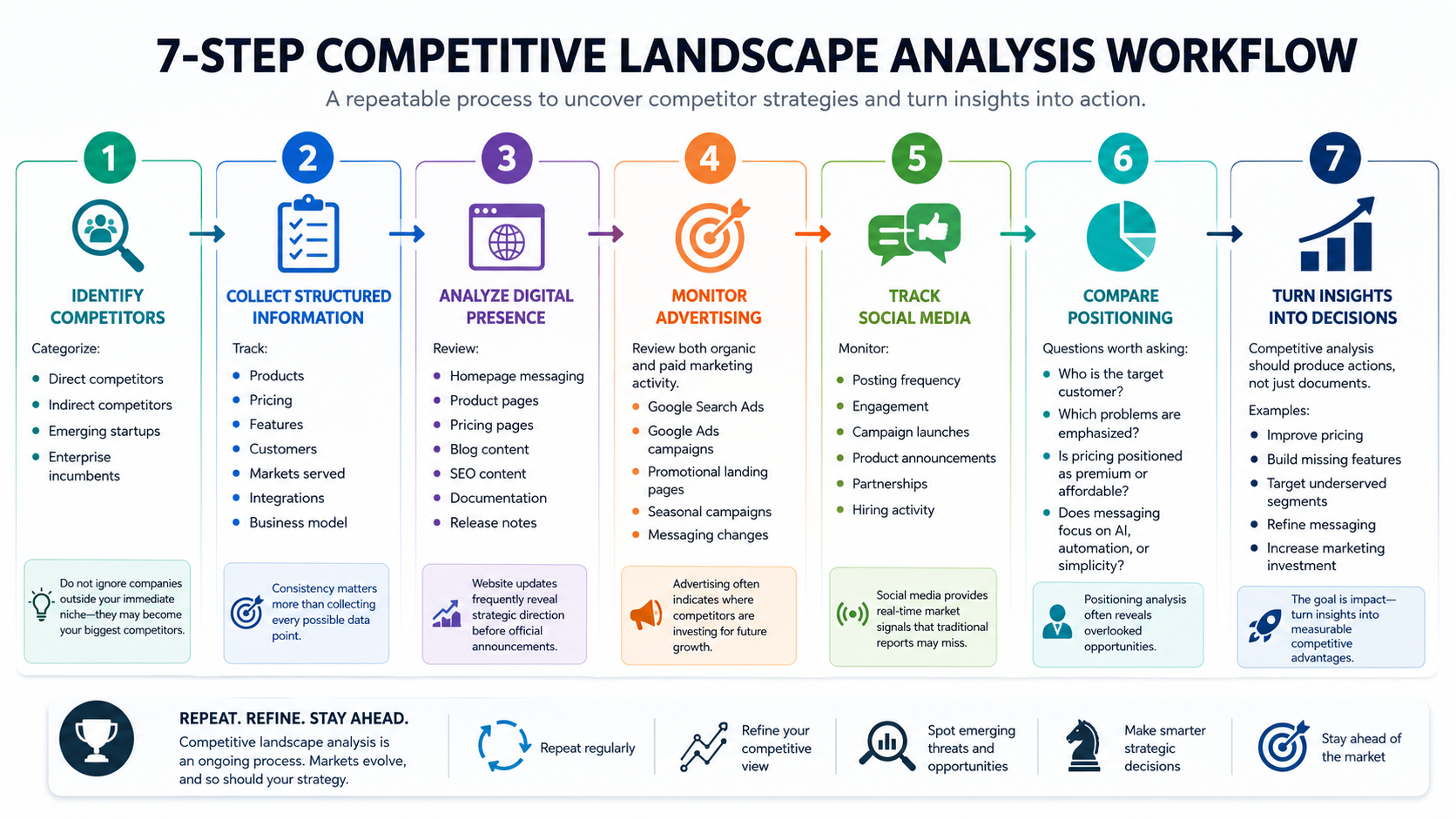
A Practical Framework: The 7-Step Competitive Landscape Analysis Workflow
This framework comes from watching how serious competitive intelligence teams actually work—not from a textbook. It's designed to be repeatable, scalable, and something you can hand to a new team member.
Step 1: Identify the Right Competitors
Don't start with a list of 50 names. Start with categories:
- Direct competitors: same product category, same buyer—these are your obvious rivals
- Indirect competitors: different solution, same problem—the "we could just use Excel instead" crowd
- Emerging startups: early-stage companies that haven't shown up on your radar yet but are gaining traction
- Enterprise incumbents: large players whose feature set overlaps with yours, even if you serve different segments
The biggest mistake I see: ignoring companies that sit slightly outside your niche. Those are often the ones that become your most dangerous competitors. A CB Insights study found that 20% of startups cite "getting outcompeted" as a primary reason for failure—and many never saw it coming.
Use our free competitor discovery tool to surface names your team may have overlooked.
For a deeper framework on competitor identification, see our guide on [how to identify direct and indirect competitors](/blog/how-to-identify-direct-and-indirect-competitors-a-complete-2026-framework).
Step 2: Collect Structured Information
Raw notes won't scale. Build a consistent data model from the start:
- Products and features (current + announced)
- Pricing: tiers, per-unit cost, discount patterns, bundling
- Target customer segments and use cases they emphasize
- Geographic markets served
- Integration ecosystems and partnerships
- Business model (subscription, usage-based, hybrid, open-core)
Consistency across competitors matters more than exhaustiveness. A messy spreadsheet with three competitors documented perfectly is more useful than a massive one with spotty coverage.
Step 3: Analyze Digital Presence
Your competitors' websites are the richest source of real-time intelligence—if you know where to look:
- Homepage messaging: headline changes, value proposition shifts, social proof updates
- Product pages: feature descriptions, screenshots, comparison tables
- Pricing pages: plan structure, price points, feature gating
- Blog and resource centers: topic investment signals strategic priorities
- SEO content: what are they trying to rank for, and how are they structuring it
- Documentation and changelogs: often announce features before marketing does
Website changes frequently reveal strategic direction well before official announcements hit the wire.
Step 4: Monitor Advertising and Paid Channels
Paid advertising is a window into where competitors are investing for growth:
- Google Search Ads: which keywords are they bidding on? Are they bidding on your brand terms?
- Display and retargeting: what messaging angles are they testing?
- Promotional landing pages: seasonal offers, webinar signups, gated content
- Ad creative evolution: copy changes, offer structures, social proof elements
A sudden increase in ad spend on a specific keyword cluster often signals a strategic push you should know about.
Step 5: Track Social Media and Public Communications
Social channels provide fast signals that formal reports miss:
- Posting frequency and engagement patterns
- Campaign rollouts and partnership announcements
- Product launches and feature teasers
- Hiring activity (especially senior roles in new functional areas)
- Customer complaints and praise (competitive vulnerability gold)
LinkedIn, in particular, is where B2B competitive signals often surface first—through executive posts, job listings, and company page updates.
Step 6: Compare Positioning Head-to-Head
Positioning is where strategy becomes words. For each competitor, ask:
- Who is the ideal customer they describe?
- What problem narrative do they lead with?
- Is their pricing positioned as premium, affordable, or transparent?
- Does their messaging lean on AI/automation, simplicity, security, scale, or integration?
- What customer logos, testimonials, or case studies are they showcasing?
The gaps between how competitors position themselves and what buyers actually need are often the most profitable opportunities.
Step 7: Turn Observations Into Decisions
Analysis without action is just busywork. Every finding should connect to a decision:
- Improve pricing: adjust tier structure, introduce a usage-based option, run a promotion
- Build missing features: fill gaps that prospects consistently ask about
- Target underserved segments: focus on a vertical or use case competitors ignore
- Refine messaging: counter common competitor claims directly
- Increase marketing investment: pour fuel on channels where competitors are underinvested
For a complete guide on turning observations into a systematic intelligence program, see our [competitive insights guide](/blog/competitive-insights-how-to-gather-and-use-competitive-intelligence-2026-guide).
Competitive Landscape Analysis Frameworks Worth Using
SWOT Analysis (Strengths, Weaknesses, Opportunities, Threats)
The classic. For each major competitor, map their strengths and weaknesses honestly, then identify the opportunities and threats they create for your business. Simple, fast, and effective when done rigorously.
Porter's Five Forces
Michael Porter's framework evaluates industry attractiveness through supplier power, buyer power, threat of substitutes, threat of new entrants, and intensity of competitive rivalry. Still the gold standard for understanding the structural dynamics of your market.
Competitive Landscape Matrix
Score every competitor across consistent dimensions: product features, pricing competitiveness, marketing investment, AI/technology capability, customer satisfaction signals, and overall market momentum. Weight each dimension based on what matters in your category.
Competitive Landscape Mapping (Positioning Quadrants)
Plot competitors visually using meaningful axes:
- Price vs. perceived value
- Innovation velocity vs. market maturity
- Enterprise focus vs. SMB focus
- Feature depth vs. simplicity
These maps make it instantly obvious where the crowded zones are—and where the open territory sits.
A Real-World Example (SaaS Analytics Platform)
Let's ground this in something concrete. Imagine you're launching a SaaS analytics tool aimed at mid-market companies.
After analyzing five direct competitors over a 60-day period, here's what a real competitive landscape analysis might surface:
- Two competitors raised prices by 15–25% in the last quarter—suggesting confidence in demand and potential room for a value-positioned alternative.
- One introduced AI-powered natural-language reporting, something none of the others offer yet—a signal of where the category is heading.
- Three redesigned their landing pages within the same month, all emphasizing "speed" and "no-code"—indicating a collective positioning shift toward accessibility.
- Four of five significantly increased social media output, particularly on LinkedIn, suggesting a fight for mindshare is heating up.
- Only one actively runs Google Search Ads on the primary category keyword—meaning organic and content-driven channels are still the primary battleground.
These signals collectively point toward specific actions: differentiate on pricing transparency for the segment stressed by recent hikes, invest in AI reporting before it becomes a table-stakes feature, and double down on SEO/content while paid competition is still light.
This is what a living analysis looks like—not a static document, but an ongoing source of decision input.
What You Should Monitor: The Complete Checklist
For a competitive landscape overview that stays fresh, monitor these signals consistently:
- ✅ Company websites (homepage, product pages, about pages)
- ✅ Pricing pages (plan structure, dollar amounts, feature gating)
- ✅ Product releases and changelogs
- ✅ Feature announcements and beta programs
- ✅ SEO content (blog posts, guides, landing pages targeting new keywords)
- ✅ Google Search Ads (keyword targets, ad copy, landing pages)
- ✅ Google Ads and paid social (creative, offers, audience targeting signals)
- ✅ Social media channels (LinkedIn, Twitter/X, YouTube, Instagram where relevant)
- ✅ Press releases and media coverage
- ✅ Customer-facing messaging (on-site copy, email campaigns, webinar topics)
- ✅ Brand positioning statements and narrative evolution
Most organizations find that automating this checklist—rather than assigning someone to manually review 11 sources across 8 competitors—is the only way to keep it current. FollowEngine's free tools give you a practical starting point for automated monitoring.
How FollowEngine Automates Competitive Landscape Analysis
Traditional competitor research often looks like this: a folder of browser bookmarks nobody checks, a spreadsheet last updated in Q2, and a Slack channel where someone occasionally drops a competitor screenshot. It's reactive, inconsistent, and doesn't scale.
FollowEngine approaches the problem differently. Instead of requiring someone on your team to manually monitor competitor activity, the platform continuously tracks public signals and centralizes them:
- Website content updates (homepage, product pages, pricing)
- Pricing and packaging changes
- Product launches and feature releases
- Google Search Ads and paid campaign activity
- Social media posts and engagement patterns
- Marketing campaign rollouts
- Public competitive signals across channels
The shift is meaningful: instead of spending hours checking dozens of websites each week, teams receive structured updates and can focus on what actually matters—deciding what to do about the intelligence.
Start with our free competitor analysis tool and see what automated monitoring surfaces for your competitive landscape.
To visualize all of this intelligence in one place, learn how to [build a competitive intelligence dashboard](/blog/how-to-build-a-competitive-intelligence-dashboard-metrics-kpis-and-real-time-tracking-2026-guide) with real-time KPIs.
Continuous Monitoring vs. Traditional Analysis: The Real Difference
| What You're Comparing | Traditional Approach | AI-Powered Monitoring |
|---|---|---|
| Cadence | Quarterly or annual reviews | Continuous, always-on tracking |
| Data collection | Manual website visits, ad-hoc notes | Automated, structured collection |
| Visibility | Siloed spreadsheets across teams | Centralized dashboard accessible to stakeholders |
| Speed to insight | Days or weeks between observation and action | Same-day awareness of meaningful changes |
| Human effort | High—hours per week per team member | Reduced—automation handles the monitoring grind |
| Completeness | Gaps are common (forgotten competitors, missed channels) | Systematic coverage across defined competitor set |
Forrester's research on competitive response times shows that organizations using automated monitoring reduce the gap between competitor action and strategic response by 60% or more. In markets where a pricing change or product launch can shift pipeline within a quarter, that latency reduction is directly revenue-relevant.
Common Mistakes (And How to Avoid Them)
- Reviewing competitors once a year: In SaaS and digital markets, monthly is table stakes. Quarterly at minimum. Annual reviews are historical documents, not competitive intelligence.
- Ignoring indirect competitors: The company that isn't on your radar is often the one that blindsides you. Adjacent players and alternative solutions matter.
- Tracking pricing but not messaging: Price points tell you what they charge. Messaging tells you who they're trying to become.
- Missing website updates: Homepage changes, new case studies, refreshed pricing pages—these happen continuously and signal strategy before anything else.
- Overlooking advertising campaigns: Paid channels reveal where competitors are investing real budget for future growth.
- Forgetting social media: LinkedIn and Twitter/X are where competitive signals surface in real time, often days or weeks before a press release.
- Treating analysis as a one-time project: Competitive landscapes shift constantly. If your analysis lives in a static document, it's already out of date.
Frequently Asked Questions
What is competitive landscape analysis?
It's the structured process of identifying competitors, evaluating their products, pricing, positioning, marketing strategies, and strategic direction, and using those insights to make better business decisions. It's market research focused specifically on the companies you compete with—both today and in the future.
How do you actually do it?
Identify relevant competitors (direct, indirect, emerging), collect structured data across product, pricing, marketing, and digital presence, compare positioning systematically, and—this is the part most teams skip—update your findings regularly. A Gartner survey of competitive intelligence professionals found that organizations updating intelligence monthly or more frequently were 3x more likely to report "high confidence" in their strategic decisions.
What frameworks are most useful?
SWOT (simplest and fastest), Porter's Five Forces (best for understanding structural market dynamics), competitive landscape matrices (best for multi-dimensional comparison), and positioning quadrant maps (best for visualizing where you fit). The right framework depends on what question you're trying to answer.
How is this different from market analysis?
Market analysis studies the entire market: customer demand, industry size, growth rates, regulatory trends. Competitive landscape analysis focuses specifically on the businesses competing within that market—their strategies, moves, and relative positions.
How often should you refresh it?
For digital businesses, monthly continuous monitoring is the standard that competitive teams aim for. Annual or quarterly reviews miss too much. McKinsey's research on organizational agility found that firms updating competitive intelligence in near-real-time were 2.5x more likely to report successful strategic pivots.
How does AI actually help?
AI eliminates the manual, repetitive parts of competitive monitoring—checking websites for changes, scanning for new ads, tracking social media activity, surfacing pricing updates. It doesn't replace strategic thinking; it removes the hours of grunt work that prevent teams from doing strategic thinking in the first place.
Final Thoughts
Competitive landscape analysis has shifted from a periodic research exercise to an operational capability that competitive teams run continuously.
Organizations that consistently monitor competitor products, pricing, websites, advertising, and positioning are measurably better at adapting to market shifts and making strategic decisions with confidence. The difference between companies that win and companies that react is increasingly about speed of competitive awareness.
For teams ready to move beyond spreadsheets, bookmarks, and manual checks, FollowEngine provides a practical way to centralize competitor monitoring across websites, Google Search Ads, social media, pricing pages, and product updates. The goal isn't more data—it's faster, cleaner intelligence that your team can actually act on.
About the Author
Dylan Dan Founder & CEO, FollowEngine
Dylan Dan is the founder of FollowEngine, bringing over 10 years of experience in competitive intelligence and competitor analysis. He has helped hundreds of businesses build structured CI programs that turn market signals into revenue decisions.
Related Articles
- [How to Monitor Competitor Ads and Promotions: Complete 2026 Guide](/blog/how-to-monitor-competitor-ads-and-promotions-complete-2026-guide)
- [Win Loss Analysis: The Real Reason You're Losing Deals (And How to Fix It)](/blog/win-loss-analysis-the-real-reason-youre-losing-deals-and-how-to-fix-it)
- [How to Gather Competitive Intelligence the Right Way (2026 Guide)](/blog/how-to-gather-competitive-intelligence-the-right-way-2026-guide)
Next step
Find your real competitors.
Run a free competitor lookup and decide what to monitor next.