Competitive Insights: How to Gather and Use Competitive Intelligence (2026 Guide)
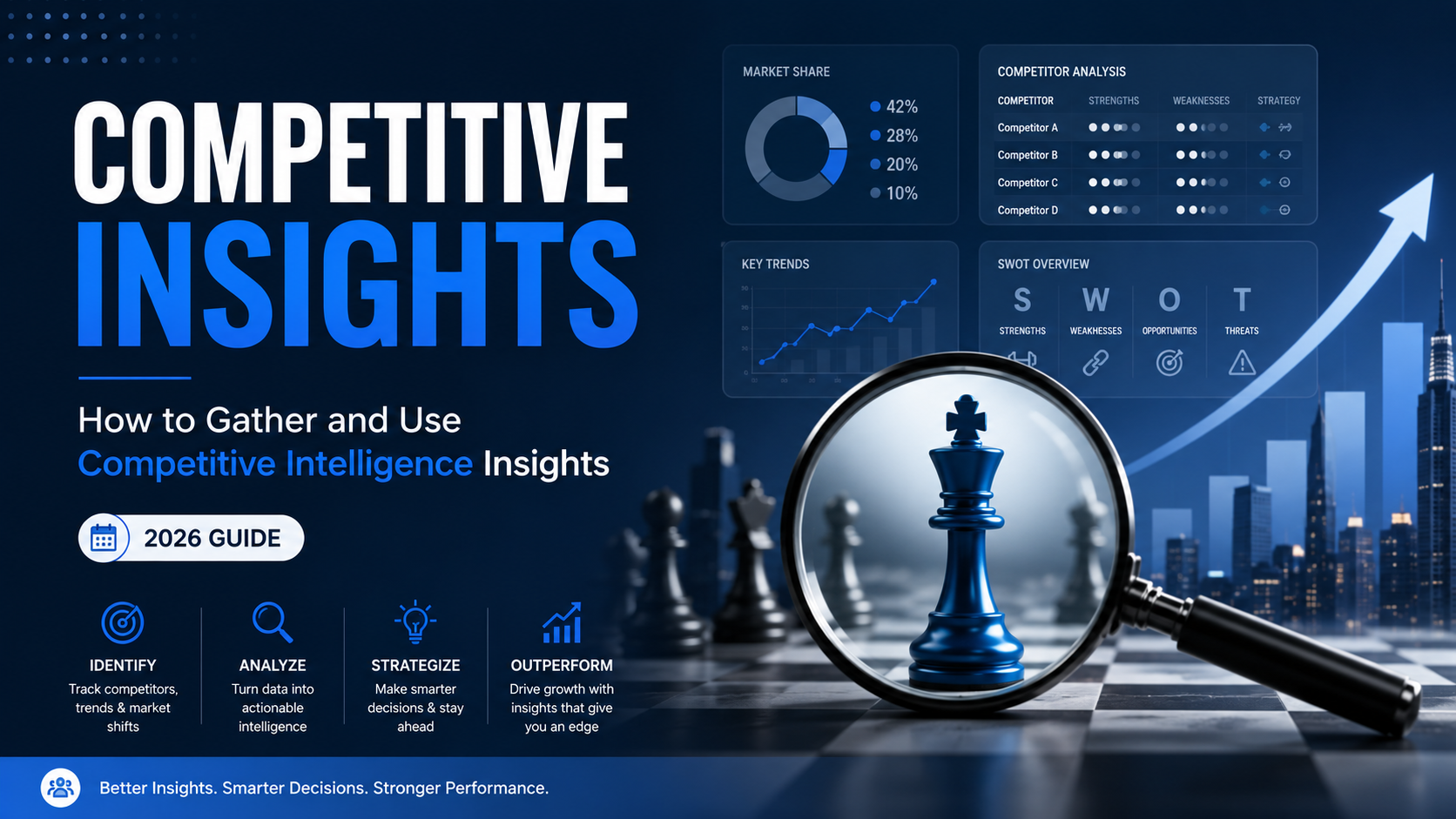
Competitive Insights: How to Gather and Use Competitive Intelligence (2026 Guide)
TL;DR
- A competitive insight answers three questions: what changed, why it matters, and what to do about it
- Companies with structured CI programs are 2.3× more likely to outperform on revenue growth (Gartner, 847 B2B organizations)
- 60%+ of purchase decisions happen before buyers reach a product comparison page (McKinsey 2025)
- This guide covers gathering, analyzing, and acting on competitive insights — from raw data to revenue decisions
For a deeper dive into the methodology, see our [guide to gathering competitive intelligence the right way](/blog/how-to-gather-competitive-intelligence-the-right-way-2026-guide).
Quick Answer
Competitive insights aren't dashboards or Slack alerts — they're actionable intelligence that answers what changed, why it matters, and what to do next. This guide walks through the full competitive intelligence lifecycle: how to collect the right signals, organize them into structured insights, and deliver them fast enough for teams to act — before competitors finish their next move.
What Competitive Insights Actually Mean
A competitive insight isn't a dashboard widget or an automated Slack alert. At its core, it answers three questions: what changed, why it matters, and what to do about it.
Gartner's 2025 Marketing Intelligence Report — covering 847 B2B organizations — found that companies with structured competitive intelligence programs are 2.3× more likely to outperform peers in revenue growth, and respond to market shifts 37% faster. McKinsey's 2025 Revenue Operations research confirmed that over 60% of purchase decisions happen before buyers ever reach a product comparison page. The competitive battle is won or lost before prospects enter any funnel.
What Competitive Insights Actually Connect
competitive insights aren't isolated data points. They connect four layers into a decision-ready chain:
- Competitor actions — pricing changes, product updates, ad spend shifts, hiring signals
- Market response — traffic migration, adoption trends, engagement patterns
- Customer behavior — search intent shifts, conversion rate changes, churn signals
- Business outcomes — quantified revenue impact, retention risk, growth acceleration paths
Forrester's 2024 Revenue Operations study tracked insight-driven marketing teams against those relying on static competitor reports and found a 20–30% efficiency gap. The difference isn't the volume of data collected — it's the interpretation layer most organizations skip entirely.
Competitive Insights vs Competitor Insights: The Distinction That Changes Decisions
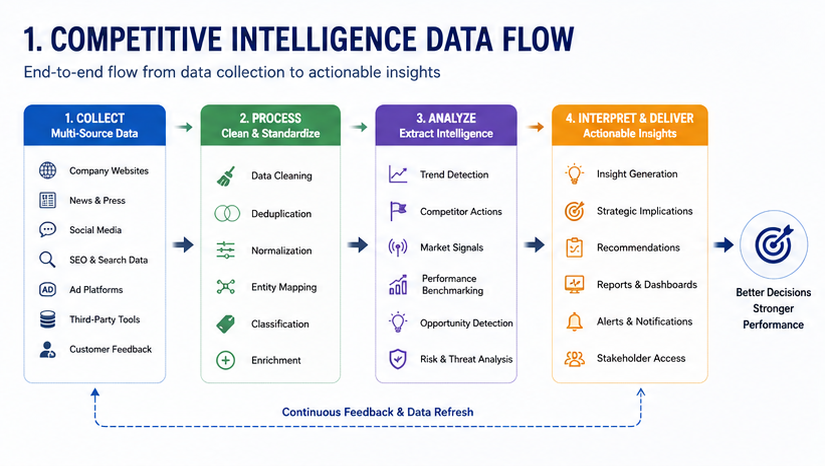
Conflating these two categories is the single biggest reason teams waste months of effort without producing actionable output.
- Competitive insights operate at the market level. Where is the category heading? What patterns emerge across multiple players simultaneously? This is the aerial view.
- Competitor insights zoom into individual players. Why did a specific competitor's traffic spike? What happens to the market if a key vendor cuts prices by 30%? This is the microscope.
Gartner's 2025 Sales Practice research confirms that organizations separating these two layers improve strategic decision accuracy by up to 40% compared to teams that dump everything into one undifferentiated bucket.
A documented case: one Series B SaaS company spent six months building detailed competitor profiles while completely missing the fact that their real threat wasn't a direct competitor — it was a free, open-source alternative rapidly gaining search visibility. The team had competitor insights. They had zero competitive insights about where the market was actually moving.
Why Competitive Insights Matter More in 2026
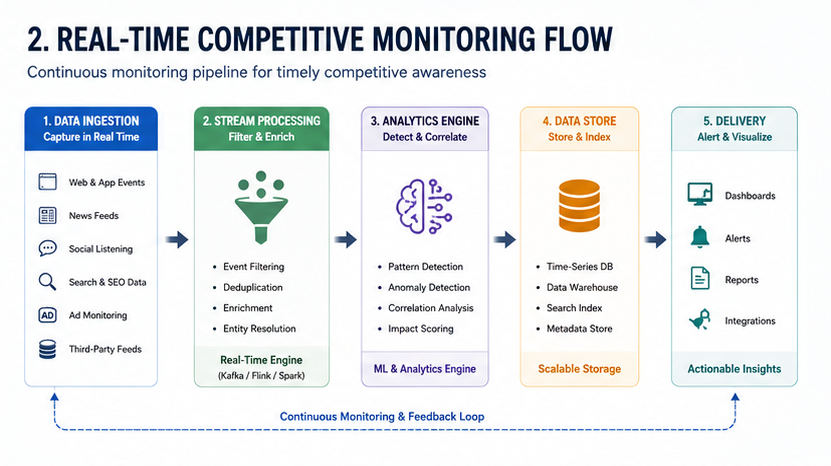
The research is consistent and compelling:
- Companies using structured competitive intelligence respond 37% faster to market shifts (Gartner, 2025)
- Insight-driven marketing teams reduce ad spend waste by 15–25% (HubSpot, 2024 Marketing Trends)
- Teams tracking both competitor SEO and paid search simultaneously identify market opportunities 45% faster (Semrush, 2025 State of Search)
- Enterprises with real-time competitor monitoring achieve up to 2× campaign efficiency (Forrester, 2024)
- Data-driven sales teams are 2.1× more likely to exceed quota compared to intuition-driven teams (Salesforce, 2024 State of Sales)
But the numbers only tell part of the story. What competitive insights actually prevent are the disasters organizations never hear about: the product features launched into markets competitors already own, the enterprise deals lost because nobody tracked a pricing change, the content strategies built around keywords nobody searches anymore.
How to Gather Competitive Intelligence: A Four-Step System
Step 1: Map the Full Competitive Landscape
Modern competitive intelligence gathering must look beyond "companies that sell what we sell." A complete competitive map spans five dimensions:
Not sure who your competitors are? Start with our [framework for identifying direct and indirect competitors](/blog/how-to-identify-direct-and-indirect-competitors-a-complete-2026-framework).
- Direct competitors — who you lose deals to in head-to-head evaluations
- Indirect competitors — alternative solutions solving the same problem differently
- SEO competitors — who ranks for your target keywords
- Content competitors — who competes for the same audience's attention
- AI-visible competitors — who appears in AI-generated answers from ChatGPT, Perplexity, and Gemini
BrightEdge's 2024 research shows over 68% of online journeys begin with a search engine — meaning SEO competitors often influence buyer decisions before product competitors even enter the conversation.
Step 2: Systematically Analyze Competitor Behavior Signals
Proper competitive insight analysis tracks observable, measurable signals:
- Pricing updates and packaging restructures
- Product launch cadence and feature releases
- SEO strategy shifts and ranking movements
- Paid advertising intensity and messaging changes
- Content production velocity and topic selection
- AI presence in generated search results
Step 3: Track Market Reaction Patterns
The difference between raw data and a real competitive intelligence insight is the causal connection:
- Pricing change → conversion rate shift
- Content update → actual ranking movement
- Ad spend increase → verifiable market share transfer
- AI visibility growth → measurable brand awareness impact
Step 4: Build Continuous Monitoring Systems
High-performing teams don't rely on quarterly reports. McKinsey's 2025 Revenue Operations research shows companies using real-time analytics make decisions up to 5× faster than those operating on lagging reports. Modern competitor insights analysis requires:
- Real-time website change detection
- Automated ad campaign monitoring
- Continuous SEO ranking and keyword tracking
- AI visibility and search presence monitoring
- Cross-channel signal integration and correlation
To turn these signals into a structured tracking system, see our guide on [building a competitive intelligence dashboard](/blog/how-to-build-a-competitive-intelligence-dashboard-metrics-kpis-and-real-time-tracking-2026-guide).
Competitive Insights Examples That Actually Drove Decisions
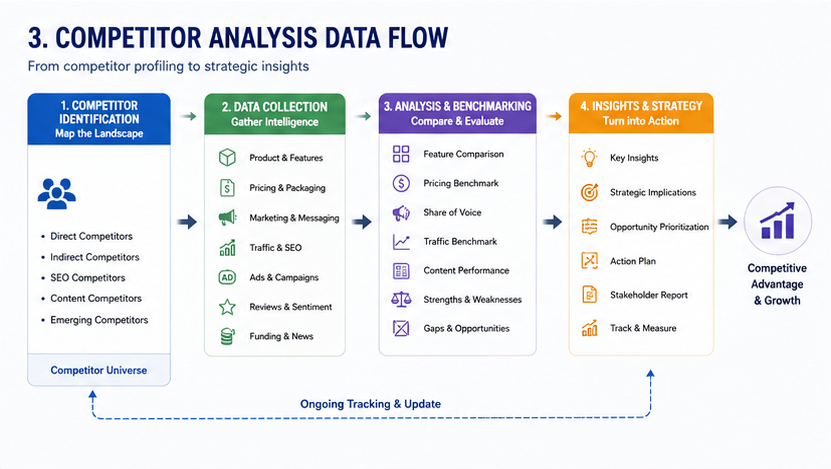
These competitive insights examples changed product roadmaps and marketing budgets within a single quarter:
- Price sensitivity insight — competitor's SEO traffic dropped after a price increase, revealing the market's actual price elasticity and saving another company from the same miscalculation
- Content maturity signal — competitor systematically shifted to long-tail SEO, signaling they were capturing late-funnel buyers and requiring an immediate content strategy adjustment
- Channel imbalance warning — competitor increased ad spend while organic traffic declined — an early indicator of product-market fit erosion
- AI authority alert — competitor appeared frequently in AI-generated search answers, creating an AI visibility gap that compounds every quarter
- Perception dominance gap — competitor appeared heavily in comparison articles but ranked poorly in direct search, revealing a blind spot in perception-level positioning
Applying Competitive Insights Across Business Functions
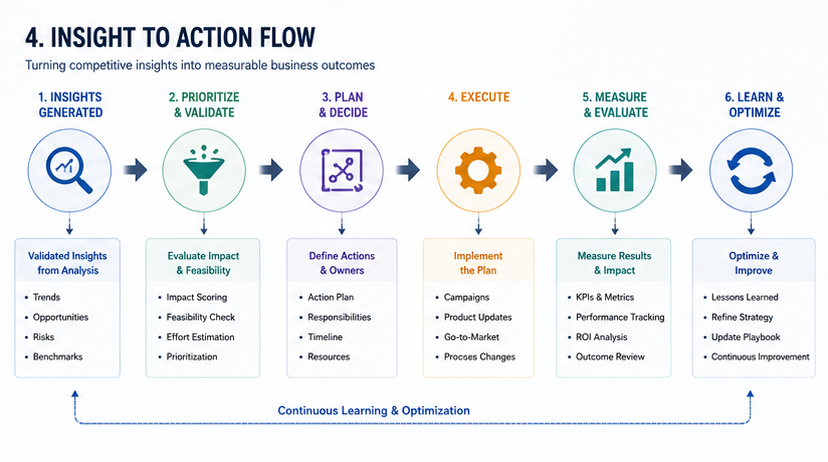
using competitive insights effectively means embedding intelligence into every decision layer:
Product Strategy — Gartner's 2025 research shows organizations integrating multi-channel win/loss analysis improve product-market alignment speed by up to 30%. Competitive insights help product teams identify competitor capability gaps and unmet user needs with precision.
Marketing Strategy — G2's 2024 data confirms 75% of B2B buyers use multiple online sources before purchase decisions. Leveraging competitor messaging and visibility data for positioning optimization directly influences how buyers perceive options during the awareness stage.
SEO Strategy — Ahrefs' analysis of millions of pages shows that those continuously monitoring competitor SEO movements are up to 3× more likely to maintain top-10 rankings. Strategy built on actual search intent distribution and competitor dominance data outperforms guesswork by an order of magnitude.
Sales Strategy — The average B2B buying cycle now involves 27+ interactions. Intelligence must flow continuously, not quarterly — sales teams facing competitors need this month's battlecard, not last year's report.
Modern Competitive Intelligence Tools
Today's competitive intelligence tools have evolved from manual tracking spreadsheets to AI-powered systems:
- Real-time competitor monitoring — website changes, pricing shifts, product updates
- SEO intelligence platforms — ranking movements, keyword strategy changes, backlink dynamics
- Advertising intelligence — ad library monitoring across Google, Meta, and YouTube
- AI visibility tracking — competitor presence in ChatGPT, Perplexity, Gemini search results
- Cross-channel integration — connecting SEO, ads, social, and product signals into unified intelligence
Platforms like FollowEngine automate the full competitive intelligence gathering process, transforming CI from a quarterly research project into a continuous operating system.
The Six-Step Competitive Intelligence Framework
High-growth SaaS companies standardize on a structured competitive intelligence system:
- Collect — capture competitor and market data across all channels
- Detect — identify behavioral patterns and anomalies
- Correlate — connect search, AI, and market signals into interpretable patterns
- Extract — distill actionable insights from signal clusters
- Apply — implement insights across product, marketing, and sales strategy
- Refine — iterate continuously based on new signals and business outcomes
What's notable: this framework is standard in high-growth SaaS but surprisingly rare in mid-market organizations — creating a measurable competitive advantage gap for those who adopt it.
FAQ: Competitive Insights
What are competitive insights?
Competitive insights are actionable interpretations derived from competitor behavior, market signals, and customer decision patterns. The distinction from raw data is critical: a data point tells you "competitor raised prices," but a competitive insight tells you "this price increase could reduce your Q3 win rate by 8% — update three pricing battlecards now."
What's the difference between competitive insights and competitor insights?
Competitive insights analyze the broader market — patterns, trends, and structural shifts across multiple players. Competitor insights zoom into a specific company's behavior, strategy, and performance. Gartner's 2025 research confirms organizations that separate these layers improve strategic accuracy by up to 40%.
How do you systematically gather competitive insights?
The four-step framework: map the five-dimensional competitive landscape (direct, indirect, SEO, content, AI-visible) → systematically analyze competitor behavior signals → track market reaction patterns by connecting actions to outcomes → build continuous monitoring to replace one-off analysis. BrightEdge data showing 68% of online journeys start with search makes the SEO dimension non-negotiable.
How do you apply competitive insights in business?
Across product roadmap prioritization, marketing positioning strategy, SEO search intent alignment, sales win rate improvement, and pricing optimization. The operating principle: the right insight, in the right format, reaching the right team, at the right time.
What tools are available for competitive intelligence in 2026?
Leading options span SEO platforms (Semrush, Ahrefs), advertising intelligence tools, AI visibility trackers, and integrated platforms like FollowEngine that provide cross-channel competitor monitoring, real-time signal detection, and automated reporting. The key selection criterion: can the tool connect internal data (CRM deal outcomes) with external signals (competitor market behavior)?
Why do competitive insights matter more now than five years ago?
Three structural shifts: search and AI have become the front line of purchase decisions (60%+ of decisions happen before comparison pages), AI-generated search results are reshaping brand visibility, and real-time data availability has made quarterly analysis cycles a competitive liability. McKinsey's 2025 research shows real-time analytics users decide 5× faster in fast-moving digital markets.
Bottom Line
competitive insights have evolved from simple competitor tracking into a multi-layer intelligence system spanning search visibility, AI-generated recommendations, content ecosystem positioning, and indirect competitor behavior.
The most successful organizations aren't the ones who track competitors most diligently — they're the ones who understand how market perception forms before competition even begins.
Start monitoring your competitors in real time, and stop playing catch-up.
About the Author
Dylan Dan Founder & CEO, FollowEngine
Dylan Dan is the founder of FollowEngine, bringing over 10 years of experience in competitive intelligence and competitor analysis. He has helped hundreds of businesses build structured CI programs that turn market signals into revenue decisions.
Related Articles
- [How to Gather Competitive Intelligence the Right Way (2026 Guide)](/blog/how-to-gather-competitive-intelligence-the-right-way-2026-guide)
- [How to Use Competitor Email Monitoring to Track Pricing and Promotions](/blog/how-to-use-competitor-email-monitoring-to-track-pricing-and-promotions)
- [How to Monitor Competitor Social Media Ads (2026 Guide)](/blog/how-to-monitor-competitor-social-media-ads-2026-guide)
Next step
Find your real competitors.
Run a free competitor lookup and decide what to monitor next.