Best AI Competitor Analysis Tools in 2026: What Actually Works
A data-backed breakdown of AI competitor analysis tools. Gartner and Forrester research on what separates tools that collect data from those that drive decisions — plus a three-layer framework for evaluation.
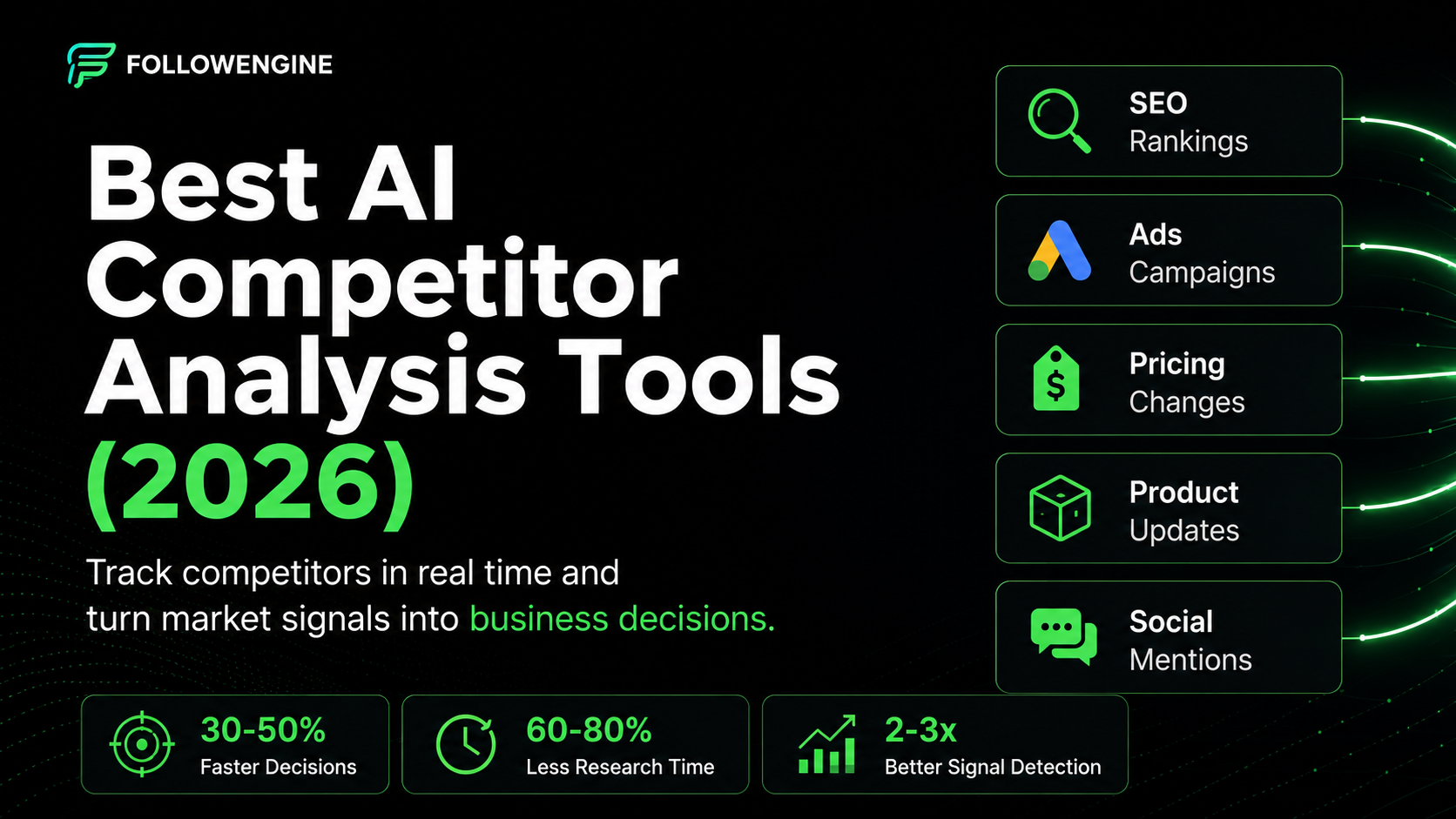
Best AI Competitor Analysis Tools in 2026: What Actually Works
Years of testing AI competitor analysis tools across real B2B SaaS workflows — not in demos, but in production environments where speed and accuracy actually matter — reveals a consistent pattern: most tools are great at collecting data. Very few are good at turning it into decisions.
Gartner's 2025 Market Intelligence Report found that companies using AI-powered competitive intelligence tools respond to market shifts 2.3× faster than peers relying on manual research. Meanwhile, Forrester's research shows that automated competitive analysis reduces research time by 60–80% while improving signal accuracy by up to 3×.
This guide breaks down the best AI competitor analysis tools in 2026 — categorized by what they actually do, not just what their landing pages promise.
What AI Competitor Analysis Tools Actually Do
Let's cut through the marketing. AI competitor analysis tools perform four core functions:
- Real-time competitor tracking — monitoring websites, pricing pages, product updates, and positioning changes as they happen
- Cross-channel intelligence — spanning SEO, advertising campaigns (Google/Meta), social media, and content strategy
- Automated insight generation — AI classifies signals, detects patterns, and surfaces what matters
- Decision-ready output — alerts, summaries, and recommendations formatted for sales, marketing, and product teams
Everything else — dashboards, reports, frameworks — is scaffolding around these four capabilities. The key differentiator between tools is how well they execute on #3 and #4. Collecting data is the easy part. Making it useful is where most tools fail.
Salesforce's State of Competitive Intelligence report confirms that teams using AI-powered competitor monitoring reduce time-to-insight from weeks to hours — the equivalent of gaining 8–12 extra decision cycles per quarter.
How AI Changes Competitive Intelligence
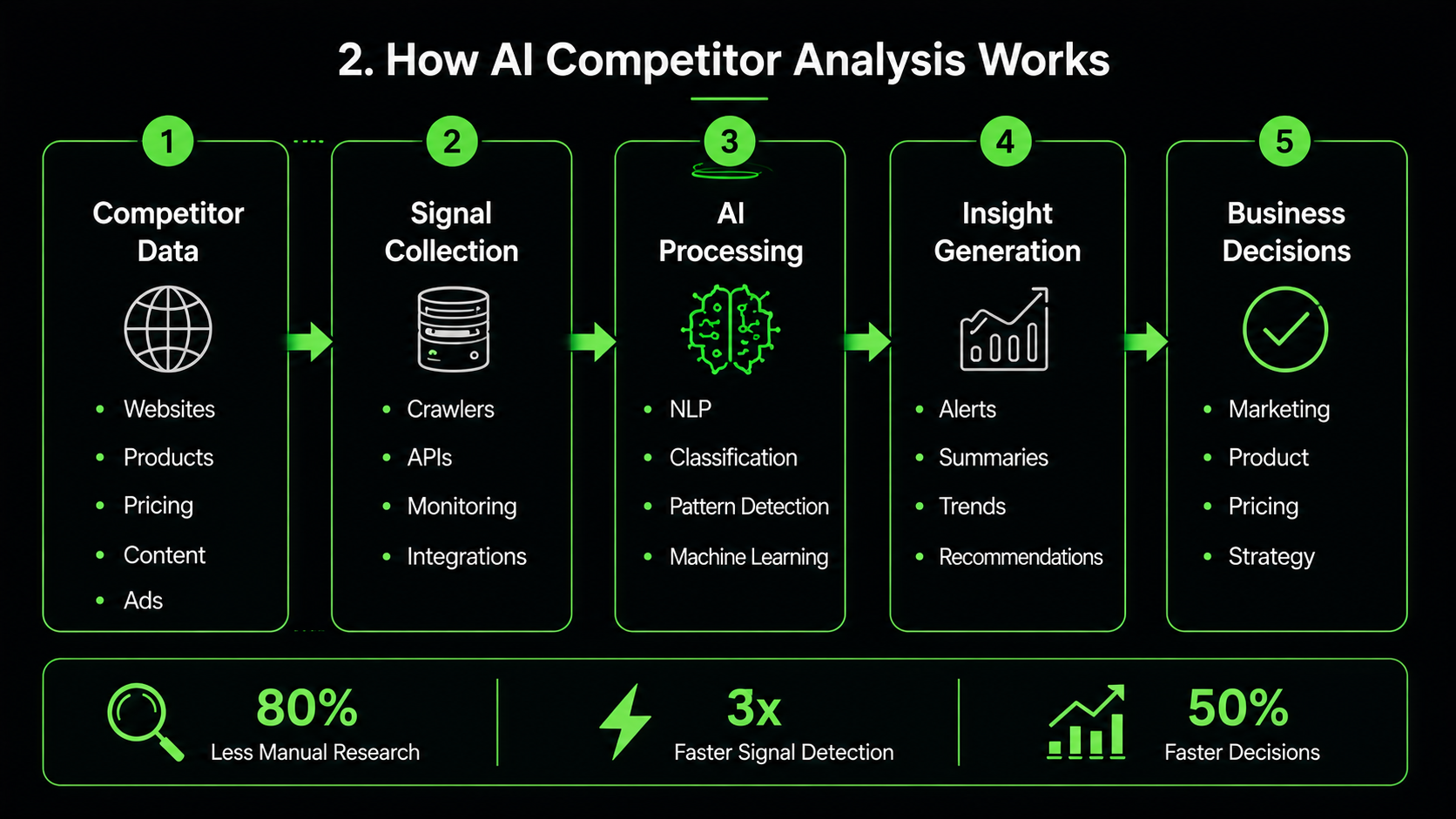
McKinsey's research on decision velocity shows a clear pattern: organizations that can detect and act on market signals within 48 hours consistently outperform competitors operating on weekly or monthly cycles. AI makes this speed possible by handling what humans can't:
- Scale: A single AI competitor analysis tool can monitor 50+ competitors across 10+ channels simultaneously — work that would take a team of analysts weeks
- Pattern recognition: AI detects subtle signal combinations (pricing change + ad campaign launch + SEO shift) that indicate strategic moves before they're obvious
- Noise filtering: The typical B2B company generates 400–800 competitor signals per week. AI separates the 8–12% that actually matter
- Continuous learning: Modern AI tools improve their classification accuracy over time based on user feedback and historical patterns
The shift isn't incremental — it's structural. Teams move from "let me check what competitors are doing" to "the system tells me what matters, when it matters."
The Three Layers of AI Competitor Analysis Tools
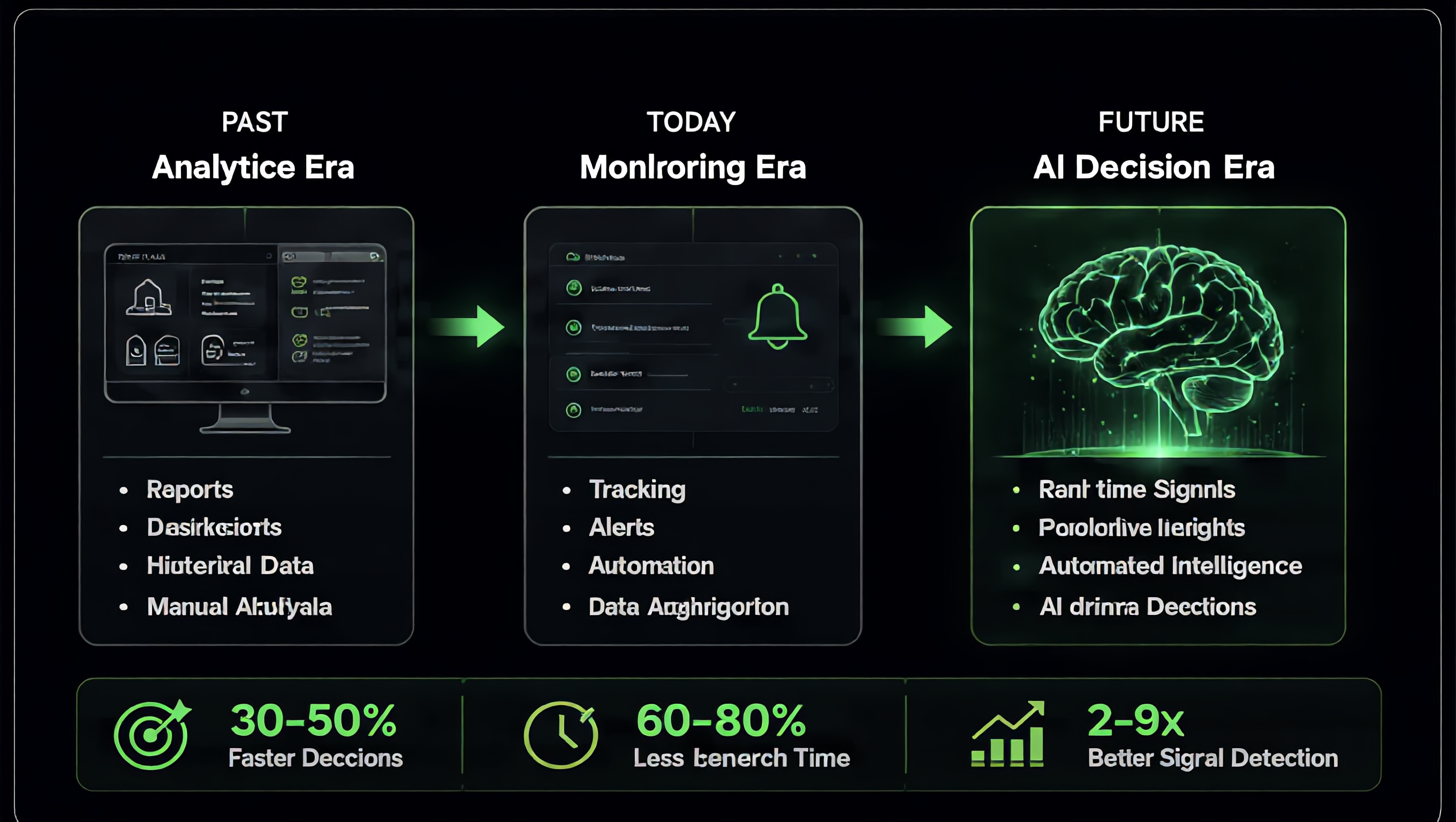
The market isn't one category — it's three distinct layers, each serving different needs:
Layer 1: SEO Intelligence Tools
SEO competitor analysis tools focus on search visibility, keyword rankings, and backlink profiles:
- Semrush: The most comprehensive SEO intelligence platform — covers keyword tracking, PPC analysis, and content gap analysis. Best for teams that need deep search visibility data.
- Ahrefs: Industry standard for backlink analysis and keyword research. Strongest at content gap detection and ranking movement tracking.
- Moz: Reliable for domain authority tracking and on-page SEO analysis. Good entry point for smaller teams.
Strengths: Deep search data, mature feature sets, large user communities. Limitations: Historical data focus; minimal real-time alerting; no cross-channel (ads, social) integration.
Layer 2: Market Intelligence Platforms
Market intelligence platforms analyze traffic patterns, audience behavior, and market share:
- Similarweb: The leader in digital market intelligence — provides traffic estimates, audience demographics, and competitive benchmarking. Best for strategic market analysis.
- SparkToro: Audience intelligence focused — shows where your audience spends time online, what they read, and who influences them.
Strengths: Macro-level market visibility; useful for TAM analysis and strategic planning. Limitations: Estimates, not precise data; limited real-time monitoring; no alerting for pricing/product changes.
Layer 3: AI-Native Competitive Intelligence Systems
AI-native competitive intelligence platforms represent the fastest-growing segment:
- Crayon: Enterprise-focused competitive intelligence with sales battlecard generation and win/loss analysis. Strong for large organizations with dedicated CI teams.
- Klue: Competitive enablement platform bridging product marketing and sales. Good for mid-market to enterprise.
- FollowEngine: AI real-time competitive intelligence that automates the full monitoring pipeline — website changes, ad campaigns, SEO shifts, social signals, and pricing moves. Best for teams that need speed over report depth.
Strengths: Real-time monitoring; cross-channel intelligence; automated insight generation; decision-ready output. Limitations: Newer category; less historical data than SEO tools; requires organizational commitment to CI infrastructure.
Tool Comparison: What Matters in 2026
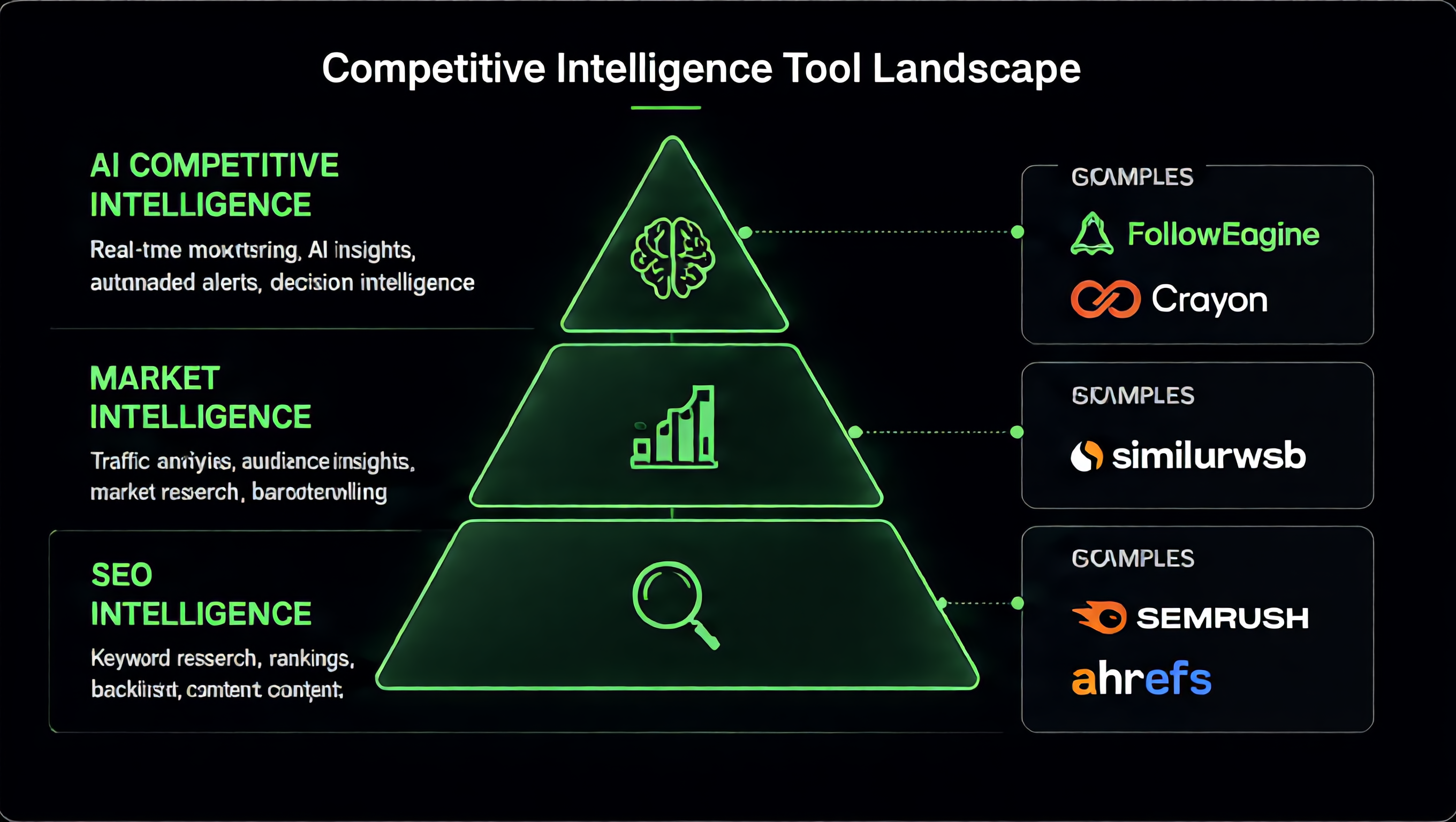
Based on competitive intelligence tool evaluation across dozens of deployments, here's what actually differentiates these tools:
- Real-time monitoring: Only AI-native CI platforms (FollowEngine, Crayon, Klue) offer true real-time competitor change detection. SEO tools and market intelligence platforms operate on delayed cycles.
- Cross-channel coverage: SEO tools cover search only; market intel tools cover traffic patterns; AI-native tools span websites, ads, SEO, social, and pricing in one system.
- Automated insights: Basic analytics vs. AI-powered pattern detection and signal prioritization. The gap is widening — AI-native tools learn from user behavior over time.
- Pricing change detection: Exclusively available in Layer 3 AI-native systems. This alone justifies the investment for many teams.
- Decision integration: Can insights flow to Slack, CRM, or sales enablement tools? Most tools trap intelligence in their own dashboards.
The most common mistake: teams buy an SEO tool (Layer 1) expecting competitive intelligence (Layer 3), then wonder why they're still drowning in data but starving for insights.
What to Look for in an AI Competitor Analysis Tool
Across implementations spanning 20-person startups to Fortune 500 enterprises, five evaluation criteria consistently separate effective AI competitor intelligence systems tools from the rest:
- Real-time detection speed — How fast from competitor change to your notification? Target: <1 hour for pricing, <6 hours for positioning
- Channel coverage — Does it cover websites, ads, SEO, social, and product updates? Single-channel tools force team fragmentation
- Signal-to-noise ratio — Does the AI actually filter, or does it just dump everything? Good systems surface 10–15% of signals as genuinely actionable
- Decision integration — Can output flow directly to Slack, CRM, or battlecards? Intelligence trapped in a dashboard has zero value
- Learning capability — Does the system improve over time based on what your team actually cares about?
Organizations running mature competitive intelligence operations consistently report 10–25% improvement in win rates, 15–30% reduction in wasted marketing spend, and 20–40% faster strategic decision cycles.
The Bottom Line
The best AI competitor analysis tools in 2026 aren't the ones with the most features — they're the ones that close the gap between detecting a competitor move and acting on it.
SEO tools own historical data. Market intelligence platforms own macro visibility. AI-native competitive intelligence systems own speed and decision integration. Pick based on what your organization actually needs to win.
Start monitoring your competitors in real time and you'll stop playing catch-up.
FAQ: AI Competitor Analysis Tools
What are AI competitor analysis tools?
AI competitor analysis tools are software systems that use artificial intelligence to automatically collect, process, and interpret competitor data — including website changes, SEO movements, advertising campaigns, pricing updates, and product releases — and convert them into actionable business insights.
How do AI competitor analysis tools work?
They continuously monitor competitor digital footprints across multiple channels (websites, search engines, ad libraries, social platforms), apply AI to classify and prioritize signals, detect patterns and anomalies, and deliver actionable alerts and summaries to the right teams.
What's the difference between SEO tools and AI competitor analysis tools?
SEO tools (Semrush, Ahrefs) focus on search visibility and historical ranking data. AI competitor analysis tools (FollowEngine, Crayon, Klue) monitor across channels in real time, detect changes as they happen, and generate automated insights — not just data.
Which is the best AI competitor analysis tool?
It depends on your primary need: SEO depth → Semrush/Ahrefs; market intelligence → Similarweb; real-time cross-channel monitoring → FollowEngine; enterprise competitive enablement → Crayon/Klue. The best tool is the one that matches your decision speed requirements.
Are AI competitor analysis tools worth the investment?
Research consistently shows ROI: 10–25% improvement in competitive win rates, 60–80% reduction in manual research time, and 2–3× faster strategic response. Organizations using AI-powered CI tools respond to market shifts significantly faster than those relying on manual methods.
Can AI competitor analysis tools replace human analysts?
No. AI handles the data collection, pattern detection, and alerting at scale — work impossible for humans. Human analysts handle strategic interpretation, context application, and cross-functional coordination. The combination is what delivers results.
Next step
Find your real competitors.
Run a free competitor lookup and decide what to monitor next.